January 2026

Pneumatics Actuator
Blog

Pneumatics Actuator Valves Explained | Types, Working & Uses

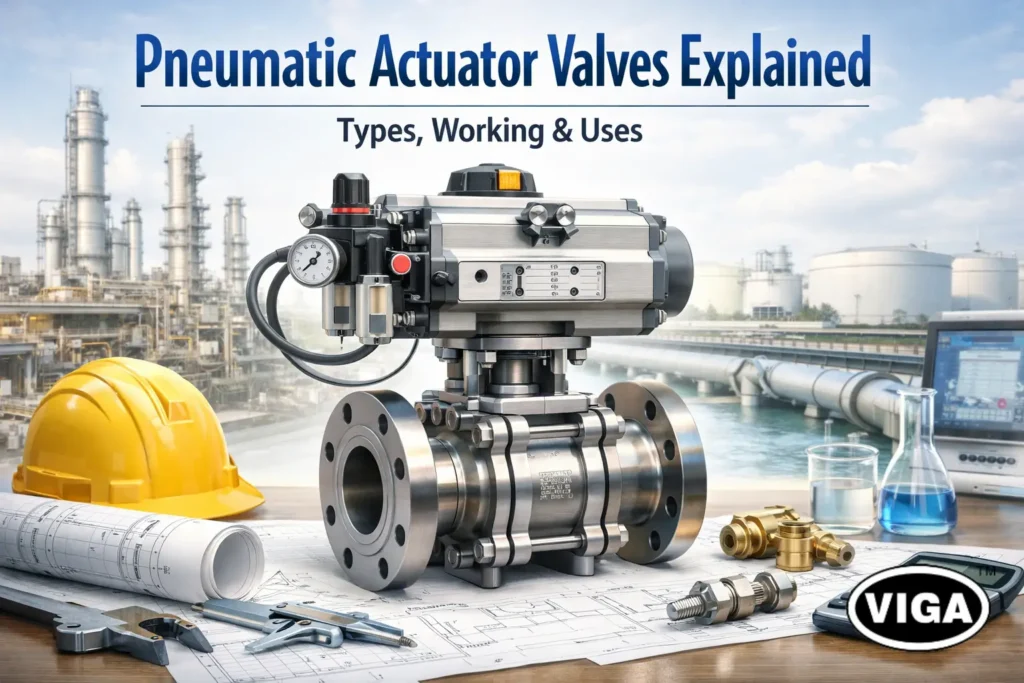
From Switch to Motion — How Pneumatic Actuator Valves Bring Automation Alive! A control signal traveling down a copper wire is just information. It has no muscle. It cannot stop thousands of gallons of water rushing through a treatment plant or shut down a high-pressure steam line in a fraction of a second. To turn that low-voltage data into physical action, industrial automation relies on the brute force of compressed air. Pneumatics actuator valves act as the conversion point between the digital control logic of a PLC and the heavy mechanical reality of piping systems. While electric servos grab the headlines for precision in robotics, the process industries—Oil & Gas, Chemical, Water, and Food Processing—run almost entirely on pneumatic actuation. This preference isn’t about nostalgia. It is about physics. Compressed air systems provide a density of force, speed of response, and inherent safety that electrical systems struggle to match at scale. For the engineer or plant manager, understanding these components is not just about knowing how to open a pipe; it is about understanding the primary safeguard between efficient production and operational failure. This technical guide dissects the mechanics of pneumatic valve automation, from the torque curves of scotch yoke actuators to the critical sizing calculations required to prevent stall conditions in the field. What Are Pneumatics Actuator Valves? Technically, there is no single component called a “pneumatic actuator valve.” It is an assembly—a marriage of three distinct pieces of hardware that must be compatible to function. The Valve Body: The wetted part that controls the media (Ball, Butterfly, Globe, or Gate). The Pneumatic Actuator: The aluminum or steel engine that sits on top, converting air pressure into torque (rotary) or thrust (linear). The Mounting Hardware: A critical, often overlooked link. This includes the mounting bracket and the drive coupling. These must strictly adhere to ISO 5211 standards to ensure the actuator turns the valve stem rather than shearing it off. When these three act in concert, driven by a pilot signal, they form the automated unit. Unlike a manual valve requiring an operator’s physical presence, or a solenoid valve which is limited to small diameters (typically under 2 inches), a pneumatic actuator valve system uses the facility’s “fourth utility”—compressed air—to drive large industrial loads with high reliability. The system scales effectively. The same 80 PSI air supply can actuate a tiny 1/2-inch sampling valve or a massive 48-inch pipeline shut-off valve; the only difference is the surface area of the piston inside the actuator. How Pneumatics Actuator Valves Work (Step-by-Step) The operating principle relies on the relationship: Force = Pressure × Area. Since plant air pressure is generally fixed (typically oscillating between 80 and 100 PSI), manufacturers generate more force by increasing the surface area of the internal pistons. The sequence of operation typically follows this path: Signal Initiation: The PLC (Programmable Logic Controller) or DCS (Distributed Control System) sends a command. This is usually a 24VDC discrete signal (for open/close) or a 4-20mA analog signal (for modulating control). Pilot Actuation: This electrical signal energizes a coil in the solenoid valve—commonly a 5/2-way or 3/2-way valve mounted directly to the actuator via a NAMUR interface. Air Injection: The solenoid spool shifts, directing air into the actuator’s pressure chamber. Energy Conversion: As the chamber fills, air pressure builds against the piston face. Once the force generated exceeds the “breakaway torque” of the valve (plus the friction of the actuator itself), movement begins. Motion Transfer: In Rack and Pinion designs, the pistons push outward, rotating a central gear. In Linear designs, the piston pushes a stem directly down. Cycle Completion: As the valve reaches its travel limit (open or closed), the air pressure maintains the position (in double-acting units) or compresses a spring bank (in single-acting units). Single-Acting (Spring Return) vs. Double-Acting This is the most critical logic distinction in the specification process. Double-Acting (DA): Uses air to open and air to close. It gives the operator control over both strokes and is physically smaller and cheaper because there are no springs taking up internal volume. However, upon air failure, the valve acts unpredictably—it stays where it is, or drifts with flow pressure. Single-Acting (Spring Return / SR): Uses air to power the valve in one direction (usually compressing a heavy internal spring). When air supply is cut—intentionally or via accident—the mechanical spring energy drives the valve back to its “fail” position (Fail Close or Fail Open). This mechanical guarantee makes SR actuators the mandatory choice for active safety systems. Types of Pneumatic Actuator Valves Not all motion is the same. Engineers categorize these valves based on the mechanical movement required to cycle the flow. 1 Based on Actuator Motion Rotary Actuators (Quarter-Turn) Used for ball, butterfly, and plug valves. Rack and Pinion: The industry standard for sizes up to 12 inches. It provides linear torque output—meaning the force is consistent throughout the entire 90-degree rotation. Scotch Yoke: Designed for heavy-duty torque. The internal mechanics allow the piston to exert maximum leverage at the beginning (break) and end (seat) of the stroke, where valves usually stick. They typically experience a torque dip in the middle of the stroke (“run” torque), which must be calculated carefully against flow velocity. Vane Actuators: A niche design involving a paddle that swings in a chamber. They are very compact and use less air but struggle with high-pressure leaks over time. Linear Actuators (Rising Stem) Used for globe, gate, and diaphragm valves. Pneumatic Diaphragm: Recognizable by the large “mushroom” top. They use a flexible rubber sheet rather than a hard piston. This creates almost zero friction, making them the superior choice for control loops where minute position changes (hysteresis) matter. Piston Cylinder: Used for high-thrust applications, such as gate valves or high-pressure globe valves where a rubber diaphragm would burst. 2 Based on Valve Body Ball Valves The workhorse of on/off automation. Because the ball “wipes” against the seat during rotation, it handles dirty media well. The torque requirement is moderate but can spike if the valve sits static for weeks (“stiction”). Butterfly Valves Common in large water lines and HVAC. They require high torque relative to their size,

Moisture Separator
Blog

Moisture Kills Compressors! How a Moisture Separator Protects Them

The Hidden Enemy Inside Compressed Air Compressed air systems have an unavoidable flaw: they generate water. On a standard 80°F (27°C) day with average humidity, a 100 HP compressor brings in enough atmospheric water vapor to produce nearly 18 gallons of liquid condensate per shift. If that water isn’t intercepted immediately, it travels downstream to rust out steel piping, wash away essential tool lubrication, and destroy pneumatic valve seals. For plant managers and system designers, the “dryness” of the air at the intake doesn’t matter. What matters is the removal strategy after compression. The Moisture Seperator is the first line of mechanical defense in this battle. Unlike complex air dryers that remove invisible vapor, a moisture separator tackles the bulk liquid—the heavy flood of water that overwhelms filters and ruins production cycles. Running a compressed air system without one is an open invitation to equipment failure. What Is a Moisture Seperator in Compressed Air Systems? A Moisture Seperator (often listed in parts catalogs as a Moisture Separator) is a vessel installed directly in the discharge piping of a compressor. It is a mechanical removal device designed to physically separate bulk liquids, oil aerosols, and solids from the air stream using inertia and gravity. It is critical to understand the distinction: A moisture seperator removes liquid water; it does not lower the dew point. In an air system schematic, the separator sits between the compressor (specifically the aftercooler) and the air treatment assembly (dryers and filters). It serves as the “roughing” filter, removing the largest volume of contaminants so that delicate downstream equipment can function properly. How Moisture Forms Inside Air Compressor Systems To fix the problem, you have to understand the physics creating it. Water in compressed air is not an accident; it is a direct result of thermodynamic laws. Concentration: A compressor takes a large volume of air—roughly 8 cubic feet of ambient air to make 1 cubic foot of compressed air at 100 PSI—and squeezes it. That compression process concentrates the invisible water vapor present in the atmosphere. Heat vs. Cooling: During compression, the air gets hot (often leaving the pump element above 200°F). Hot air can hold significant amounts of water vapor. The Dew Point Crash: As the air leaves the compressor and enters the distribution piping or the aftercooler, it cools rapidly. Cold air cannot hold as much vapor as hot air. The excess moisture has nowhere to go, so it changes phase from gas to liquid condensate. This phase change typically happens right at the compressor outlet. If a compressed air moisture separator is not positioned here to catch the liquid immediately, that condensate is blown down the pipe at 100+ PSI. How a Moisture Seperator Works (Step-by-Step) The vast majority of industrial separators utilize “cyclonic” or “centrifugal” action. They have no moving parts inside the housing, which makes them durable and reliable if sized correctly. Directional Intake: Compressed air enters the housing through a directional vane or contoured inlet. This geometry forces the linear airflow into a high-velocity spiral. Centrifugal Force: As the air spins violently inside the housing, distinct g-forces are created. Water droplets, oil mist, and dirt are significantly denser than the air itself. The spin flings these heavy contaminants outward against the housing wall. Friction and Gravity: Once the water hits the metal wall, friction kills its velocity. The droplets combine into larger drops and slide down to the “sump” (the collection area at the bottom of the bowl) via gravity. The Vortex Finder: A specialized tube located in the center of the housing allows the dry air—which stays in the middle of the vortex due to lower density—to rise and exit the outlet port. Baffle Protection: Most units have a baffle near the bottom to ensure the turbulent air doesn’t dip into the sump and re-absorb (re-entrain) the dirty water already collected. Types of Moisture Separators Used in Industry Different flow rates and applications call for specific separation technologies. 1 Mechanical Moisture Separators Centrifugal Type: The standard design described above. It offers low pressure drop and high efficiency (removing 99% of bulk liquid) assuming steady airflow. It relies on velocity to create the “spin,” so correct sizing is non-negotiable. Baffle (Impingement) Type: These rely on a tortuous path rather than a spin. The air is forced to make sharp turns around internal plates. The water momentum carries it straight into the plate where it drains off. These are excellent for variable flow rates but often create a higher pressure drop (energy penalty) than centrifugal types. 2 Coalescing Moisture Separators Strictly speaking, coalescers are filters, but they are often grouped into this category. They utilize a borosilicate glass matrix to capture oil aerosols and fine mists that mechanical separators miss. Engineering note: A coalescer creates a barrier. If hit with a slug of bulk water, a coalescing element will saturate, causing a massive pressure spike. It must always be installed downstream of a mechanical moisture seperator. 3 Moisture Seperator vs Air Dryer These terms are not interchangeable. Moisture Seperator: Removes liquids. Leaves the air at 100% relative humidity. Air Dryer (Refrigerant/Desiccant): Removes vapor. Reduces relative humidity. A system needs both. A separator without a dryer creates “wet” air as soon as the pipe cools further. A dryer without a separator will flood and fail. Why Moisture Is Dangerous for Compressors & Pneumatic Equipment Condensate in the lines is more than just water; it is often an acidic slurry of water, atmospheric hydrocarbons, and compressor oils. This mixture is aggressive. Pneumatic Automation Failure: High-speed solenoids and actuators rely on factory-applied grease. Water washes this grease away. The result is “stick-slip” friction, causing valves to jam and cylinders to seize. Corrosion Scale: Iron and steel piping corrodes rapidly in the presence of warm, oxygen-rich water. This rust eventually flakes off, traveling downstream to clog fine orifices and blast nozzles. End-Product Spoilage: In spray painting, a single droplet of oil/water creates “fisheye” craters. In food packaging, it contaminates the sanitary environment. Freezing: In outdoor facilities, accumulated condensate freezes in winter. This blocks flow and can burst expensive rigid piping or housing bowls. Benefits of Installing a Moisture Seperator The

Scroll to Top