

Pressure Switch: Working Principle, Types & Applications
Pressure Switch Explained: Working Principle, Types & Industrial Applications
What is a Pressure Switch?
A pressure switch is a device that monitors fluid or gas pressure and automatically opens or closes an electrical contact when a preset pressure level is reached. It is widely used in industrial systems to control pumps, compressors, and safety circuits.
A pressure switch is a simple, binary hero. It isn’t a complex computer. It is a robust mechanism that feels physical pressure and slams a switch into place when things go right—or wrong. When that fluid or gas hits your set threshold, the contacts trip. Your motor turns on. The compressor vents. The safety alarm blares.
Stop treating instrumentation as a textbook concept. It is not. It is the gatekeeper of your plant floor.
Pressure Switch Working Principle
When you understand the pressure switch working principle, you stop worrying about machine uptime and start controlling it. If your process pressure wanders outside the red line, your output quality drops, and your maintenance bill skyrockets. You need that reliability. Let’s get into the mechanics of why these devices work, how they break, and why your choice of switch will define your system’s life expectancy.
Why Precision Controls Fail (And What You Need to Know)
We see the same patterns repeated in facility after facility. Engineers order the cheapest switch off the shelf. They install it. It runs for three months. It begins “chattering,” then the contacts weld together, and the system burns out a motor. Then they blame the motor. It wasn’t the motor. It was the lack of understanding of the industrial pressure switch duty cycle.
You are not just buying a sensor. You are buying a logic-gate that reacts to real-world force. To stop these failures, you need to think about two things: hysteresis and fatigue.
Types of Pressure Switch
There are different pressure switch types used in industrial applications. When you browse options, the mechanical vs electronic pressure switch debate is always the first wall you hit. Forget the buzzwords. Here is the field reality:
- The Mechanical Reliability: These rely on a spring fighting a physical force. They are ugly. They are cheap. But they are brutally reliable in high-vibration, “set-it-and-forget-it” setups. They don’t need a clean power supply to work. If your plant goes dark, the physical spring still holds the setting.
- The Electronic Precision: You pay more. You need an instrument technician to calibrate them. But they don’t drift like mechanical units do when the spring loses its “temper.” They offer digital deadband adjustment, meaning you can dial in a two-PSI differential so precisely that you almost entirely eliminate the start-stop hunting that kills pump life.
Expert Pro-Tip: Always verify the vibration rating on mechanical units. If your pump house shakes the whole structure, a cheap mechanical switch’s spring will dance, causing the contacts to bounce and arc internally. Over time, that arcing carbonizes the switch contacts until they fail completely. Use a dampened mounting bracket if you aren’t sure.
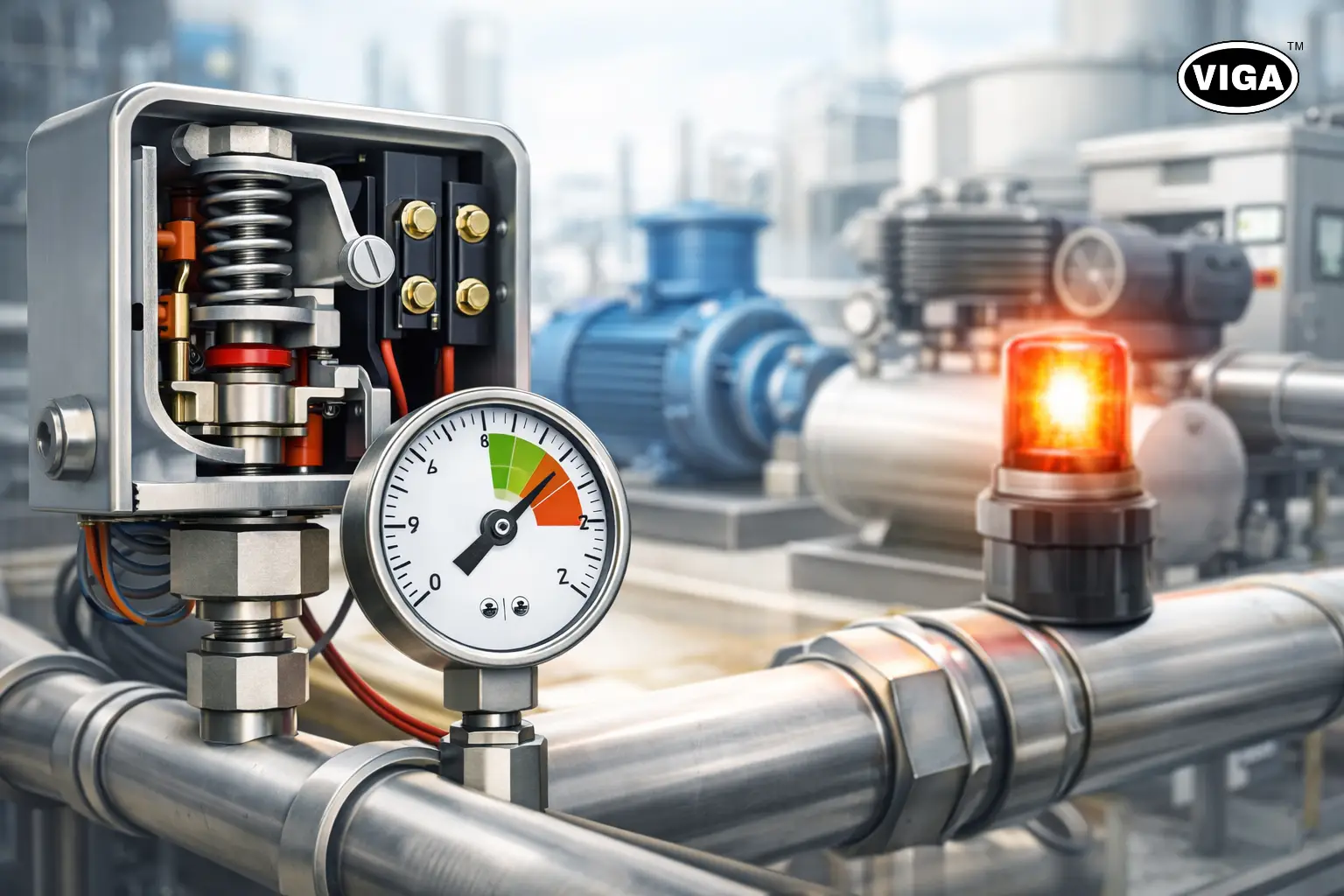
Sensing Elements in Pressure Switch
How does it really know what the pressure is? It comes down to translating energy.
The pressure switch working principle boils down to the sensing element. Think of the sensing element as the nervous system.
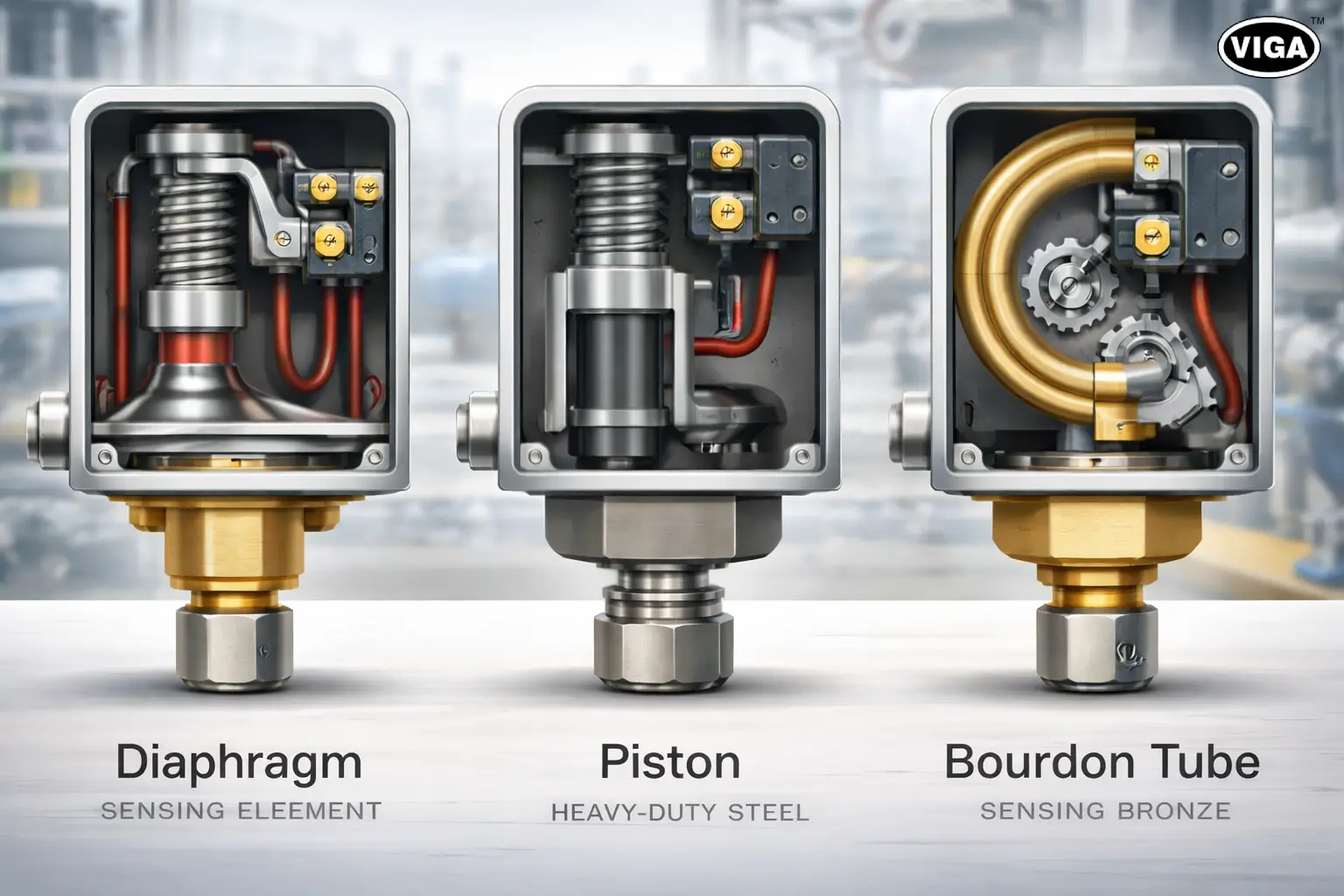
- The Diaphragm Approach: A flexible metallic disk. Think of it like a drum skin. Fluid hits it, it flexes, that flex pushes a rod.
- The Piston Approach: This is a machined sliding seal. It’s heavy duty. Use these for hydraulic systems that have rapid, violent spikes—the kind of pressure surges that would rupture a standard diaphragm.
- The Bourdon Tube: An internal C-shaped tube. Think of the classic paper noisemaker at a birthday party—that coiled-up tube that straightens when you blow into it. It’s elegant, very stable, but if it hits a corrosive environment, it will fail from the inside out.
Once that sensing element pushes, it needs to hit the microswitch. This is the part that does the actual work. Inside that box, you have silver or gold-plated contacts. You want them to “snap” open or closed, not glide slowly. If they glide, you get sparks. If you get sparks, you get pit-holes in your metal contacts. A quality industrial pressure switch has a rapid, audible click for a reason.
Choosing the Right Pressure Switch for Fluid
How to Select the Right Pressure Switch
Not all switches handle every fluid. Putting a standard rubber-diaphragm unit on a fuel line? Bad news. Within a week, the fuel will eat the rubber, and you’ll be leaking product all over the floor.
Matching the Media
You need to talk to your supplier about wetted materials. That means any part of the switch that actually touches your process media.
Media | Ideal Sensing Element | Ideal Seal/Gasket Material |
Water / Coolant | Stainless Steel (316L) | Viton or Buna-N |
Hydraulic Oil | Piston / Steel | Buna-N (Nitrile) |
Compressed Air | Phosphor Bronze | EPDM |
Corrosive Acids | Tantalum or Hastelloy | PTFE (Teflon) |
Pressure switch calibration isn’t an art—it’s math. You check your gauge, you see the deviation, you adjust the set-point screw. If your reading says 50 PSI, but your mechanical gauge says 55, you’ve got an error. Never guess. Always calibrate against a trusted standard, not just by looking at a beat-up analog gauge hanging on a wall that hasn’t been verified since 1998.
Pressure Switch Calibration & Maintenance
Mastering The Hysteresis (Deadband)
I want to spend a moment on the deadband. This is where most engineers fail the test.
Your pump is trying to fill a tank. The switch triggers at 20 PSI to start the pump. It triggers again at 40 PSI to shut the pump off. That 20 PSI difference is your deadband.
If your deadband is too tight, your pump is going to experience “short-cycling.” The motor hits 40, stops, and three seconds later, because a valve leaked or a pipe pulled a bit of flow, it drops to 39 and tries to start again. Starting a three-phase motor is when it pulls the most current and builds the most heat. If your switch doesn’t provide enough deadband, your motor starter contactor will be a melted blob in no time.
Look for the phrase “adjustable differential” in your product specs. If it’s a fixed-differential switch, make sure that differential matches your system’s actual usage habits, or you are inviting disaster.
Troubleshooting: When the Logic Fails
So, it’s not working. You’re standing in front of a cabinet, looking at the mess of wires. Follow this protocol before you toss it in the bin:
- Isolation: Can you manually toggle the switch with an external pressure source, or does it refuse to trip at all? If it won’t move when you pressurize the input port, the diaphragm is ruptured or the piston is frozen. Swap it out.
- Contact Resistance: Grab your multimeter. Set it to ohms. With the system unpowered, click the switch and see if it goes to true zero. If you show 5 or 10 ohms of resistance, your contacts are corroded or burnt. That resistance will heat up the wires, confuse the PLC input, and make your life hell.
- Wiring Continuity: I have seen countless “bad” switches that were simply wired incorrectly. A pressure switch wiring diagram usually shows NC (Normally Closed) and NO (Normally Open) terminals. If you wired your alarm loop into the NC port, the alarm will stay on all the time, or vice-versa. Trace the loop, confirm the state of your load, and verify which terminal you’ve physically locked into.
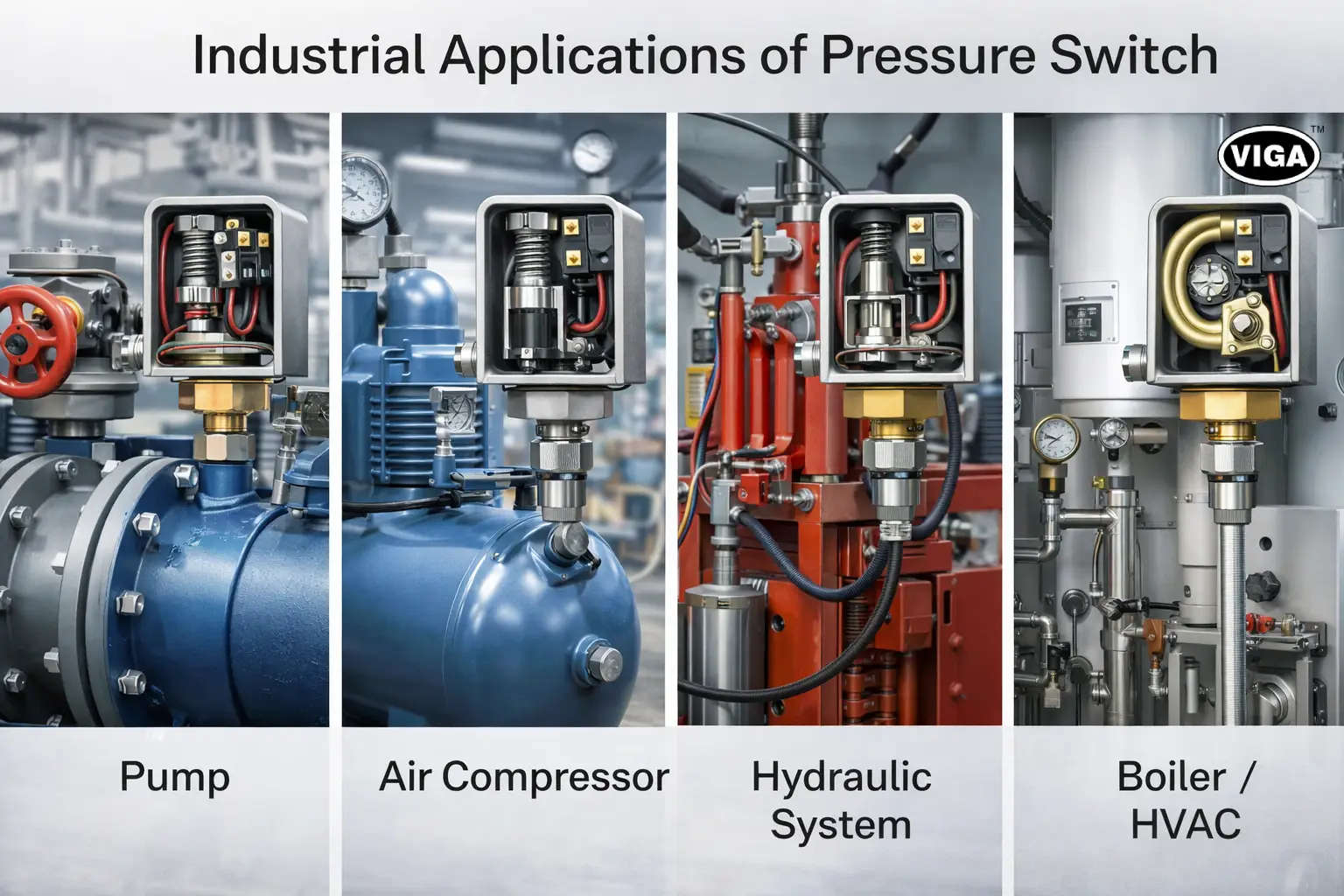
Industrial Applications of Pressure Switch
Real-World Industrial Installations: From Pumps to Power
An industrial pressure switch is widely used in pumps, compressors, hydraulic systems, and HVAC applications.
Where do these live in your daily world? Let’s map it out.
- Pressure Switch for Pump: You are dealing with liquid mass. Liquids don’t compress. If you shut a valve suddenly, you create a “water hammer.” If you don’t account for this in your pressure switch placement, that sudden wave will trick your switch into firing unnecessarily. Install it on a manifold branch, away from the immediate, high-velocity stream if possible.
- Pressure Switch for Air Compressor: These have the easiest life but get the worst treatment. Because air is humid, they suffer from internal corrosion and condensate pooling. Always mount these vertically with the port facing down so moisture drains away, not into the diaphragm cavity.
- Hydraulic Systems: This is a different beast. You aren’t just controlling an “on/off” switch here; you are usually controlling an entire process safety circuit. Use piston-style switches with an oil-filled housing. The oil acts as a dampener to keep the switch from oscillating during pressure pulses from hydraulic actuators.
- Boilers/HVAC: Here, it’s all about high-limit safety. These switches should be checked for “trip-to-reset” time. If your system relies on this for safety, don’t buy the cheapest, un-branded component you can find online. Pay for a certified safety-rated switch that has an iron-clad response time documented on the data sheet.
Expert Pro-Tip: For air-based systems, always look at your NEMA/IP rating. A NEMA 4X-rated switch can handle the washdown spray during regular facility maintenance. If you get water inside the terminal block of an outdoor switch, you won’t just get a signal failure—you’ll get a short circuit that can backfeed into your PLC and ruin your entire automation board.
Why Buying Cheap Hurts Your Budget
When a plant manager looks at the pressure switch price, they often think, “It’s a twenty-dollar item.” It is never a twenty-dollar item. The switch is a twenty-dollar part, but the technician’s labor to diagnose the issue is two hundred. The lost production time when the switch kills the compressor at 3 AM is thousands.
Stop buying the generic knock-offs found on discount platforms. Industrial-grade hardware matters. When you buy from reputable manufacturers who provide comprehensive data sheets and vibration-proof construction, you aren’t paying for the logo. You are paying for the testing that ensures the internal microswitch can withstand 500,000 cycles, not just the first fifty.
Long-Term Operational Integrity
Once you have the right pressure switch in place, don’t walk away. It’s a component, and all components age. Put it on your CMMS (Computerized Maintenance Management System). Schedule a visual check every quarter for signs of fluid weeping from the housing. Set a physical trigger test on your yearly plant shutdown list.
Treat it like the piece of critical hardware that it is. An adjustable pressure switch that hasn’t been checked in two years isn’t an automation tool—it’s a latent liability.
FAQs About Pressure Switch
Q1. Is it safe to repair a faulty internal microswitch in an industrial pressure switch?
A: Technically, yes, if you are a skilled instrument tech. Economically, no. The labor cost to open, replace the microswitch, reseal, and re-calibrate will likely exceed the cost of buying a new factory-calibrated unit. Plus, if the housing gasket doesn’t reseal perfectly, you risk a pressure leak in your cabinet.
Q2. How do I stop a pressure switch from “hunting” in my HVAC setup?
A: Your pump or fan is cycling too quickly. Increase the differential setting on the switch (the deadband). This requires the pressure to rise higher before it triggers and drop significantly before it restarts, smoothing out your control loop and stopping the rapid-fire switching.
Q3. What does “proof pressure” mean vs. “operating pressure”?
A: Operating pressure is where your switch lives day-to-day. Proof pressure is the absolute limit—the “do not exceed” number—before the mechanical internals warp, crack, or blow out. Never design a system where you are running close to the proof pressure. Always build in a 25-50% safety margin.
Q4. My pressure gauge says X, but the switch fires at Y. Who is lying?
A: The switch usually. It’s the harder part to monitor. However, also check for a clogged impulse line. If the tubing leading to the switch has sediment or crud in it, the switch isn’t feeling the same pressure as the main line. Always use a purging tee when installing on heavy-duty or sludge-carrying lines.
Q5. Which wiring contact is standard: NO or NC?
A: There is no “standard.” It depends on your safety strategy. Fail-safe design dictates that if your system should stop when pressure gets too high, use a Normally Closed switch. If power is cut to the switch for any reason, the switch opens, simulating a “high pressure” event, and stops your equipment safely. Always prioritize fail-safe architecture.