

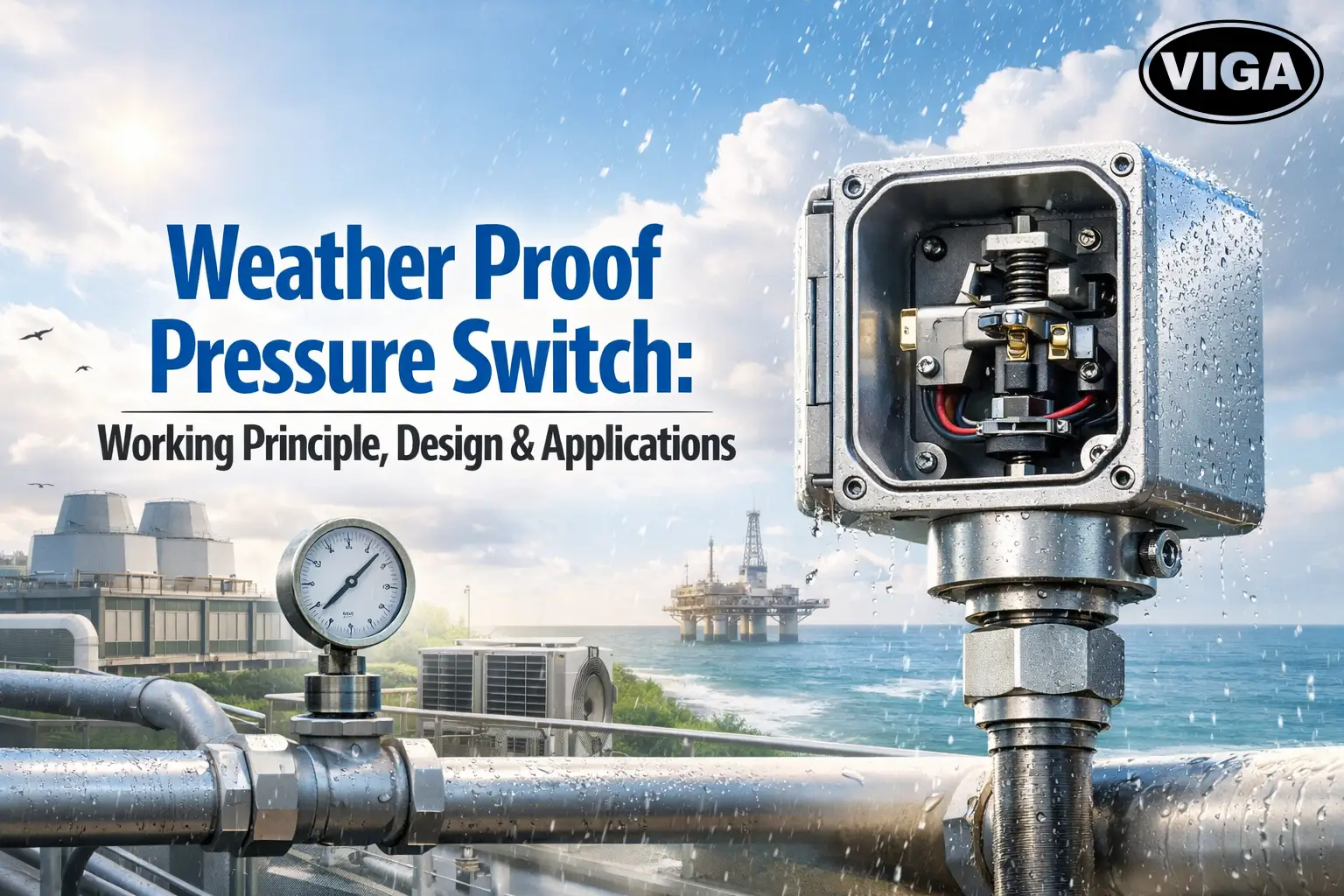
Weather Proof Pressure Switch Explained: Working Principle & Uses
A weather proof pressure switch is a device designed to operate reliably in outdoor environments by preventing moisture, dust, and environmental damage. It is widely used in water treatment, HVAC systems, and industrial outdoor applications.
Field engineering demands reality. It demands hardware that doesn’t just work on a bench test, but holds up under driving rain, relentless coastal fog, and massive daily thermal shifts. When we discuss a weather proof pressure switch, we aren’t talking about “resisting a spill.” We are talking about critical process infrastructure that stands between a steady state of operation and a catastrophic system failure. If you are managing outdoor equipment, you know the cycle: condensation forms inside the housing, salt enters the thread-gaps, and suddenly, the switch becomes an expensive paperweight.
This guide tears down the mechanics, the rating myths, and the installation errors that cause the majority of field-level instrumentation failures.
Working Principle of Weather Proof Pressure Switch
The weather proof pressure switch working principle is designed to resist environmental damage while maintaining accurate pressure control. The environment acts on every component of an outdoor pressure switch. You have to account for more than just rain. You have to consider internal heat cycles, high-velocity wind, and dust intrusion.
The Problem with Air Exchanges
The biggest hidden enemy in the field is a phenomenon often called “breathing.” During a hot day, air inside the switch housing expands. It leaks out past the cable gland. At night, when the temperature plummets, the unit cools down, the internal air contracts, and it sucks in fresh, moisture-laden air through that same path. If this keeps happening, eventually you have a pool of water resting on your electrical contacts.
A properly engineered weather proof pressure switch stops this. It uses high-quality seals that withstand years of hardening and softening without losing their compression.
Sensing Element Fatigue
Diaphragm units offer high sensitivity. They are great for water-line pressure, but they do not love hydraulic shock. If you install one on a pipe that experiences “water hammer”—the banging you hear when a valve closes too fast—you are beating the life out of that diaphragm. Every pressure pulse is a micro-fracture event. If your system runs high-frequency pump cycles, pivot to a piston-actuated design. It trades a bit of raw sensitivity for immense physical resilience against shock loading.
IP Rating and Protection Standards
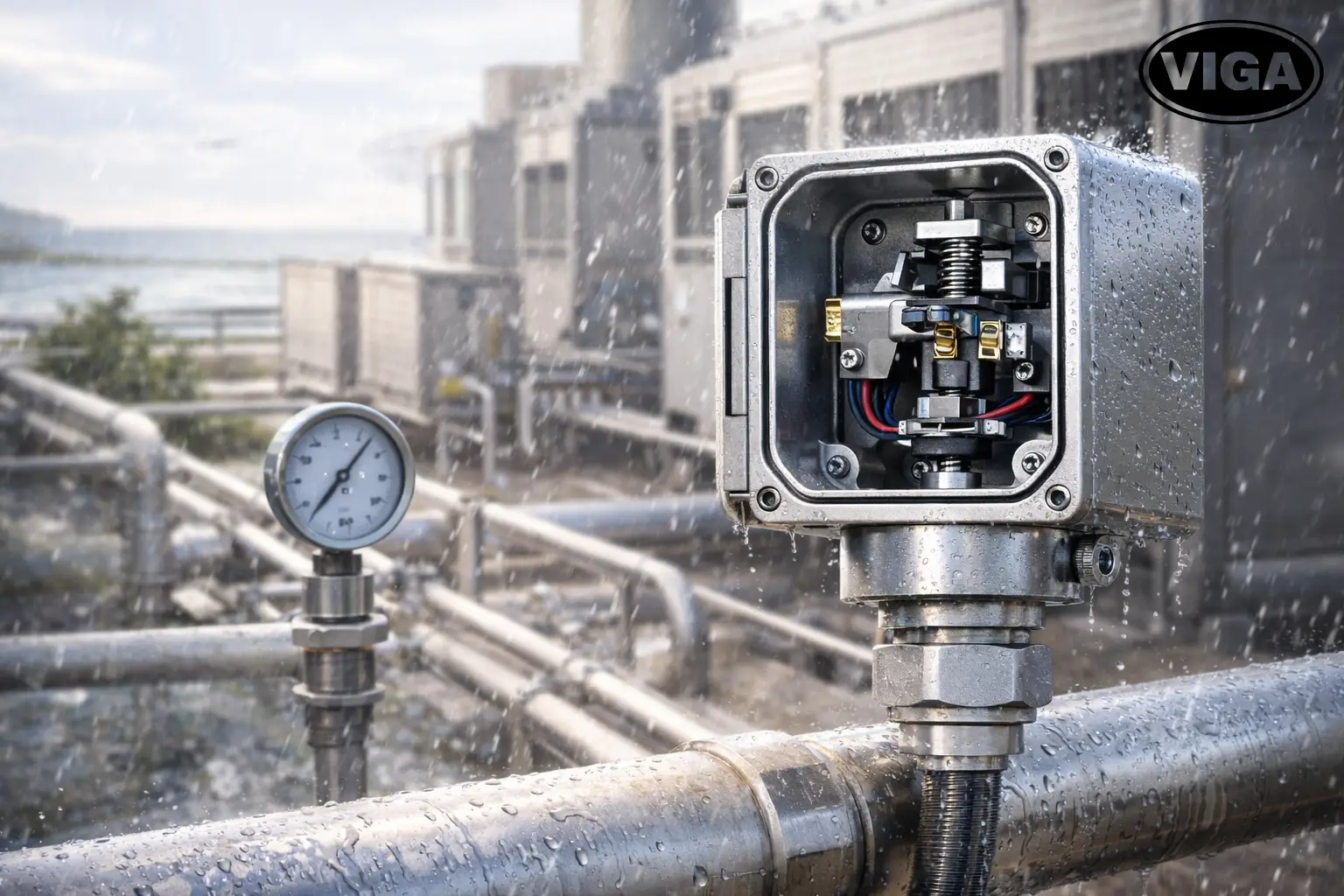
Outdoor pressure switches must be designed to handle moisture, dust, and temperature variations. Do not get hung up on the number alone. An IP rating pressure switch tells you the level of protection, but not the duration.
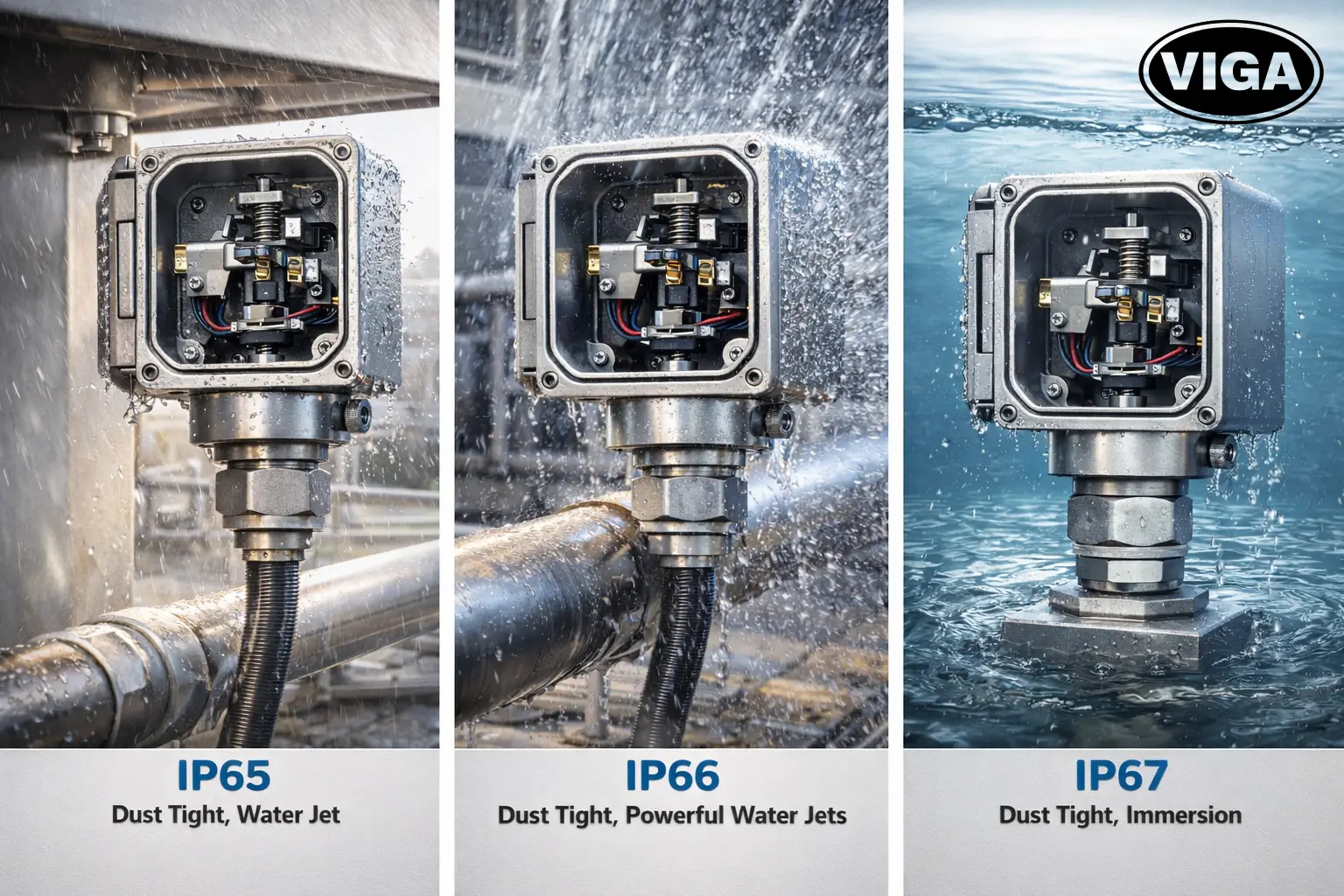
- IP65 (Dust tight, water jet): It survives a heavy spray. Do not mistake this for being “submersible” or “weatherproof” in a high-intensity marine setting. It belongs in a semi-sheltered area, like under a roof eave.
- IP66 (Dust tight, powerful water jets): This is the baseline for outdoor, unsheltered use. If it sits on an open pipe rack, IP66 is your entry fee to reliability. It deals with heavy rain without skipping a beat.
- IP67 (Dust tight, immersion): This protects against incidental contact with water. It implies that even if the ground-mounted vault where your switch sits floods to a foot deep, the electronics survive until the water drains.
Expert Pro-Tip: Never rely solely on an IP rating if your cabling is trash. You can buy the most robust, marine-grade, IP67-rated switch on earth, but if you run the cable through a standard indoor plastic cord grip, you’ve introduced a direct path for water. Use armored glands or liquid-tight conduit fittings specifically rated for exterior utility environments.
Industrial Applications of Weather Proof Pressure Switch
An industrial weather proof pressure switch is commonly used in outdoor installations such as water treatment and HVAC systems.
Strategic Applications in Industrial Work
Water Treatment Infrastructure
This is arguably the most brutal environment. You have moisture, heavy cleaning chemicals, and high-frequency start-stop cycles on lift station pumps. Here, an industrial weather proof switch needs two things: 316-grade stainless steel wetted parts to resist chemical pitting, and high-quality gold-plated electrical contacts to prevent oxide buildup. Regular brass or mild steel fittings will turn into powder within a few years of chemical-laden air exposure.
HVAC Outdoor Arrays
Outdoor chiller systems operate in a “hot-cold” extremes loop. When the sun beats down, the outer casing reaches intense temperatures, and when the refrigerant dumps in, the switch port drops. This thermal expansion stress pulls on the switch body. Rigid, heavy-duty mountings that don’t warp under these gradients are vital.
Marine and Coastal Pump Controls
In these zones, humidity is saturated with salt. Salt creates an incredibly conductive film that spans across terminals. If your switch doesn’t feature an internal gasket-protected secondary cavity—a compartment specifically to shield the wiring from the pressure chamber—you are setting yourself up for shorts.
Weather Proof vs Flame Proof Pressure Switch
Most people in the procurement department see “Weather Proof” and “Flame Proof” and think they are similar. They are not.
Feature | Weather Proof (IP Rated) | Flame Proof (Explosion Proof) |
Main Objective | Keep external moisture out | Keep internal fire contained |
Enclosure | Gasket-sealed (often NEMA 4) | Tight-fit, thick metal/threaded |
Venting | Often breathers or weep holes | Strictly flame paths (quenching) |
Cost Basis | Seal/gasket quality | Machining precision/safety specs |
Choosing the wrong one creates two risks. A Flame Proof switch used outdoors, without proper draining, often collects its own condensation inside. A Weather Proof switch in an explosive area is a failure point that creates a disaster. Always align your device with the atmospheric risk profile of the specific plot of land where it’s being installed.
Installation and Calibration Best Practices
The Calibration Ritual
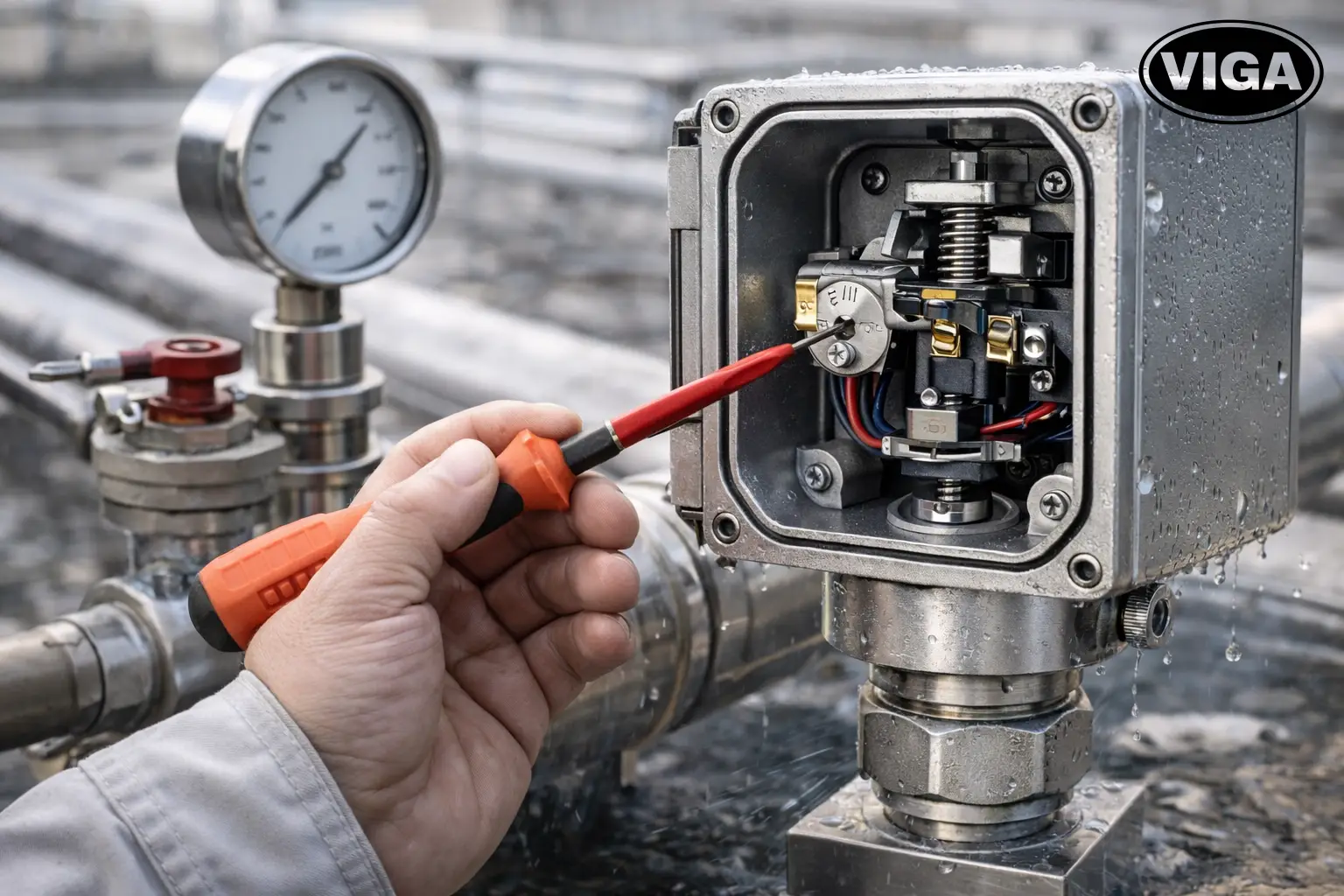
- Remove Load: Always use a bypass valve to disconnect the switch from the live pressure pipe before calibrating. Never trust the static pressure on a live line when trying to hit a precision set-point.
- External Adjustment: Choose switches with external set-point dials that are protected by O-ring sealed covers. This allows field techs to dial in the switch during commissioning without opening the enclosure and exposing sensitive electronics to rain or wind.
- Vibration Mitigation: If you mount the switch directly to a pump, you are asking for “ghost” tripping. Mount it to a rigid bulkhead or a stanchion adjacent to the pump and run a small-bore high-pressure hose to the sensor. This isolation saves the contact mechanism from mechanical oscillation.
Expert Pro-Tip: Always install your outdoor pressure switch in a location that isn’t at the “end” of the piping dead-leg. If you trap a small bubble of air in a pocket and the ambient temperature drops, that bubble contracts, throwing off your pressure sensing. Keep the switch vertical, port-down, so air pockets can bleed back into the main process line.
Troubleshooting and Maintenance
Why does your signal fluctuate? If it’s not the environment, it’s almost always the electrical path. Outdoor electronics are sensitive to voltage spikes and erratic grounding.
- Terminal Greasing: Use dielectric grease on your contact screws. It keeps out air, preventing the moisture-salt reaction that turns connections into crusty, high-resistance disasters.
- Strain Relief: When wiring outside, use enough slack in the cable so that the weight of the cable isn’t pulling on the entry gland. That pull will create a tiny gap in the gasket seal, letting moisture track right in.
How to Choose the Right Weather Proof Pressure Switch
There is a massive range in the market between low-cost hardware and legitimate field-tested components. When you are looking at specs, ask for:
- Proof of Environmental Testing: Don’t take “IP rated” at face value. Does the manufacturer hold a third-party audit for these ratings?
- Contact Materials: Ask specifically for “hard-wiping” contacts. When the switch actuates, the mechanism should create a slight wiping motion against the contact pad, clearing away any microscopic dust or oxidation that may have formed.
- Seal longevity data: Ask for the rated lifespan of the O-rings and bellows at specific ambient temperature swings (e.g., -20°C to +70°C).
The Economics of Choosing the “Right” Gear
I have seen far too many projects ruined by picking a cheaper alternative on the initial bill of materials. You are building an instrumentation cluster that needs to last for years of service. A cheap unit might save you money on day one. But what happens on day 200 when it gets brittle in the winter or leaks during a storm?
The loss of control logic at a water treatment site results in more manual site visits. One site visit, in a remote location, for a technician to replace a broken, rusted, leaking $100 part consumes much more capital than the cost of simply buying the proper, $400 corrosion-resistant switch in the first place. You are not buying a plastic or steel box; you are buying the ability to stay home while your facility manages itself.
Establishing Long-Term System Stability
Longevity comes down to how well the enclosure rejects the elements. It’s not just the ingress of water. It’s the movement of moisture across the device. Even the best equipment drifts if the air temperature cycles violently every day.
For the highest stability, look for switches with integrated damping, where the internal electronics are encapsulated in a conformal coating. This stops micro-corrosion of the circuit traces. Also, evaluate the mounting orientation one last time. If you mount a unit in a way that creates a ledge or a pool, water will always win. Always mount devices so that if a water drop lands on them, it falls, rolls, or drips away.
Think like the weather. Think like the moisture. When you respect the simple, annoying physics of the outside world, you design systems that stop being sources of stress.
FAQs About Weather Proof Pressure Switch
Q1. Why does my outdoor pressure switch leak at the terminal box?
A: Usually, it’s “wicking.” Water flows down the jacket of the cable from a high point, enters the back of the gland, and saturates the inside of the box. Use a drip loop and a silicone-sealed, waterproof gland to cut that path.
Q2. Does a stainless steel enclosure need regular cleaning?
A: Even 316-grade steel will “tea stain” (minor rust spotting) if left in heavy salt spray or soot. A quick spray with a freshwater wash followed by a wipe with a clean cloth once or twice a year is enough to keep the surface passivated and rust-free.
Q3. Is it safe to replace a single switch with a dual-stage switch for backup safety?
A: Absolutely. Adding a second, independent sensing mechanism or a double-pole setup is a smart way to ensure redundancy. If your primary process is mission-critical, using a DPDT switch lets you signal your primary logic controller and a secondary “alarm-only” circuit on separate, independent lines.
Q4. How do I tell if the switch’s set point is failing?
A: Use a master gauge. Place your calibration unit on the same pressure port. If you notice a variance between the switch action and your master gauge, your bellows/diaphragm is physically changing shape. This indicates the component is nearing its mechanical fatigue life and needs an immediate swap.
Q5. Do plastic housings offer any real-world benefit over metal?
A: Plastic does not conduct electricity. In some specific utility zones where electrical noise or grounding loops are a nightmare, a high-quality, glass-reinforced polycarbonate can actually be a safer choice. However, make sure it is explicitly UV-rated, otherwise it will crack from the sun long before it fails from pressure cycles.