
Table of Contents
What is an industrial temperature switch?
An industrial temperature switch is an electromechanical or solid-state safety device that monitors thermal limits in process automation. When a system exceeds a calibrated setpoint, it instantly opens or closes an electrical circuit to trigger alarms or shut down heavy machinery.
Heat kills machinery. It is that simple.
You do not get a polite warning when a heavy compressor’s oil cooler fails. You do not get a heads-up before a pressurized boiler loop hits its absolute metallurgical limit. You just get a massive repair bill. The metal warps. The bearings seize. Production stops dead.
If you manage a process plant or oversee heavy automation, hoping for the best is not an engineering strategy. You cannot rely on manual observation. You need fail-safe hardware that reacts in milliseconds.
This guide strips away the catalog jargon. We are looking at the raw physics happening inside the switch casing. You will learn exactly how to match internal contact logic and sensing technologies to your specific plant floor. Buying the wrong switch—or confusing it with a standard thermostat—will cause rapid-fire false trips and destroy your electrical contactors.
Let’s look at the hardware that actually protects your facility. Before you specify another switch for your pneumatic automation or boiler loop, you need to understand the raw physics inside the casing.
In This Engineering Guide:
- The Raw Physics: Actuation, Set Points, and the Deadband Trap.
- Hardware Breakdown: Bimetal, Capillary, and Solid-State Electronic.
- The Industrial Trenches: Deployments in Boilers, Compressors, and HVAC.
- The Procurement Checklist: How to specify wetted parts and IP ratings.
- The Hard Truth: Why a switch is not a thermostat or a sensor.
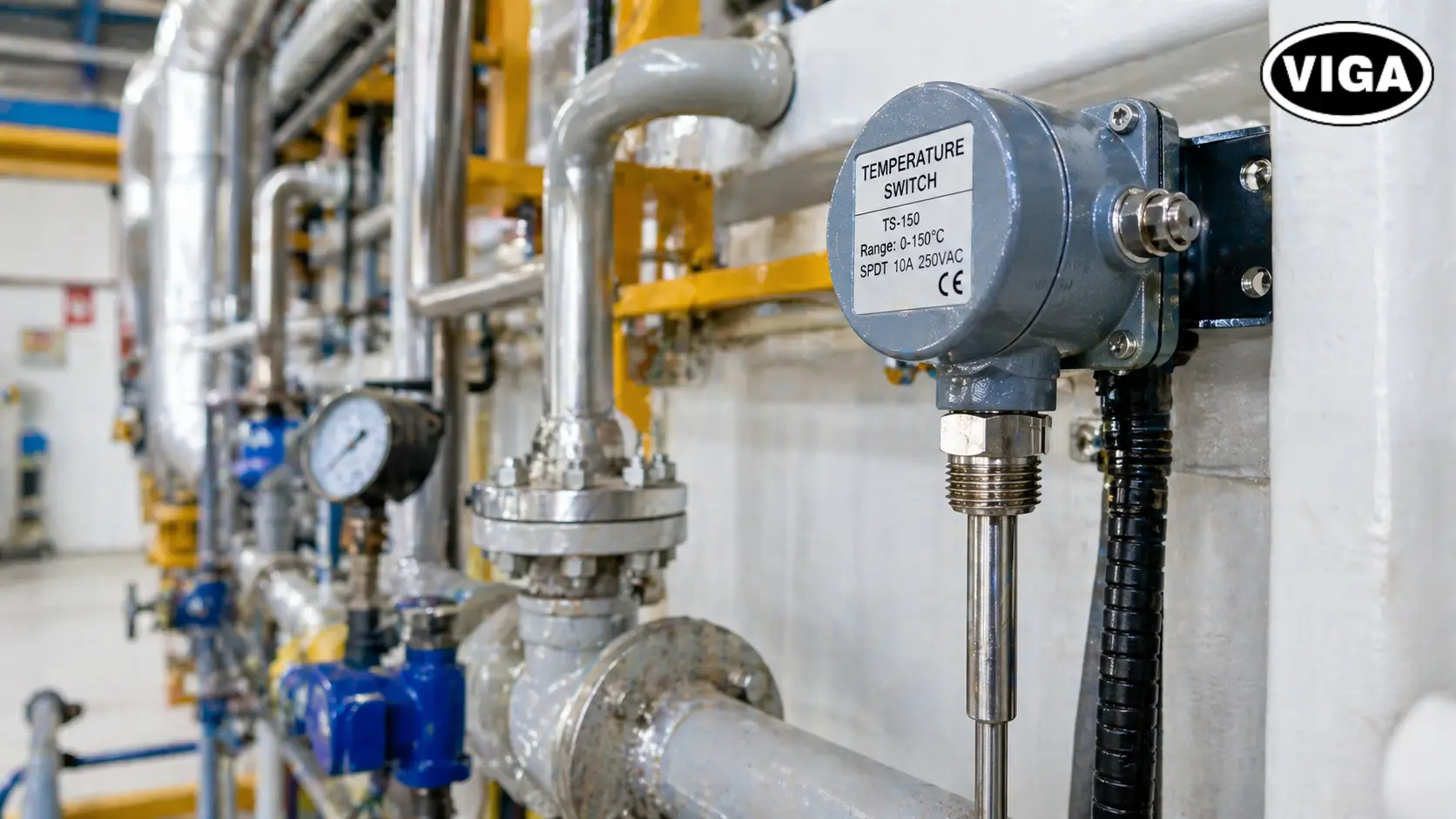
A temperature switch is a specialized electromechanical or solid-state safety device that monitors thermal limits. When a process breaches a specific heat threshold, it instantly opens or closes an electrical circuit to trigger alarms, shut down machinery, or start cooling cycles, preventing catastrophic equipment failure.
Walk onto any heavy manufacturing floor. The noise is deafening. The machinery is massive. But the real enemy is completely silent. It is heat. Uncontrolled thermal energy is the fastest way to destroy millions of dollars of capital equipment, and it happens faster than a human operator can hit an emergency stop button.
You cannot rely on manual observation to catch thermal runaway. You need automated, instantaneous hardware. That is exactly what temperature switches do. They sit on your process lines, inside your compressor housings, and bolted to your boiler tanks, waiting for the exact millisecond things get too hot. Then, they kill the power.
We are going to break down exactly how this hardware works. We will strip away the marketing fluff and look at the actual physics happening inside the casing. If you are an instrumentation engineer or a plant manager trying to stop burning through your maintenance budget on blown seals and seized motors, pay attention. Buying the wrong switch is just as bad as having no switch at all.
The Raw Physics: Temperature Switch Working Principle
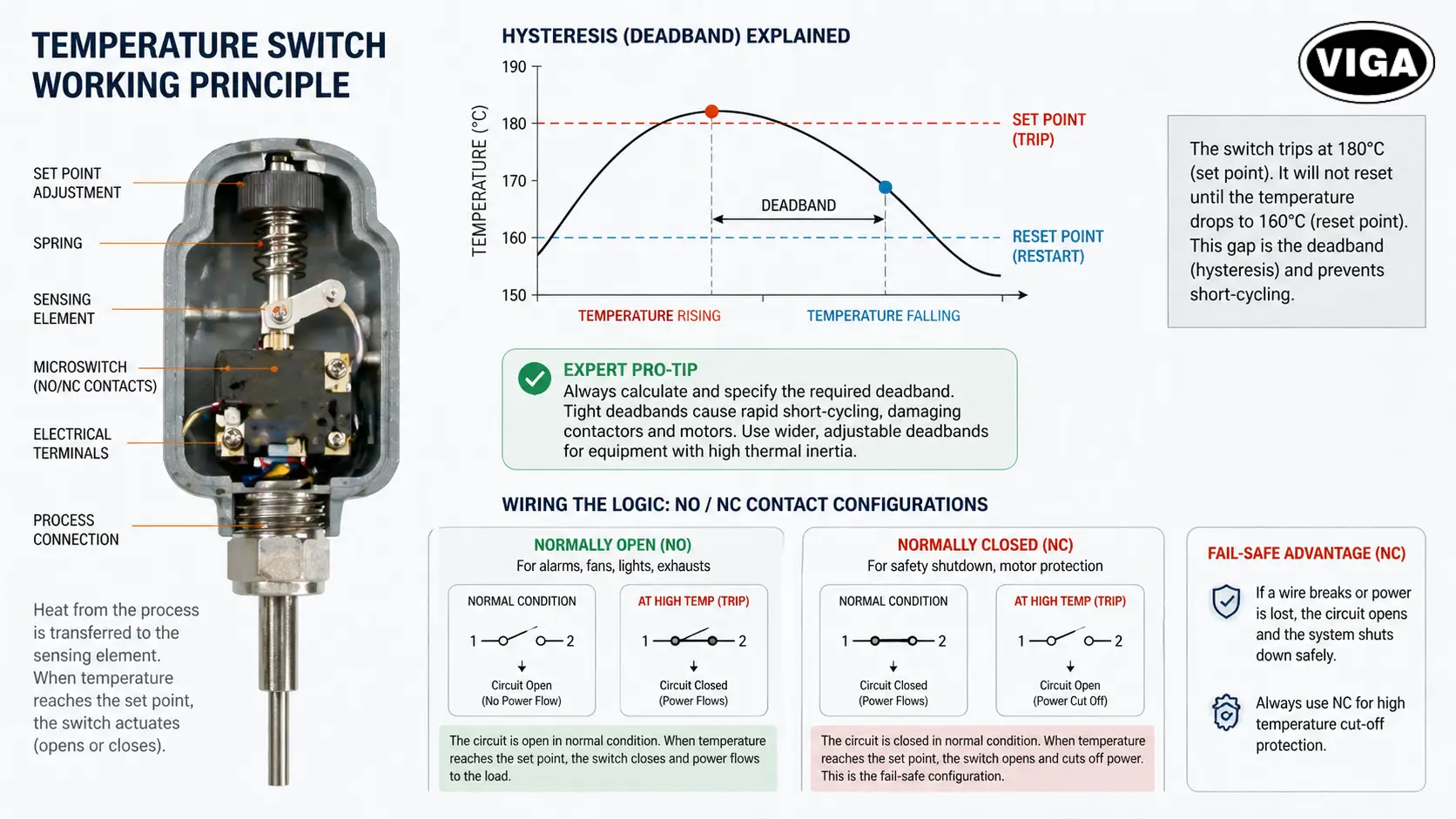
Stop thinking of these devices as black boxes. To troubleshoot them, you need to understand the mechanical reality of what happens when they get hot. The foundational temperature switch working principle is entirely based on converting raw thermal energy into either physical mechanical motion or a measurable shift in electrical resistance.
When your target process—be it a pool of lubricating oil or a high-pressure steam line—heats up, that energy transfers into the switch’s sensing element. The element reacts. Once that reaction hits a calibrated threshold (your set point), it physically forces a microswitch to actuate.
It snaps open. Or it snaps shut. It is a harsh, binary action.
The Hysteresis Trap: Set Points vs. Deadbands
Engineers screw this up constantly. The temperature set point adjustment is just the start. You dial in your limit—say, 180°C. The temperature hits 180°C, the switch trips, and your emergency cooling fan kicks on.
But what happens next?
The process cools down to 179°C. Does the switch reset and turn the fan off? If it does, you have a massive problem. The temperature will immediately bump back to 180°C a second later, and the fan kicks on again. This rapid on-off-on-off cycle is called “short-cycling.” It will absolutely destroy your contactors and burn out your fan motor in a matter of days.
This is why deadband (hysteresis) exists. Deadband is the required temperature gap between the actuation point and the reset point. You set it to trip at 180°C, but you engineer the deadband so it does not reset until the temperature drops down to 160°C.
Expert Pro-Tip: Never specify a switch without calculating your required deadband first. In heavy pneumatic automation setups, the thermal inertia of a massive compressor block means heat dissipates slowly. A tight deadband will cause the main drive motor to chatter. Specify a wide, adjustable deadband for large rotating equipment to protect your electrical switchgear.
Wiring the Logic: NO/NC Contact Configurations
The switch itself is dumb. It just moves. The electrical contacts inside dictate the actual safety logic of your plant. You have two choices.
Normally Open (NO): The electrical circuit is broken. Power cannot flow. When the switch hits its high-temperature limit, the internal mechanism slams the contacts shut. Power flows. You use this configuration to turn things on in an emergency. Sirens. Flashing lights. Emergency exhaust louvers.
Normally Closed (NC): The circuit is complete under normal, healthy conditions. Power flows freely to keep your machine running. When the heat spikes to a dangerous level, the switch forces the contacts apart. Power is instantly severed. This is the only way you should wire a high temperature cut off switch. It is a fail-safe. If the wire gets cut accidentally, the machine shuts down.
The Hardware Breakdown: Types of Industrial Temperature Switches
A chemical processing plant is not an office building. You cannot slap commercial-grade plastic parts onto a vibrating generator skid and expect them to survive. You have to match the internal sensing technology to the physical realities of your operating environment.
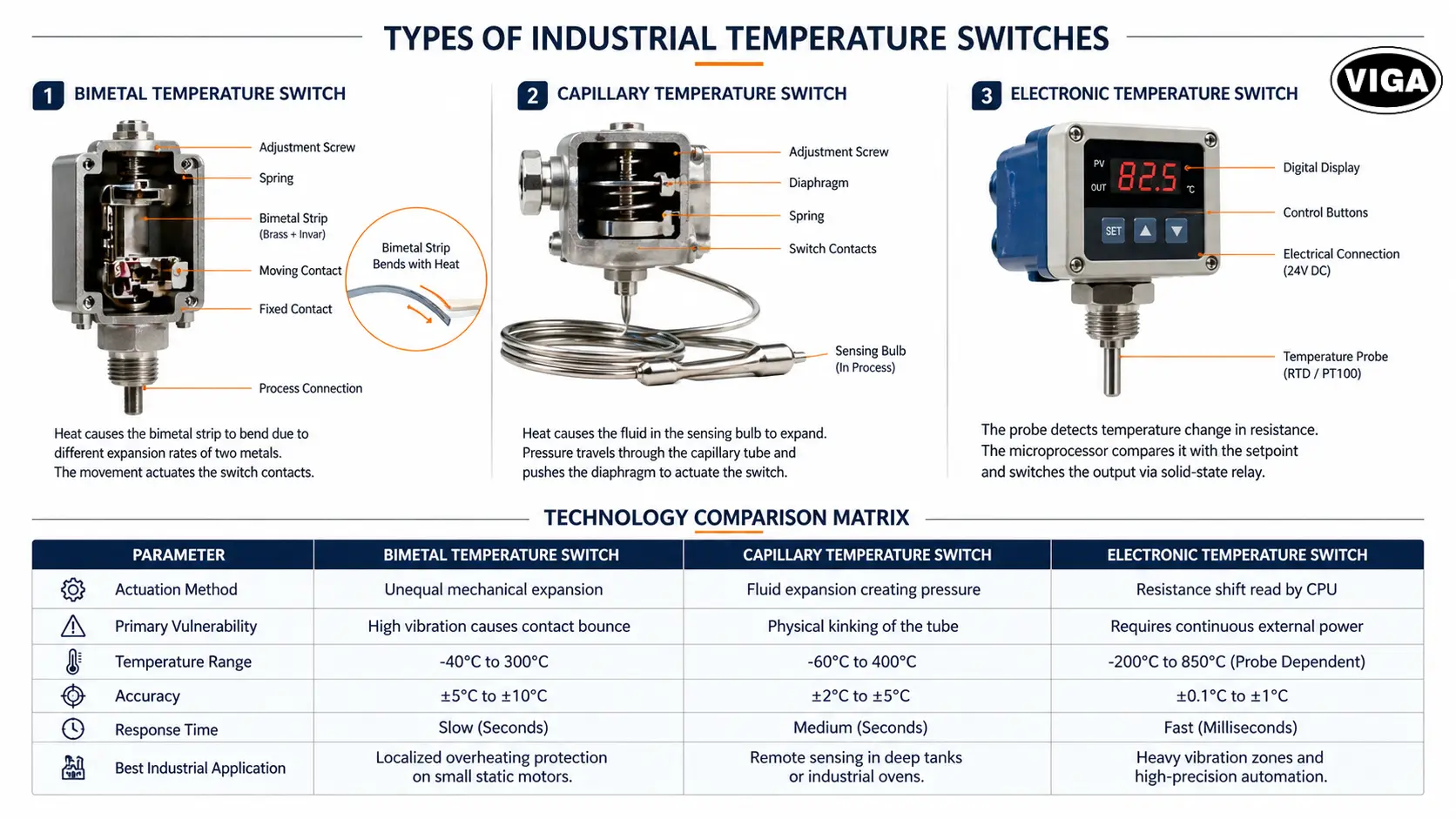
1. The Bimetal Temperature Switch
This is the oldest, cheapest, and most straightforward technology on the market. A bimetal temperature switch operates on grade-school physics.
Inside the housing, there is a small strip made of two totally different metals welded together back-to-back. Usually, it is brass and invar. Because these metals have different thermal expansion coefficients, they react to heat differently. Brass expands aggressively when heated. Invar barely expands at all.
When the temperature of your machine rises, the brass tries to stretch out, but the invar holds it back. The only physical way for the energy to release is for the entire welded strip to bend in a curve. As it bends, it physically pushes against the electrical contact. Snap. The circuit breaks.
The Reality Check: They are incredibly cheap and compact. You will find them everywhere in small machinery. But they are slow. And worse, they are highly susceptible to vibration. If you mount a bimetallic switch on a heavy vibrating press, the physical shaking will cause the bent strip to bounce against the contact, creating electrical arcing and false trips. Keep them off heavy machinery.
2. The Capillary Temperature Switch
When you need to keep the delicate electrical components away from insane heat or dangerous fluids, you use a capillary switch. It relies entirely on fluid dynamics.
It consists of a rigid sensing bulb (usually stainless steel) inserted into your process. Inside this bulb is a highly sensitive proprietary fluid or gas. Connected to the bulb is a very long, very thin flexible metal tube—the capillary. This tube runs all the way back to the main switch housing, terminating at a flexible diaphragm.
As the process heats up, the fluid inside the bulb expands rapidly. This internal pressure forces its way up the tiny capillary tube. That pressure forces its way up the tiny capillary tube and punches the diaphragm. The diaphragm balloons outward, hitting the microswitch.
The Reality Check: They are fantastic for remote sensing. You can drop the bulb deep into a vat of hot oil and mount the switch housing safely on a wall 10 feet away. But they have a fatal flaw. The capillary tube is fragile. If a careless maintenance tech steps on the tube or kinks it during installation, the pressure cannot travel. The switch is instantly dead, and it will give you zero warning that it has failed.
3. The Electronic Temperature Switch
This is where modern process control lives. An electronic temperature switch (often called a solid-state switch) completely abandons the mechanical bending strips and fluid pressures. There are no moving parts in the sensor.
Instead, it uses a high-precision electrical probe—usually a Resistance Temperature Detector (RTD) like a PT100, or a thermistor. These probes do one thing perfectly: their electrical resistance changes at a highly predictable, exact rate as they get hotter.
A tiny microprocessor inside the switch housing constantly reads this resistance. You program the exact trip point and the exact deadband using a digital keypad. When the microprocessor sees the resistance hit your programmed limit, it fires a solid-state relay.
The Reality Check: They are expensive. They require a constant 24V DC power supply to operate the internal computer. But they are completely immune to vibration. They offer pinpoint accuracy. If you are dealing with critical infrastructure, this is what you buy.
Technology Comparison Matrix
|
Switch Technology |
Actuation Method |
Primary Vulnerability |
Best Industrial Application |
|
Bimetal |
Unequal mechanical expansion |
High vibration causes contact bounce |
Localized overheating protection on small static motors. |
|
Capillary |
Fluid expansion creating pressure |
Physical kinking of the tube |
Remote sensing in deep tanks or industrial ovens. |
|
Electronic |
Resistance shift read by CPU |
Requires continuous external power |
Heavy vibration zones and high-precision automation. |
The Real-World Trenches: Industrial Applications
Knowing how they work is only half the battle. Knowing where to install them saves your facility from disaster. Let’s look at how these devices are actively deployed across heavy industry to prevent catastrophic failures.
Defending the Vessel: Temperature Switch for Boiler Systems
Boiler rooms are effectively controlled bombs. You are dealing with intense fire, massive water volumes, and extreme pressurized steam. If the primary control loop (the PLC or DCS) freezes or a valve sticks open, the burner will just keep firing. The water temperature will skyrocket past safe metallurgical limits.
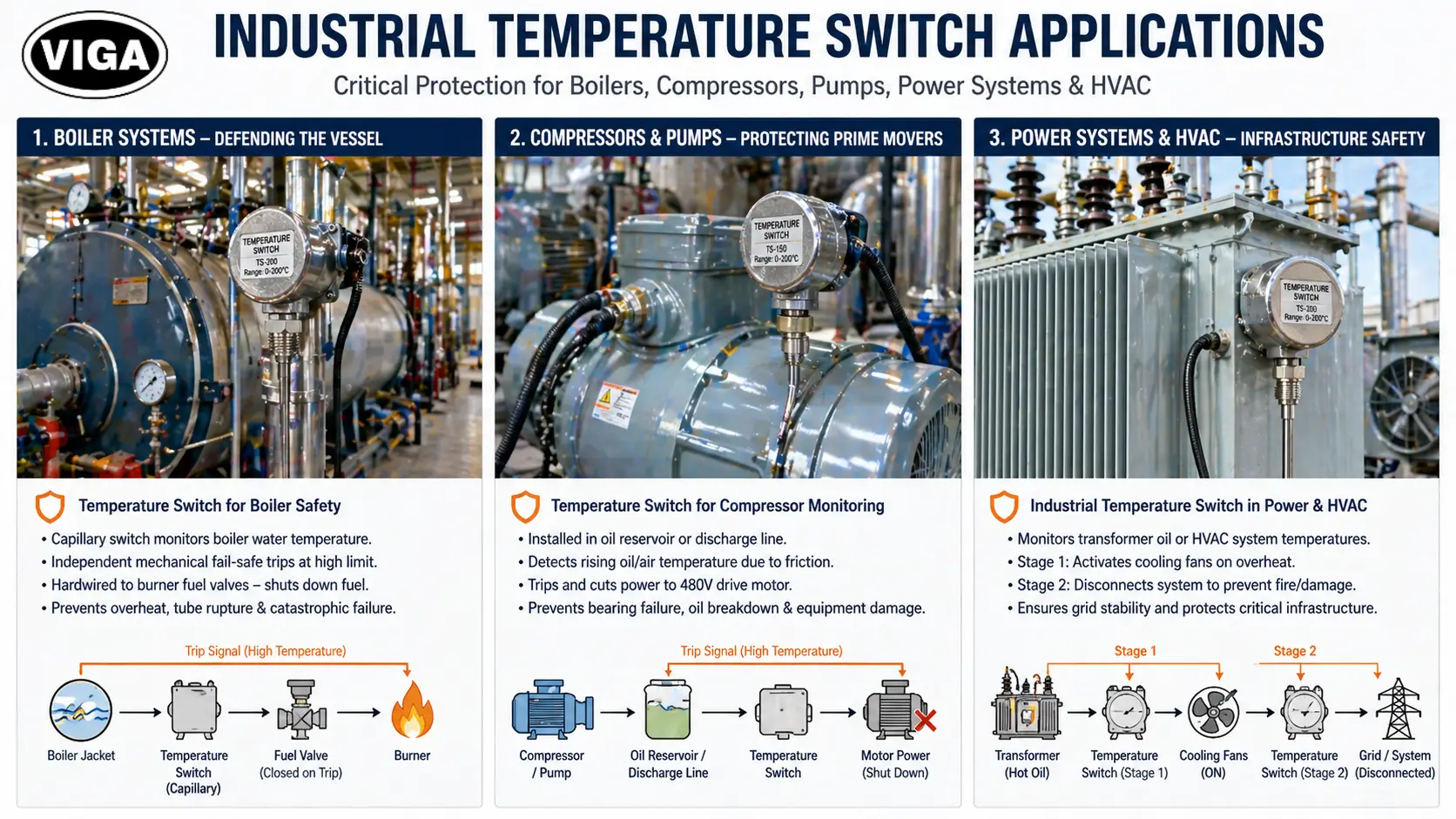
This is where a temperature switch for boiler applications serves as the ultimate, un-hackable safety net. A heavy-duty capillary switch is physically plumbed into the boiler jacket. It is entirely independent of the main computer. If the water hits the critical high limit, the expanding fluid trips the switch, which is hardwired directly into the main power feed of the burner fuel valves. It slams the fuel valves shut instantly. This mechanical fail-safe operates independently of your PLC (Programmable Logic Controller), ensuring true redundancy. It prevents the steel tubes from warping, rupturing, and leveling the building.
Protecting the Prime Movers: Compressors and Pumps
Industrial manufacturing runs on compressed air and moving fluids. Compressors and pumps generate massive amounts of internal friction. They rely entirely on a thin film of lubricating oil to keep the metal parts from tearing each other apart.
When a bearing starts to fail, or an oil cooler clogs up, the internal casing temperature spikes incredibly fast. If you wait for the operator to notice the smell of burning oil, the machine is already dead.
You install a temperature switch for compressor monitoring directly into the oil reservoir or the pneumatic discharge air line. If the oil gets too hot, its viscosity breaks down. It turns to water. The metal grinds. The switch senses the rising discharge heat and severs the power to the massive 480V drive motor. It sacrifices a few hours of production downtime to save a $50,000 compressor block from becoming scrap metal.
Infrastructure Safety: Power Systems and HVAC
Managing heat isn’t just about hot fluids. It is about keeping electrical and cooling grids stable. Look at heavy power infrastructure. Massive step-down transformers sitting in substations generate incredible heat. They are filled with dielectric cooling oil.
If that oil overheats, it degrades, and the transformer shorts out, taking out power to an entire manufacturing sector. A dedicated industrial temperature switch in HVAC systems and power grids monitors this oil. At the first stage of overheating, the switch trips and fires up massive external cooling fans. If the heat keeps rising to stage two, a second switch trips and actively disconnects the transformer from the grid to save it from catching fire.
The Procurement Trap: How to Choose a Temperature Switch
Engineers routinely default to whatever brand they bought last year. Procurement managers buy whatever is cheapest in the catalog. Both approaches lead to early mechanical failure.
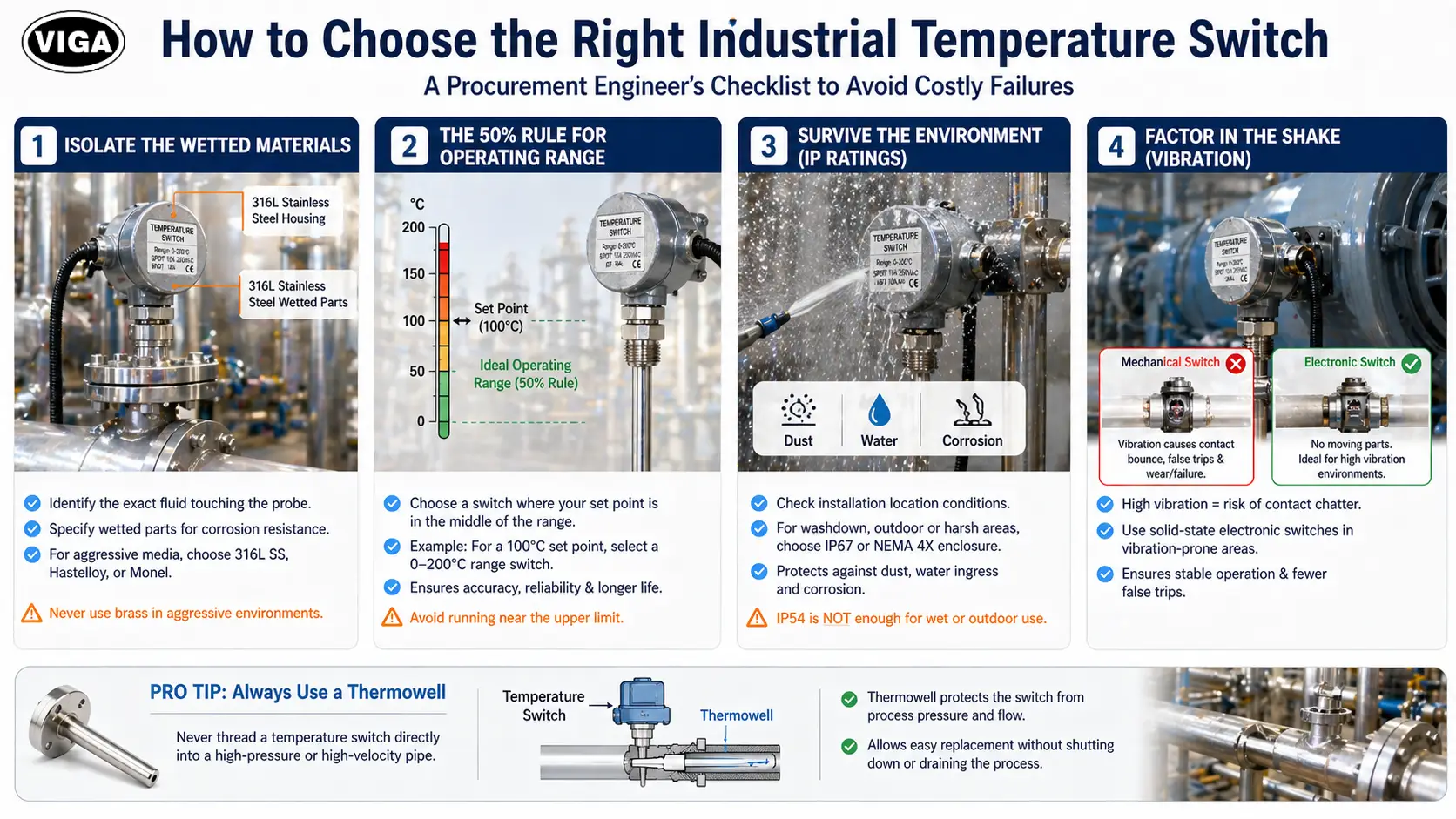
When you sit down to select an industrial temperature switch, you must cross-reference the physical hardware against the harsh realities of your specific plant floor. Use this exact framework before you sign a purchase order.
1. Isolate the Wetted Materials.
What exact fluid is touching the sensing probe? Is it deionized water? Is it highly aggressive sulfuric acid? Is it thick, abrasive sludge? If you put a standard brass probe into an aggressive chemical line, it will dissolve in a week. You must specify the wetted parts. For aggressive media, demand 316L Stainless Steel, Hastelloy, or Monel.
Expert Pro-Tip: Never thread a temperature switch directly into a high-velocity, pressurized pipe. Always use a thermowell. A thermowell is a hollow metal tube welded into the pipe. The switch drops into the thermowell. This allows you to unscrew and replace a broken switch without having to shut down the process, drain the pipe, and halt production.
2. The 50% Rule for Operating Range.
If your normal process runs at 100°C, do not buy a switch that maxes out at 110°C. Mechanical sensing elements (like bimetal and capillaries) suffer from fatigue if they are constantly pushed to their absolute physical limits. To guarantee accuracy and a long lifespan, choose a switch where your target set point falls roughly in the exact middle of its adjustable range. If you want to trip at 100°C, buy a switch rated from 0°C to 200°C.
3. Survive the Environment (IP Ratings).
Look at the physical location where the switch will live. Is it outside in the rain? Is it on a food processing line that gets blasted with high-pressure, 180-degree washdown hoses every single night? If the electrical housing gets wet, the switch shorts out. Stop buying cheap IP54 rated switches for wet areas. Demand an IP67 rating (totally dust tight and protected against temporary immersion) or NEMA 4X enclosures.
4. Factor in the Shake.
We talked about this earlier, but it bears repeating. Mechanical vibration destroys mechanical contacts. If the installation point vibrates—like a stamping press, a diesel generator skid, or a heavy pneumatic automation manifold—you have to spend the extra money on a solid-state electronic switch. Mechanical contacts will chatter, sending a rapid-fire string of false trip signals to your control panel, driving your operators insane.
The Industry Confusion: Temperature Switch vs Thermostat vs Sensor
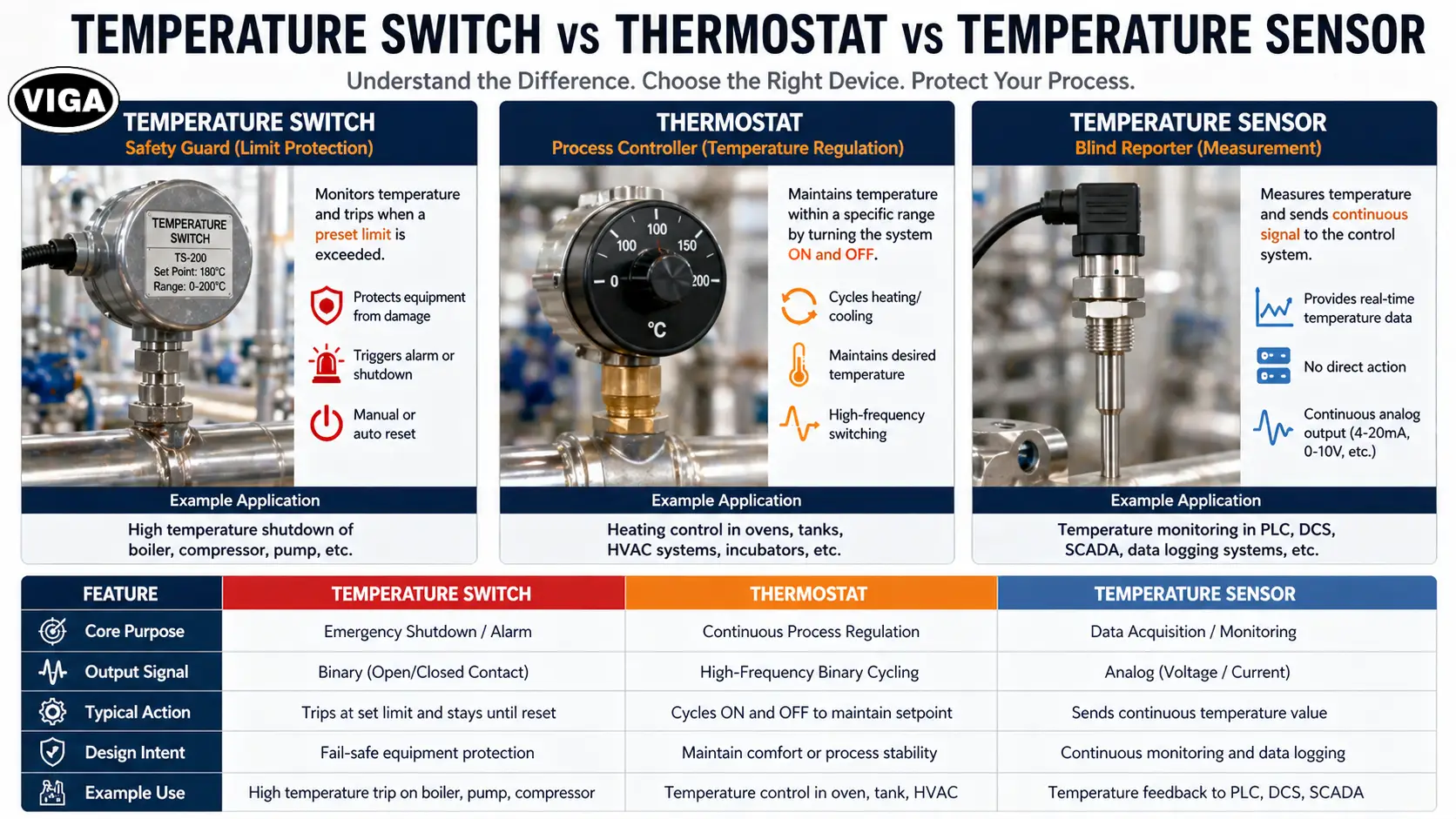
Go into any plant, and you will hear guys on the floor using these three terms as if they mean the exact same thing. They do not. Mixing up this terminology during the design phase of a project leads to systems that fundamentally do not work. Let’s draw the hard lines.
- The Temperature Switch: This is a safety guard. It is a binary, on/off device. It sits there doing absolutely nothing during normal operations. It only takes action when things go wrong. Its job is to protect equipment from destruction.
- The Thermostat: This is a process controller. A thermostat working principle is entirely about maintaining a specific band of heat. It constantly cycles a heater on and off, on and off, all day long to keep a tank at exactly 150°C. It is built for high-frequency cycling.
- The Temperature Sensor (Thermocouple/RTD): This is a blind reporter. It does not open or close circuits. It does not turn things off. It simply sits in the fluid and sends a continuous, fluctuating electrical signal (like a 4-20mA current) back to a central computer. The computer decides what to do with the information.
Device Capability Breakdown
|
Device Classification |
Core Operating Purpose |
Output Signal Action |
Design Intent |
|
Temperature Switch |
Emergency Shutdown / Alarm |
Binary (Open/Closed Contact) |
Fail-safe equipment protection. |
|
Thermostat |
Continuous Process Regulation |
High-Frequency Binary Cycling |
Maintain comfort or process stability. |
|
Temperature Sensor |
Data Acquisition |
Analog (Voltage / Current) |
Continuous monitoring and data logging. |
Final Thoughts on Process Thermal Defense
You do not install thermal protection just to check a box on an insurance compliance form. You do it because heavy industrial processes are inherently dangerous and completely unforgiving.
Stop treating these critical components as generic commodities to be sourced from the lowest bidder. Treat them as the vital, frontline fail-safes they actually are. By stripping away the guesswork and meticulously matching your actuation technology, contact logic, and housing materials to the exact physical demands of your fluids and mechanical loads, you eliminate the plague of false trips.
More importantly, you guarantee that when a valve sticks, or a bearing fails, and temperatures start rocketing toward the critical limit, your hardware will react instantly, sever the power, and ensure your facility lives to run another day.
Frequently Asked Questions (FAQ)
Q1. Why is my capillary switch tripping at different temperatures every week?
A: You likely have a microscopic leak. Capillary switches rely entirely on internal fluid pressure to actuate. If the stainless-steel bulb or the fragile capillary tube gets a tiny pinhole leak, the fluid slowly escapes. As fluid is lost, it takes a much higher external temperature to generate enough internal pressure to punch the diaphragm. The switch is permanently compromised and must be fully replaced.
Q2. How do you accurately test an industrial temperature switch without removing it from the plant?
A: You never test a switch with a heat gun or an open flame; that guarantees uneven heat distribution and ruins calibration. If the switch is mounted in a thermowell, you pull the switch probe out of the well and insert it directly into a portable, calibrated dry-block heater. You slowly ramp up the heat on the dry-block while monitoring the switch’s electrical terminals with a digital multimeter to pinpoint the exact moment the contacts open or close.
Q3. Can I wire a heavy 480V compressor motor directly through a temperature switch?
A: Absolutely not. The microswitches inside these devices are incredibly small. They are generally rated for only 5 to 15 amps of low-voltage control current. If you try to route massive motor current directly through the switch, the contacts will instantly weld together from the electrical arc. You wire the temperature switch into the low-voltage control circuit of a heavy-duty magnetic contactor, and the contactor handles the massive 480V load.
Q4. What is the functional difference between an auto-reset and a manual-reset high limit switch?
A: An auto-reset switch will kill the power when it gets too hot, and then automatically turn the power back on once the machine cools down below the deadband. A manual-reset switch kills the power and locks out. The machine will not restart, even after it cools down, until a human operator physically walks over to the switch and presses a mechanical reset button. Manual resets are mandatory on boilers to ensure an engineer inspects the system for damage before it fires again.
Q5. Why did my bimetal switch fail on a vibrating stamping press?
A: Bimetal switches rely on a slow, physical bending motion to make electrical contact. On a heavy stamping press, the constant, violent physical shock waves travel through the machine and cause that slowly bending strip to bounce rapidly against the contact point. This bouncing creates electrical arcing (sparks), which physically pits and burns away the metal contacts until they completely fail to conduct electricity. Electronic switches are required for high-shock environments.
Related Articles
Loading articles…

