
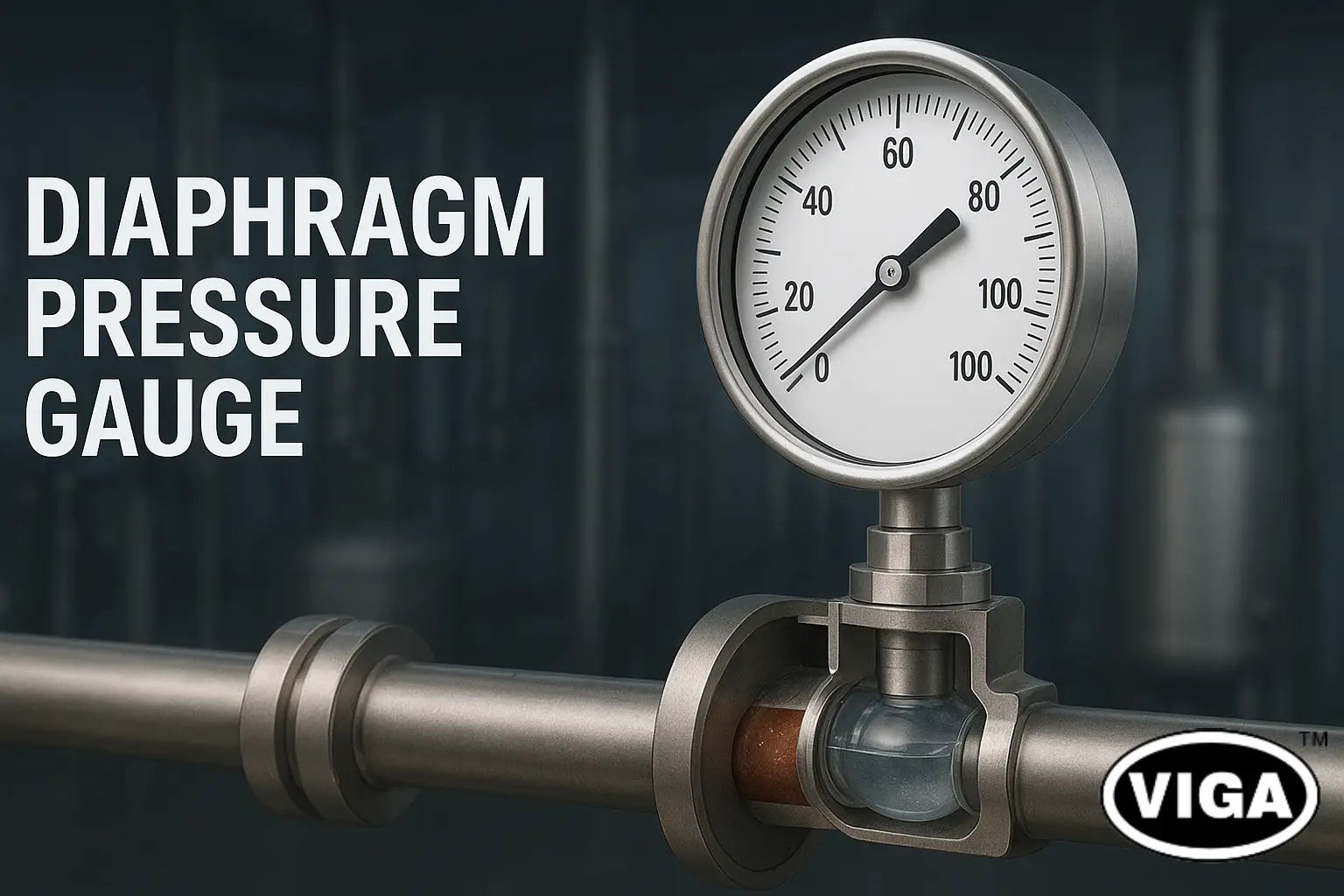
Add Your Heading Text Here
WIKA Pressure Gauge vs Local Brands: Procurement Guide for Indian Plant Engineers
Last month, a plant manager from Faridabad called with a straightforward problem. Three pressure gauges on his boiler system had failed within a year — dial fogged up on one, another started leaking from the socket, and the third just read zero one morning. His maintenance contractor had sourced them from a local market supplier. They looked fine on the outside. Cheap too.
His question was simple: should he spend 3x more on WIKA, or do cheaper pressure gauges get the job done?
It’s the most common dilemma in the instrumentation business. But instead of asking “which is cheaper,” the real question should be: “which option is right for this specific measurement point?”.
Twenty-plus years of supplying pressure instruments to plants across Delhi NCR — pharma units in Baddi, chemical plants in Panipat, manufacturing facilities in Manesar, food processing in Kundli — teaches you something. Engineers who try to use one grade of instrument for everything either overpay on utility points or end up with inadequate gauges where they cannot afford them. The plants that run well are the ones that know exactly where to spend and where to save.
This article is that knowledge, written down.
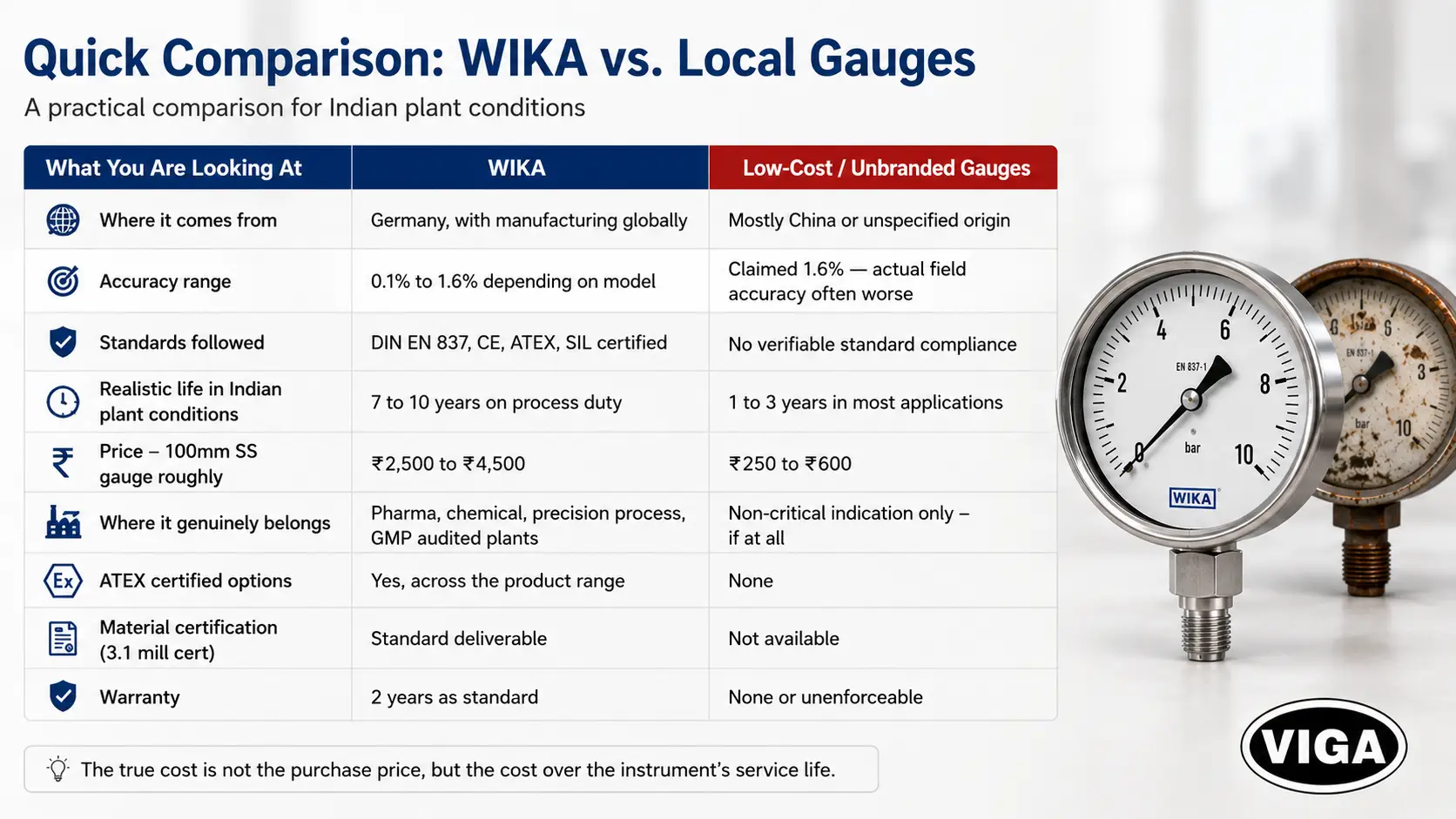
Quick Comparison: WIKA vs. Local Gauges
Here is a breakdown of how both options compare, including realistic field lifespans in Indian conditions:
What You Are Looking At | WIKA | Low-Cost / Unbranded Gauges |
Where it comes from | Germany, with manufacturing globally | Mostly China or unspecified origin |
Accuracy range | 0.1% to 1.6% depending on model | Claimed 1.6% — actual field accuracy often worse |
Standards followed | DIN EN 837, CE, ATEX, SIL certified | No verifiable standard compliance |
Realistic life in Indian plant conditions | 7 to 10 years on process duty | 1 to 3 years in most applications |
Price — 100mm SS gauge roughly | ₹2,500 to ₹4,500 | ₹250 to ₹600 |
Where it genuinely belongs | Pharma, chemical, precision process, GMP audited plants | Non-critical indication only — if at all |
ATEX certified options | Yes, across the product range | None |
Material certification (3.1 mill cert) | Standard deliverable | Not available |
Warranty | 2 years as standard | None or unenforceable |
The life expectancy row tells the real story. An unbranded gauge at ₹400 replaced every 18 months costs ₹267 per year — and that is only the product cost. Add the labour cost of replacement, the downtime if it fails mid-operation, and the risk of a wrong reading on a critical loop, and the apparent saving disappears very quickly. A WIKA gauge at ₹3,500 lasting 9 years costs roughly ₹390 per year and delivers documented, traceable accuracy for its entire service life. On critical loops where a gauge failure means a process shutdown or a GMP deviation, that comparison does not even need to be made — WIKA is simply the right specification.
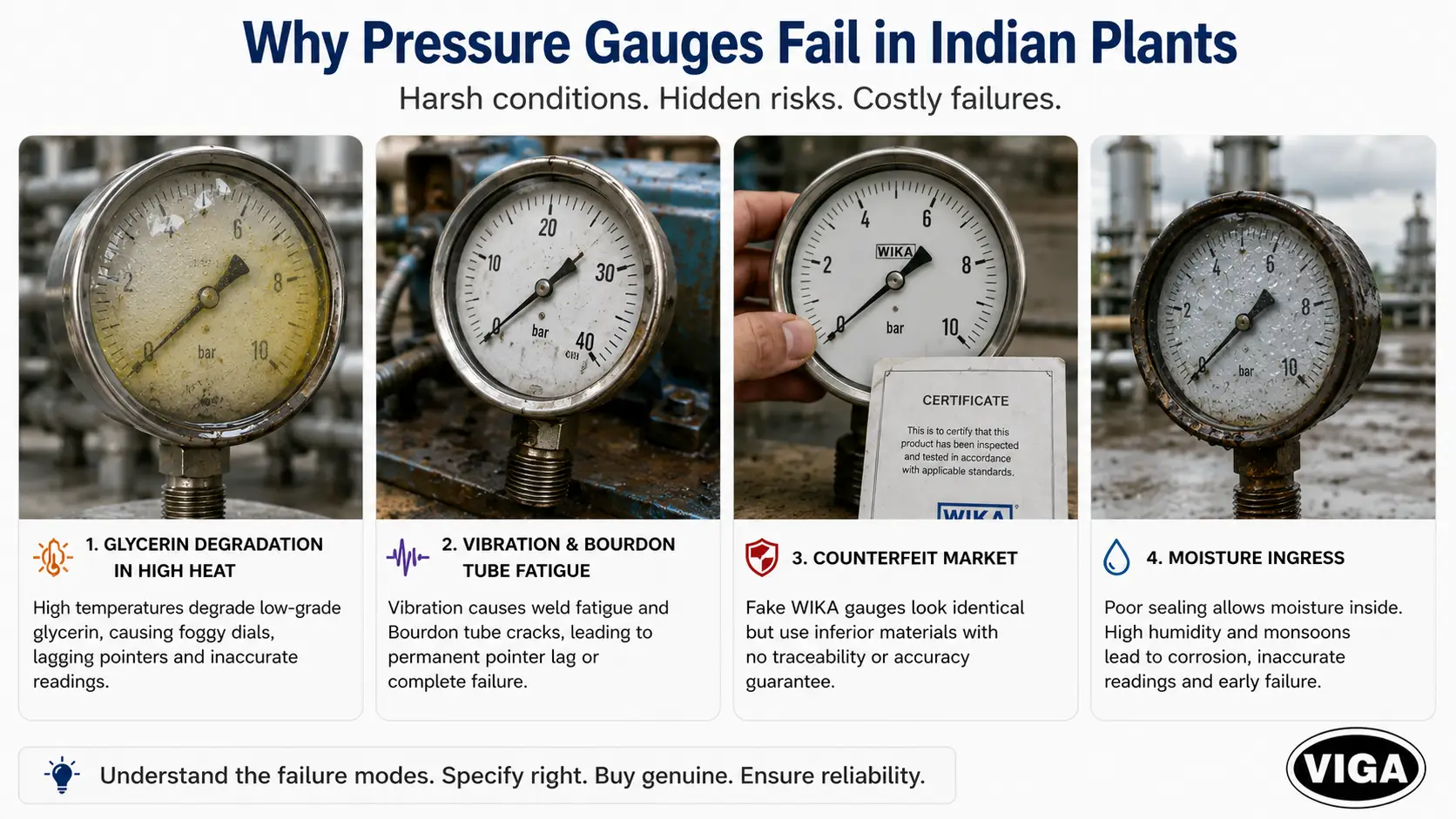
Why Pressure Gauges Fail in Indian Plants
Indian industrial environments are genuinely harsh. European manufacturers design their instruments for European conditions — 20 to 25 degrees ambient, clean utility air, relatively stable power. What those instruments face in a Haryana plant in June is a different story entirely.
- Glycerin Degradation in High Heat: At 45 degrees ambient and above, low-grade glycerin yellows and turns viscous. The dial goes foggy. The pointer starts lagging. Engineers mistake this for gauge failure when it is actually a filling quality problem. Unbranded gauges almost universally use the lowest grade of glycerin available. It costs less, it ships cheaper, and the failure it causes happens after the sale. WIKA’s specification for glycerin grade and temperature stability is precisely defined and tested before the gauge leaves the factory. Beyond 50 degrees ambient, or in coastal plants with high humidity combined with heat, silicone-filled options from reputable manufacturers are worth specifying.
- Vibration and Bourdon Tube Fatigue: Reciprocating compressors are brutal on Bourdon tube gauges. The tube tip weld fatigues, the pointer develops permanent lag, and eventually the tube cracks. In unbranded gauges, the Bourdon tube wall thickness is inconsistent — not by design, but because the manufacturing process has no tolerance control. A batch of unbranded gauges from the same supplier can have wildly varying tube dimensions. WIKA’s tighter wall thickness consistency and weld quality mean predictable, documented fatigue life under continuous cycling. For compressor discharge gauges on high-pressure reciprocating machines, this difference is not minor — it is the difference between a gauge that lasts three years and one that fails in eight months.
- The Counterfeit Market: This is a problem specific to branded gauges, but it is worth understanding because it affects how to buy correctly. WIKA fakes are common because the brand carries a premium that makes copying profitable. They look identical, they have WIKA labels, they come with what looks like a certificate. But the Bourdon tube wall thickness is inconsistent, the glycerin is poor quality, and there is zero traceability on materials. The only protection is buying from authorized distributors who can show their authorization documentation. An unbranded gauge does not have this problem — but it also has none of the certified accuracy, material traceability, or warranty that comes with a genuine branded instrument.
- Moisture Ingress: Indian monsoons push humidity to 90%+ in many regions. Unbranded gauges almost never carry meaningful IP ratings — the case sealing is nominal at best. A gauge with inadequate sealing in an outdoor installation in Mumbai or Chennai will see moisture inside the case within two monsoon seasons. Specifying IP65 or higher for outdoor installations is not optional — it is the difference between a 5-year service life and a 2-year replacement cycle. Verified IP ratings exist only on instruments from manufacturers who test against the standard and certify accordingly.
Knowing these failure modes changes how you compare options. You stop asking “which is cheaper upfront” and start asking “which handles my specific conditions reliably over its service life.”
WIKA Standards: Why Pharma & Chemical Plants Demand It
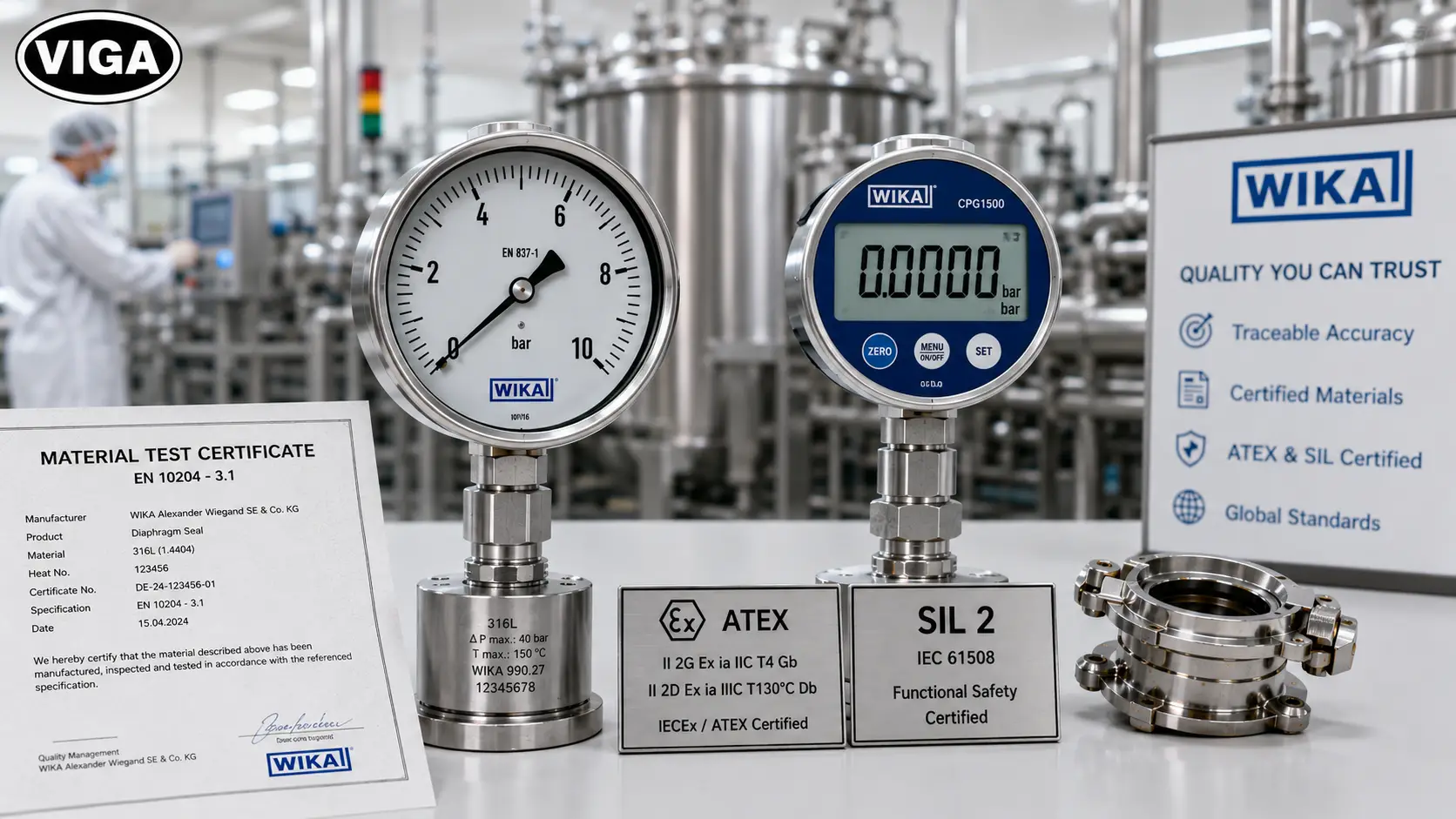
WIKA has been making pressure instruments in Germany since 1946. That number — 78 years — is not marketing. It means the manufacturing processes, the material specifications, the internal quality systems are refined through decades of iteration in a way that very few manufacturers anywhere in the world can match. When a WIKA 232.50 pressure gauge leaves the factory, it has been calibrated against a traceable reference, its accuracy has been documented, and the material of every wetted component has been certified to DIN 3.1 mill certificate standard.
That documentation chain is why certain industries will not accept anything else.
A pharmaceutical plant running under Schedule M or cGMP cannot have a pressure instrument on a product contact loop without material traceability. If an auditor asks for the 3.1 mill certificate on the diaphragm seal used on the WFI tank pressure monitoring point, the plant needs to produce it. WIKA provides this as a standard deliverable. Unbranded or low-cost manufacturers cannot provide this — there is no material certification process in their supply chain to draw from.
Similarly, plants with ATEX-classified hazardous areas — petroleum refineries, chemical plants with flammable vapors, fertilizer units — need instruments certified for Zone 1 or Zone 2 installation. WIKA has ATEX certified versions across its transmitter and switch range as catalog items. This is not a special order; it is a standard product. For SIL 2 rated safety loops, WIKA transmitters carry functional safety certification. These requirements cannot be met by uncertified instruments regardless of price. For plants that need them, there is simply no low-cost alternative that qualifies.
The accuracy side of WIKA matters most in plants where measurement drives process decisions rather than just indicating whether something is running. A precision digital WIKA CPG1500 at 0.025% accuracy is used for calibration verification in quality labs and as the reference instrument for checking other gauges. The consistency and traceability of that accuracy is what makes it useful. A low-cost gauge with a claimed 1.6% accuracy but no factory calibration documentation is not a meaningful reference for anything.
One thing worth knowing if you are buying WIKA in India: always verify authorized distributor status. Ask for the current year’s authorization letter from WIKA India. A genuine authorized distributor has it and will show it without hesitation. VIGA (Vinod Gautam Sales) has been an authorized WIKA distributor for Delhi NCR — if you need genuine WIKA stock with full documentation, that is the check to run on any supplier before placing an order.
Need WIKA gauges with genuine calibration certificates for your Delhi NCR plant? Check current stock at viga.in/wika-products or WhatsApp for same-day availability on stocked models.
When to Use (and Avoid) Low-Cost Pressure Gauges
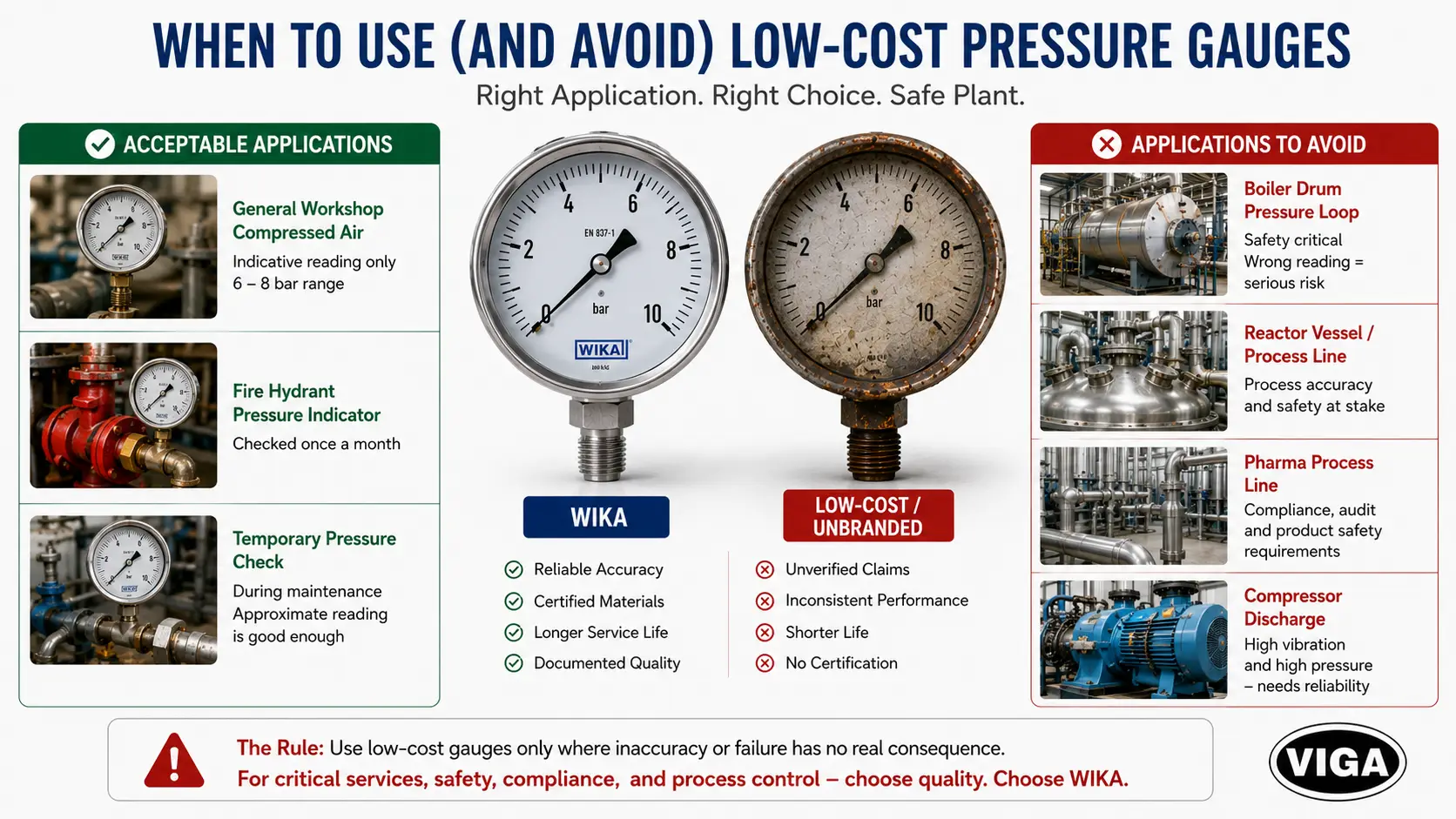
Low-cost gauges sourced from local markets have flooded the industry. While dismissing them entirely isn’t practical, it’s critical to understand where they fit.
Low-cost pressure gauges, sourced through trading channels mostly from Chinese manufacturers, have flooded the Indian market over the past decade. Walk through any industrial hardware market in Delhi, Mumbai, or Chennai and they are everywhere. Prices from ₹150 to ₹600 for a 100mm gauge that looks, at a glance, like any standard process instrument. Some suppliers label them with specification claims — accuracy class 1.6, SS 316 Bourdon tube, IP54 case — that they cannot actually verify or certify.
The fundamental problem is not that these gauges exist. It is that the performance claimed on the label frequently does not match the performance delivered in the plant.
What consistently goes wrong with low-cost gauges in Indian plants:
- Inconsistent Bourdon Tubes: Without controlled manufacturing tolerances, wall thickness varies across the tube. This means the elastic behaviour of the tube is not consistent, which means the accuracy is not consistent across the pressure range. A gauge that reads correctly at midscale may be significantly out at the low and high end of its range — a problem that only shows up when you calibrate it, which most plants do not do on utility-grade instruments.
- Unverified Wetted Materials: The SS 316 claim on many low-cost gauges is not backed by material certification. What arrives may be SS 304, or a lower grade stainless, or in some cases a chrome-plated brass that looks similar to stainless at a glance. For aggressive media — even moderately corrosive cooling water in some plants — material that is not genuinely SS 316 can fail by pitting corrosion within 18 months. There is no way to verify this without the 3.1 mill certificate, which does not exist for these products.
- Substandard Movement Gears: The gear train and pinion that converts Bourdon tube movement to pointer rotation needs to be precision machined to deliver accurate, consistent readings. Low-cost gauges use cast or stamped movements with minimal finishing. The result is a gauge that works acceptably on initial installation but degrades faster over time as the movement wears.
Where low-cost gauges are genuinely acceptable:
That said, for truly non-critical indication — a general workshop compressed air point where the operator just needs to see that pressure is somewhere in the 6 to 8 bar range, a fire hydrant pressure indicator that is checked once a month, a temporary pressure check during maintenance — the case for spending ₹3,500 on a WIKA is hard to justify. The gauge is doing an indicative job. Approximate is good enough. Replacement is easy.
The problem is not the low-cost gauge in that application. The problem is the low-cost gauge that ends up on a boiler drum pressure loop, a reactor vessel, a pharma process line, or a compressor discharge — because it was cheap and available and the procurement decision was made on price alone without thinking about what the gauge is actually measuring and what the consequence of a wrong reading is.
The line between acceptable low-cost application and unacceptable low-cost application is the consequence of failure or inaccuracy. When the consequence is nothing — replace the gauge and carry on — the cost trade-off may be acceptable. When the consequence is a process incident, a safety event, or a failed audit, the low-cost gauge is always the wrong choice, regardless of how many units you could buy for the price of one WIKA.
Looking for quality pressure gauges for every application in your Delhi NCR plant? VIGA stocks instruments across the full range of quality tiers for different application requirements. Talk to the team about the right specification for your specific measurement points. → viga.in or WhatsApp directly.
On-Site Performance: How the Difference Feels
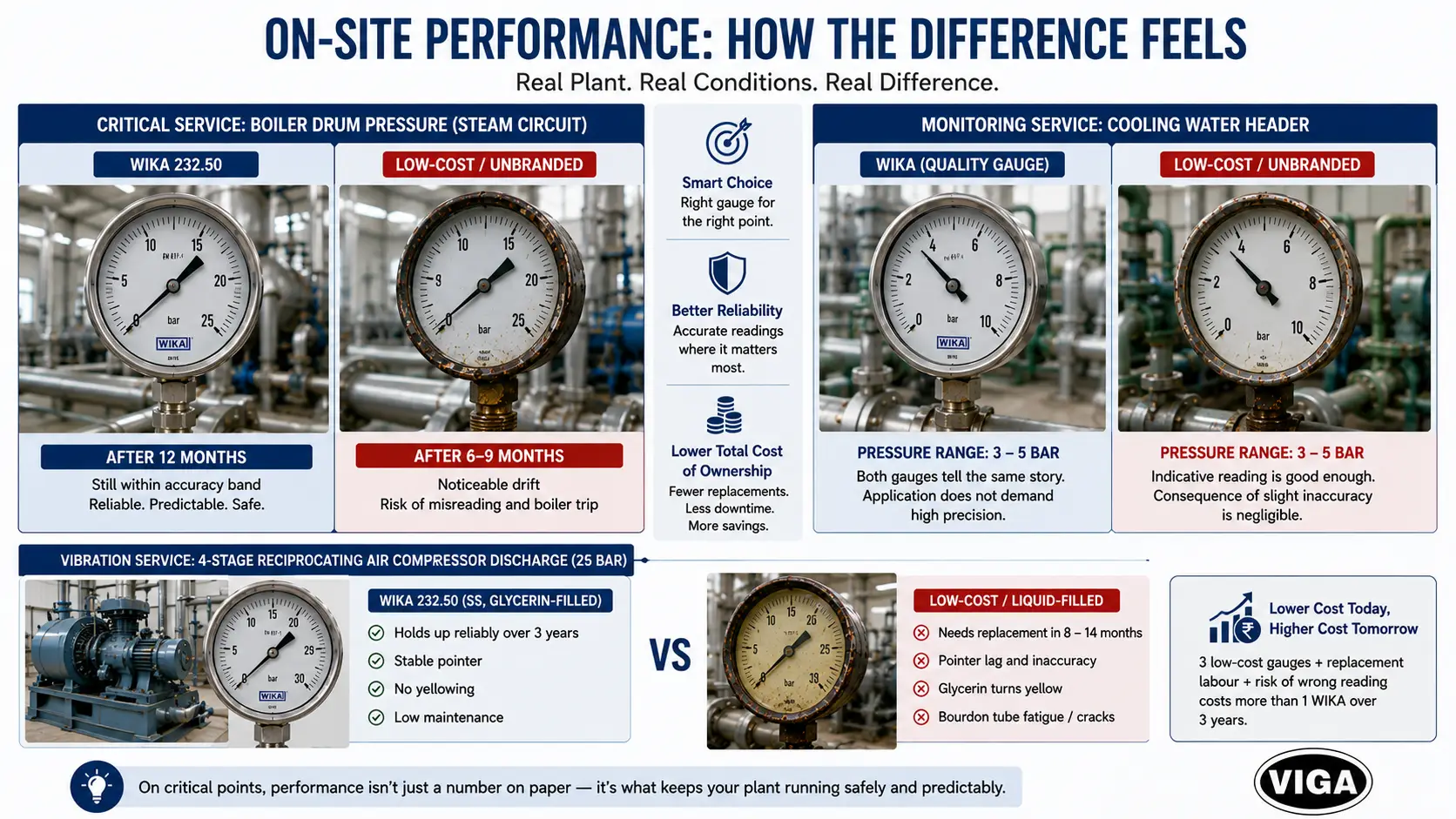
Accuracy class numbers are easy to state. What is harder to communicate — and what matters more to a maintenance engineer — is what the difference feels like over three years of plant operation.
On a 100mm gauge measuring boiler drum pressure on a critical steam circuit, a WIKA 232.50 calibrated at installation will still be within its stated accuracy band after 12 months of operation. A low-cost gauge on the same duty — even one that was within specification on day one — will typically show significant drift within 6 to 9 months, particularly if the steam quality has been variable and pressure cycling has been frequent. For a boiler that runs continuously and where drum pressure accuracy affects steam quality and safety, this difference is not academic. It is the difference between a plant that runs predictably and one that has a boiler trip because the gauge was misread.
On a cooling water header in the same plant, serving a monitoring function where the operator just needs to see that pressure is between 3 and 5 bar, a calibrated quality gauge and an unbranded gauge will tell the same story most of the time. The application does not demand precision. The consequence of being slightly off is negligible. This is where procurement intelligence matters — not specifying WIKA on every single monitoring point, but knowing clearly which points genuinely need certified accuracy and which ones are just indicators.
The material comparison becomes critical on specific services. WIKA’s ability to supply Hastelloy C-276 Bourdon tubes, Monel wetted parts, PTFE-coated internals, and gold-plated movement components as catalog items addresses the most aggressive chemical service requirements. Low-cost gauges offer no exotic material options. For strong acid service, halogenated compounds, or oxidizers, the only instruments worth specifying are those from manufacturers with documented material traceability — which in practice means reputable branded instruments only.
On vibration: on a 4-stage reciprocating air compressor discharge at 25 bar, the WIKA 232.50 SS glycerin-filled gauge holds up reliably over three years. Low-cost liquid-filled gauges on the same duty routinely need replacement within 8 to 14 months. The pointer lags, the glycerin yellows, and eventually the Bourdon tube tip develops a hairline crack. The cost of three low-cost gauges over three years, plus the labour of three replacements, plus the risk of an inaccurate reading during the period before failure is noticed, consistently exceeds the cost of one WIKA.
Application Guide: Where to Spend vs. Where to Save
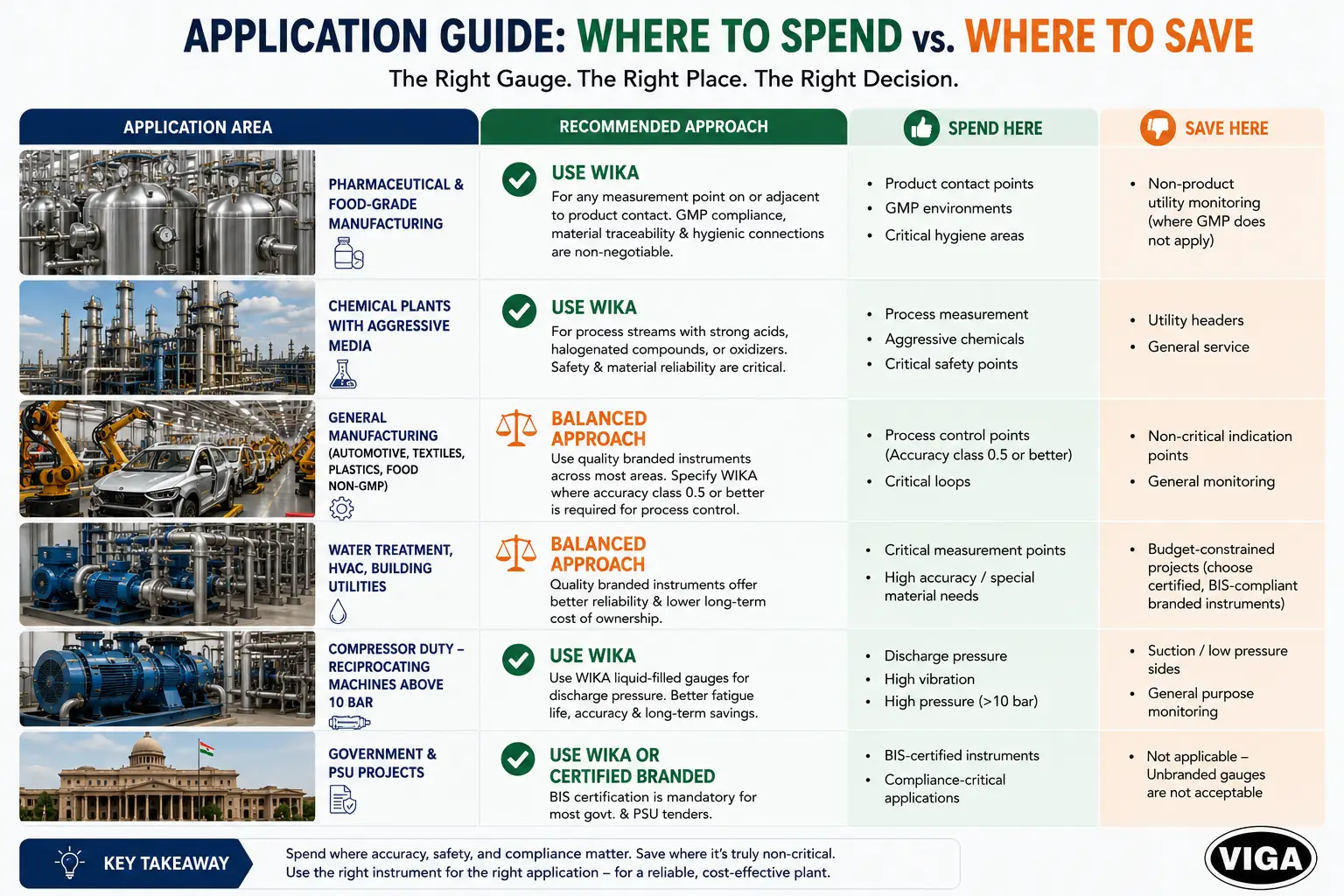
- Pharmaceutical and food-grade manufacturing: WIKA without question for any measurement point on or adjacent to product contact. The GMP requirements for material traceability, hygienic connections, and surface finish cannot be met by low-cost or unbranded instruments. Utility system monitoring — cooling water, plant steam, compressed air, instrument air — can use quality branded alternatives where GMP requirements do not apply to the instruments themselves. But critical product contact measurement points need WIKA-grade specification, period.
- Chemical plants with aggressive media: WIKA for process streams containing strong acids, halogenated compounds, or oxidizers. Quality branded instruments for utility headers and general service. Unbranded gauges have no place in chemical plant process measurement — the material claim on the label cannot be verified, and the consequence of a failed seal in aggressive chemical service is not a gauge replacement, it is a safety incident.
- General manufacturing — automotive, textiles, plastics, food (non-GMP): Quality branded instruments across most of the plant, with WIKA specified where accuracy class 0.5 or better is genuinely required for process control reasons. Low-cost gauges acceptable only on truly non-critical indication points where the consequence of inaccuracy or failure is minimal.
- Water treatment, HVAC, building utilities: Quality branded instruments are the sensible choice. The cost difference over the service life, when replacement frequency and maintenance labour are factored in, is smaller than the headline price gap suggests. For large system procurement where budget genuinely constrains every gauge to a minimum quality tier, the approach should still favour certified, BIS-compliant branded instruments over genuinely unbranded stock.
- Compressor duty — reciprocating machines above 10 bar: WIKA liquid-filled for discharge gauges. The fatigue life advantage on high-pressure reciprocating applications makes WIKA the cost-effective choice over the instrument’s lifetime, even at 3x the purchase price.
- Government and PSU projects: BIS-certified instruments are a mandatory requirement in most government and PSU tenders. Unbranded gauges do not carry BIS certification. This is not a quality preference — it is a compliance requirement.
Service, Availability, and the Grey Market Problem
WIKA operates through authorized distributors who are trained, periodically audited, and required to maintain genuine stock with full documentation capability. The risk with WIKA procurement is the grey market — WIKA instruments are counterfeited and sold in India through unauthorized channels at prices that look attractive. The physical appearance is convincing. The internals and documentation are not. The only way to be certain is to buy from an authorized distributor and ask for documentation.
Low-cost instruments do not have this grey market problem — but only because there is nothing to fake. The absence of a certification trail that could be counterfeited is the same as the absence of a certification trail that verifies quality. These instruments are what they are, priced at what they are, with the service life they deliver.
For Delhi NCR specifically: VIGA (Vinod Gautam Sales) holds authorized distributor status for WIKA, along with Switzer, Indfos, Uflow, Shavo, and other quality brands. Genuine products, valid certificates, technical guidance, and after-sales support across the full product range. Same-day delivery is available on stocked WIKA models. For bulk enquiries, technical consultation before ordering, or help selecting the right quality tier for a specific application — that is the kind of support that authorized distributors provide and market suppliers cannot.
The Final Verdict: Tiered Specification is Key
The Faridabad plant manager’s gauges failed not because he chose a wrong brand. They failed because the procurement decision was made purely on price, without thinking about what those gauges were measuring and what the consequence of a failure was. Boiler drum pressure is not the right place for the cheapest gauge available.
The right approach is tiered specification. Every plant has critical measurement points — loops that feed safety systems, compliance-audited loops, high-accuracy process control loops, and hazardous area instruments. These need WIKA-grade specification: documented accuracy, material traceability, certified construction. Every plant also has a much larger population of general monitoring gauges — utility headers, non-critical process indicators, simple pressure checks — where a quality branded instrument at a competitive price point does the job reliably without the full WIKA premium.
The Faridabad plant manager, after this conversation, specified WIKA on his boiler drum pressure loops, steam header critical points, and the two pressure transmitters feeding his DCS. Quality branded alternatives went on the rest — cooling water, compressed air, instrument air, and general service. His total gauge count was around 60. He ended up with a technically correct, cost-managed installation where the right specification was applied to the right measurement points.
That is the practical outcome of getting this decision right. Not everything needs to be WIKA. But the things that matter need to be.
Ready to specify the right gauges for your plant? VIGA supplies genuine WIKA instruments and quality branded alternatives to plants across Delhi NCR with technical support, calibration documentation, and same-day delivery on fast-moving models. Browse WIKA stock at viga.in/wika-products or WhatsApp directly for specific model availability, pricing, and application guidance.
Frequently Asked Questions (FAQs)
Q1. Is WIKA worth the price compared to cheaper gauges?
For precision and compliance applications — without doubt, yes. For safety-critical loops, GMP-audited measurement points, ATEX-classified areas, and any loop where a wrong reading has a real consequence — the WIKA price is not a premium, it is appropriate cost for the level of risk the instrument is managing. For general utility monitoring where the measurement is indicative and the consequence of inaccuracy is low, a quality branded alternative at a lower price point is a sensible procurement decision. The mistake is applying the cheap option to the critical loop.
Q2. What is the actual total cost of using low-cost gauges?
The purchase price is only part of it. Low-cost gauges in Indian plants typically need replacement every 18 months to 3 years depending on the application. WIKA instruments last 7 to 10 years on process duty. Factor in replacement labour — typically 1 to 2 hours per gauge including re-commissioning and calibration check — and the annual cost gap between a WIKA and a low-cost gauge on moderate-duty service narrows considerably. On severe duty — vibration, aggressive media, outdoor installation — the gap closes further because replacement frequency increases sharply.
Q3. Can a plant use WIKA on some points and cheaper alternatives on others?
Yes, and this is the recommended approach for most plants. The only practical requirement is a clear instrument register that records brand, model, and quality tier at each tag number, so the maintenance team knows what is installed and what the calibration schedule should be. WIKA instruments on critical loops, quality branded alternatives on general service — this is how well-managed Indian plants across Delhi NCR and the rest of the country approach instrumentation procurement. The decision on which points are “critical” needs to be made explicitly and documented.
Q4. How do you spot a fake WIKA gauge?
Ask the supplier for their current WIKA India authorization letter. A genuine authorized distributor has this and will show it without hesitation. Inspect the certificate that comes with the gauge — genuine WIKA certificates have specific formatting, reference numbers, and traceability details that are difficult to replicate convincingly. If the price seems significantly lower than the market rate for WIKA, treat that as a warning sign worth investigating before committing an order.
Vinod Gautam Sales (VIGA) has been supplying process instrumentation to manufacturing, pharmaceutical, chemical, and process industries across Delhi NCR for over 20 years. VIGA is an authorized distributor for WIKA, Switzer, Indfos, Uflow, Shavo, Electropneumatics, and Pilot. For technical guidance, genuine products, and competitive pricing — viga.in.