

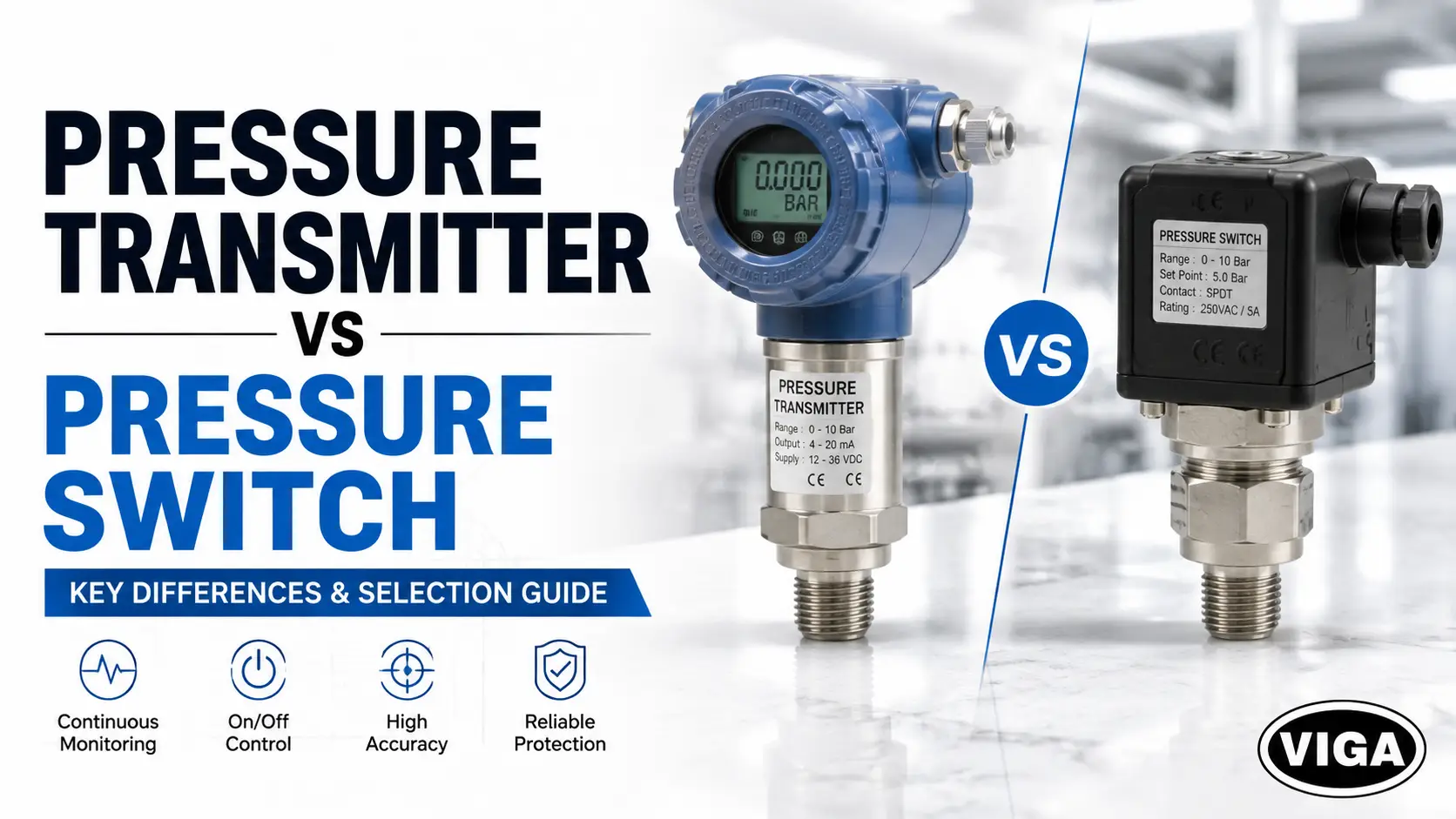
Pressure Transmitter vs Switch: Key Differences & Selection Guide
Pressure Transmitter vs Pressure Switch: Key Differences Explained
One device gives an on/off signal. The other gives a continuous reading. Pick the wrong one and the entire control panel may need rewiring — sometimes after the machine is already mounted, piped, and running on the shop floor.
That single decision sits behind thousands of pressure points across Indian process plants, and getting it right starts with understanding what each instrument actually delivers.
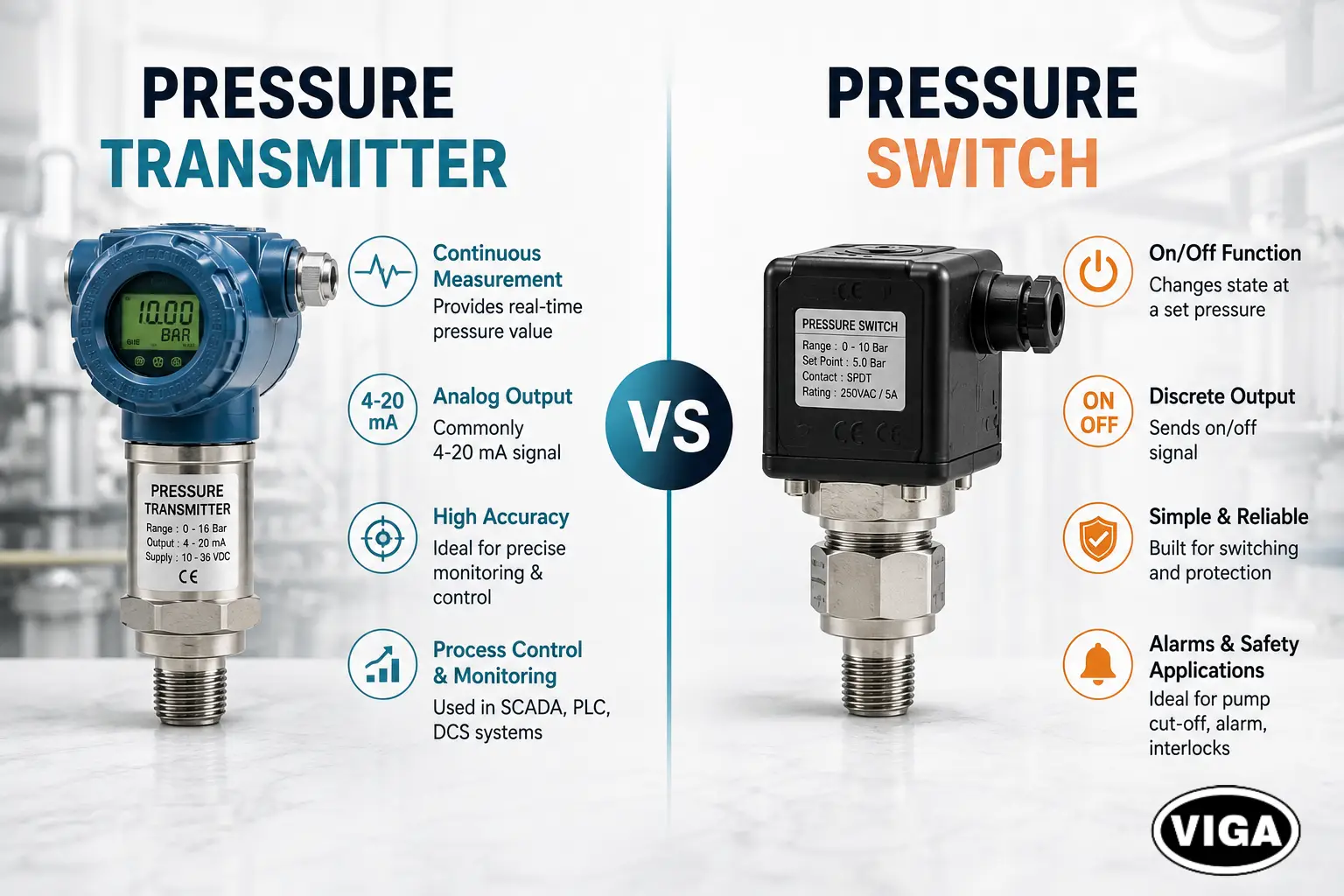
Pressure Switch vs. Pressure Transmitter
Pressure Switch
Outputs a discrete ON/OFF signal that trips at a single fixed setpoint.
Pressure Transmitter
Outputs a continuous 4–20 mA analog signal across its full range for exact values.
The choice of pressure transmitter vs pressure switch is one of the most common crossroads for anyone specifying instrumentation. It looks simple on a datasheet. On a live panel, the difference between transmitter and switch decides wiring complexity, PLC input type, calibration effort, and the cost of every spare held in store. Knowing when to use a pressure switch versus when to use a pressure transmitter separates a clean I/O list from a costly redesign.
This guide walks through both instruments the way a senior commissioning engineer would explain them to a junior on day one.
The Core Difference
A switch gives a yes or no. A transmitter gives the whole story.
Cares about one question: Has pressure crossed the trip point? When it does, contact closes, pump shuts, and a panel lamp glows. Nothing more.
Reports live pressure value — 2.1 bar → 2.4 bar → 2.7 bar — second by second, as a continuous electrical signal for the controller.
Pressure Switch
A threshold device. It acts at a specific setpoint.
Pressure Transmitter
A measurement device. It reports across a full range.
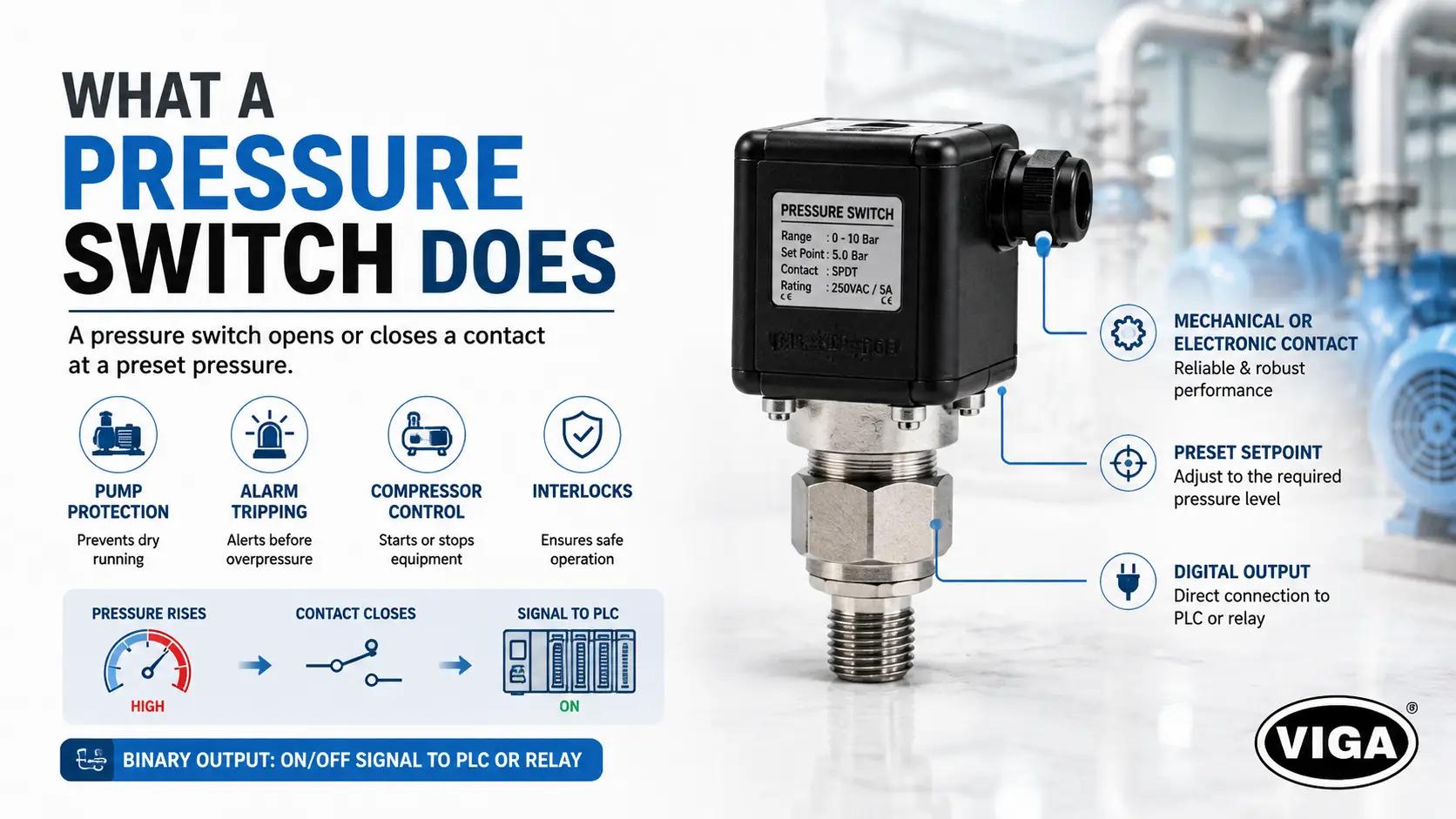
What a Pressure Switch Does
A pressure switch is a mechanical or electronic contact that opens or closes when process pressure reaches a preset value. The output is binary. There is no in-between.
Inside a conventional switch sits a sensing element — a diaphragm, piston, or Bourdon element — linked to a snap-action microswitch. As pressure builds, the element moves. At the pressure switch setpoint, that movement flips the contact. Drop below the reset point and the contact returns. The plant gets a clean digital event: ON or OFF, HIGH or NORMAL.
Where switches earn their place:
- Pump protection — cutting a pump when discharge pressure drops, guarding against dry running.
- Alarm tripping — flagging a high-pressure condition before relief valves lift.
- Compressor control — starting and stopping based on receiver pressure in pneumatic systems across Okhla and Wazirpur workshops.
- Interlocks — preventing a sequence from advancing until a safe pressure is confirmed.
The signal wires straight into a PLC digital input or a relay coil. No analog card. No scaling. The logic engineer simply asks the controller, “Is this contact made?”
Brands like Indfos, Switzer, and Danfoss-class switches distributed through VIGA cover the bulk of this duty in Indian plants, from refrigeration lines to hydraulic power packs. A field anecdote worth remembering: on a hydraulic press line in Mayapuri, a single mis-set switch reset point caused the pump to chatter on and off every few seconds — the device worked perfectly, but the deadband had never been adjusted for the application. The fix took ten minutes. The lost production took a full shift. Switches are simple, but the setpoint and deadband still demand respect.
What a Pressure Transmitter Does
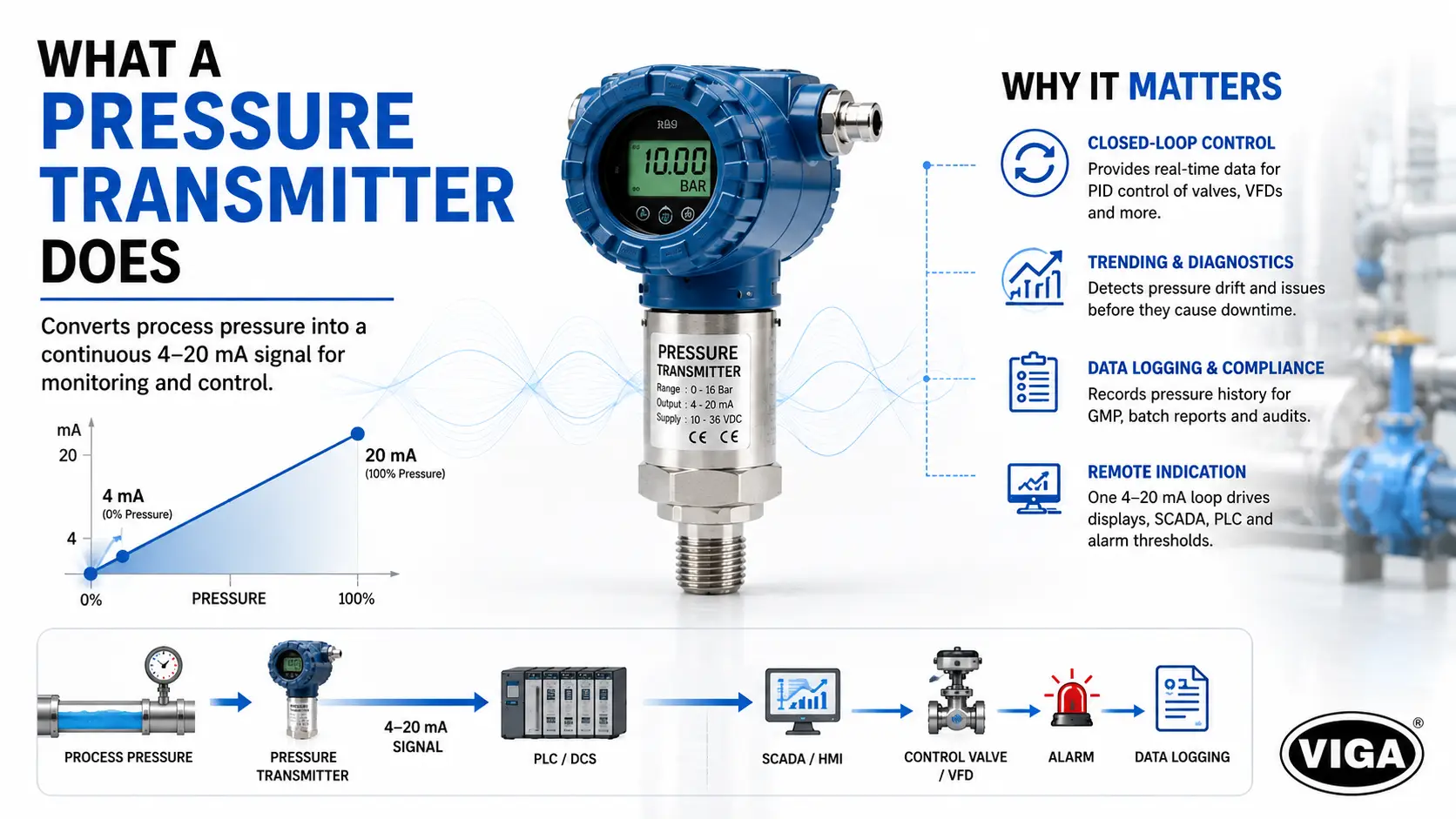
A pressure transmitter converts process pressure into a proportional, continuous electrical signal — most commonly 4–20 mA — that represents the entire measuring span.
The sensing core is usually piezoresistive or capacitive. As pressure changes, the sensor’s electrical property shifts in proportion. Onboard electronics condition that tiny change into a clean, linear current loop. At zero pressure the loop sits at 4 mA; at full scale it reaches 20 mA; every value between maps to an exact pressure. The PLC reads that current, scales it, and now holds a live number for the operator, the trend, and the control algorithm.
This is transmitter continuous monitoring in practice. Instead of a single trip event, the controller sees the full curve — every rise, dip, and oscillation.
Why that matters:
- Closed-loop control — a PID loop needs a continuous measured value to modulate a valve or VFD. A switch cannot supply that.
- Trending and diagnostics — slow pressure drift over weeks reveals a fouling filter or a leaking seal long before a switch would ever trip.
- Data logging and compliance — pharma and food plants in Baddi and Noida need recorded pressure history for batch records and GMP audits.
- Remote indication — one 4–20 mA loop drives a panel display, a SCADA tag, and an alarm threshold simultaneously.
WIKA transmitters from Germany, supplied by VIGA as an authorized distributor, sit on critical lines where accuracy and long-term stability decide product quality. A 4–20 mA transmitter does the work of a sensor, a transducer, and a signal conditioner in one body — which is exactly why it costs more and wires differently than a humble switch.
Signal Comparison: Discrete vs Analog
The cleanest way to see analog vs discrete signal is to look at what reaches the PLC.
Pressure Switch vs. Pressure Transmitter
| Feature | Pressure Switch | Pressure Transmitter |
|---|---|---|
| Output type | Discrete (on/off contact) | Analog (continuous 4–20 mA, sometimes 0–10 V) |
| Information delivered | Single threshold event | Full pressure value across range |
| 4–20 mA vs on/off output | On/off only | 4–20 mA proportional |
| PLC input required | Digital input (DI) or relay | Analog input (AI) card |
| Setpoint | Fixed, one trip point | Software-defined, unlimited thresholds |
| Resolution | None — binary | High, reads every increment |
| Closed-loop control | Not possible | Standard capability |
| Diagnostics / trending | None | Full trend history |
| Typical accuracy | Repeatability, not precision | ±0.25% to ±0.5% of span |
The practical takeaway around PLC pressure input is this: a switch consumes a cheap digital channel, while a transmitter needs an analog input card that costs more per point and demands correct scaling in the program. Plan the I/O list early. Discovering halfway through panel wiring that twelve transmitters were budgeted as switches — and the analog card slots simply do not exist — is a familiar and avoidable headache.
There is a deeper point hidden in the table. A transmitter’s analog signal can be used to create any number of switch points in software. One 4–20 mA loop can raise a low alarm, a high alarm, and a trip — all in PLC logic, all adjustable without touching a wire. A physical switch can never be turned into a transmitter. Signal richness only flows one direction.
Cost & Wiring Comparison
Money and labour usually decide the final call, so weigh the cost of transmitter vs switch honestly — across the whole life of the point, not just the purchase order.
Switch economics
- Lower unit price, often a fraction of a transmitter’s cost.
- Two wires to a digital input or relay. Minimal terminations.
- No analog card consumed.
- Setpoint adjusted mechanically once; little ongoing calibration on basic units.
- Spares are inexpensive and easy to stock in depth.
Transmitter economics
- Higher unit price, reflecting the sensor and electronics inside.
- Two-wire loop, but into a more expensive analog input channel.
- Periodic calibration against a reference to hold accuracy.
- One device replaces a sensor, gauge, and multiple alarm points combined.
- Fewer instruments overall when several thresholds are needed on one line.
Here lies the trap that catches procurement teams. A switch looks cheaper on the line item. Yet a process line needing a low alarm, a high alarm, and a control point would require three separate switches — three penetrations, three wiring runs, three calibration tasks. A single transmitter handles all three in software. Counted that way, the transmitter often wins on total installed cost, not just on capability.
The reverse is equally true. For a lone pump cut-off that needs nothing but a trip, fitting a transmitter and an analog card is paying for a full orchestra to play one note. The cost transmitter vs switch answer is never universal — it depends entirely on how much information that point actually has to deliver.
When to Choose a Switch
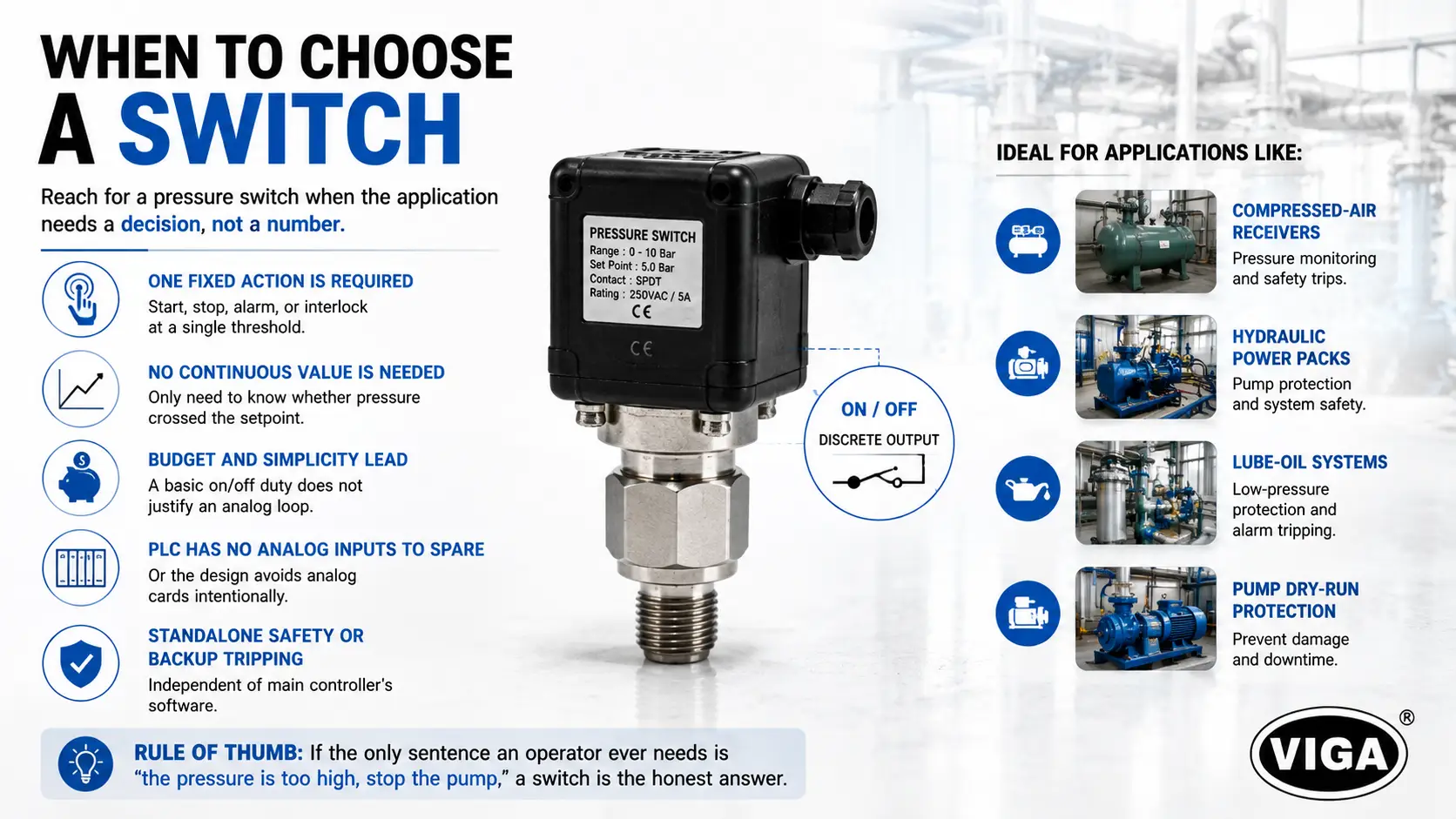
Reach for a pressure switch when the application needs a decision, not a number.
A switch is the right call when:
- One fixed action is required — start, stop, alarm, or interlock at a single threshold.
- No continuous value is needed — nobody has to know the exact pressure, only whether it crossed a line.
- Budget and simplicity lead — a basic on/off duty does not justify an analog loop.
- The PLC has no analog inputs to spare, or the design intentionally avoids analog cards.
- Standalone safety or backup tripping is wanted, independent of the main controller’s software.
Compressed-air receivers, hydraulic power packs, lube-oil low-pressure trips, and pump dry-run protection across countless Delhi NCR units run perfectly on well-chosen switches. The instrument does exactly one job and does it reliably for years. Adding a transmitter there buys complexity nobody uses.
A grounded rule of thumb from the field: if the only sentence an operator ever needs is “the pressure is too high, stop the pump,” a switch is the honest answer.
When to Choose a Transmitter
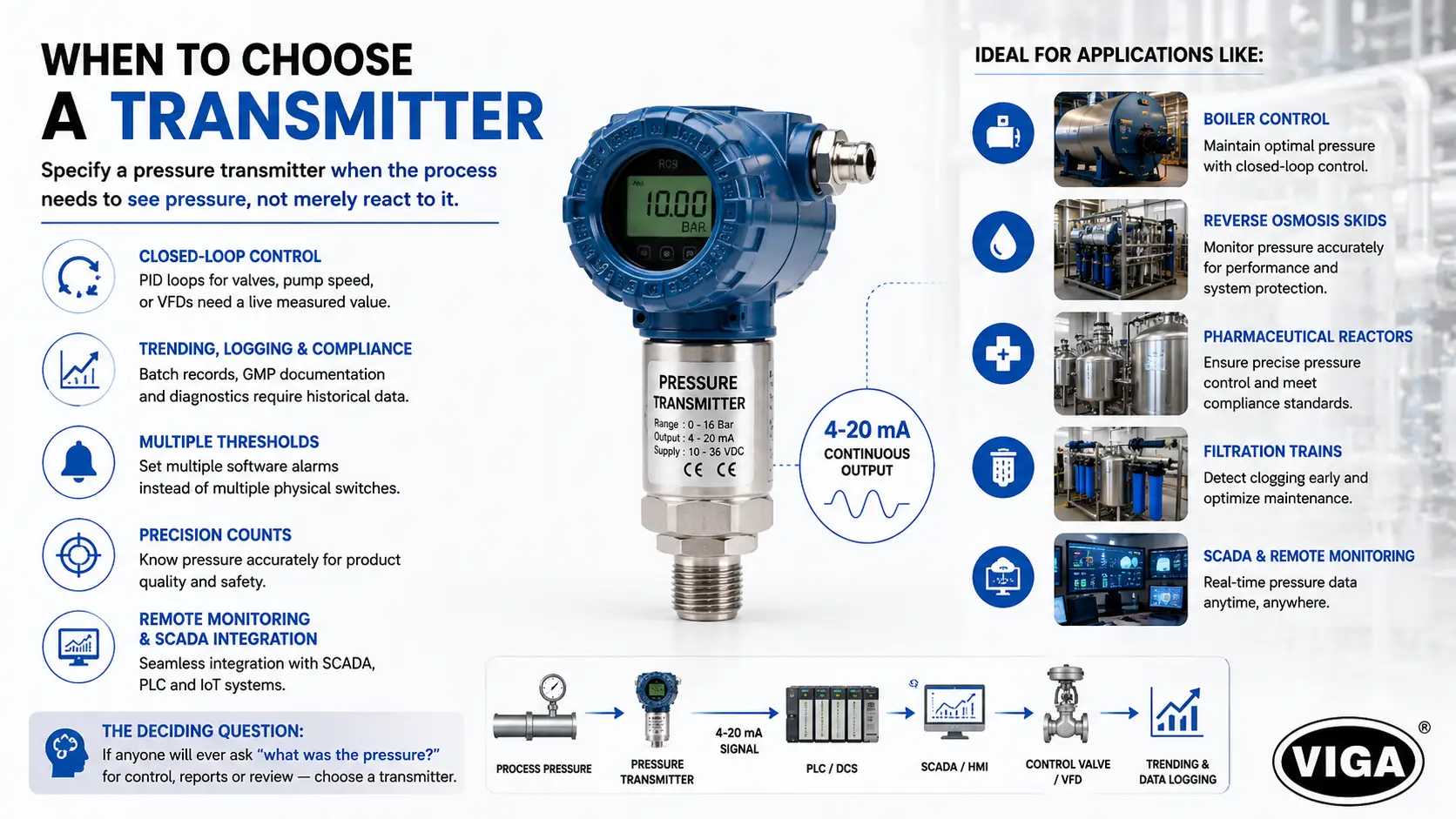
Specify a pressure transmitter when the process needs to see pressure, not merely react to it.
A transmitter is the right call when:
- Closed-loop control is involved — a PID loop modulating a valve, pump speed, or VFD demands a live measured value.
- Trending, logging, or compliance matters — batch records, GMP documentation, or maintenance diagnostics require historical data.
- Multiple thresholds are needed on one line — several software alarms beat several physical switches.
- Precision counts — product quality or safety margins hinge on knowing pressure to within a fraction of a percent.
- Remote monitoring or SCADA integration is part of the scope.
Boiler control, reverse-osmosis skids, pharmaceutical reactors, filtration trains, and any line feeding a control loop belong to the transmitter. On a filtration skid in a Gurgaon plant, a transmitter’s slow upward drift over two weeks flagged a clogging cartridge days before pressure would ever have tripped an alarm — a diagnostic insight a switch structurally cannot provide.
The deciding question is forward-looking. If anyone will ever ask “what was the pressure?” — for control, for a report, or for a post-incident review — the transmitter is the only instrument that can answer.
Can You Use Both Together?
Often the strongest design uses both, each playing to its strength. This is not a contest with one winner.
A common and robust arrangement on critical lines:
- A transmitter handles continuous monitoring and feeds the control loop with a live 4–20 mA value.
- A pressure switch sits in parallel as an independent hardwired safety trip.
The logic is sound. The transmitter runs the process and gives full visibility. The switch provides a last line of defence that does not depend on the PLC’s analog input, the software, or the program scan running correctly. If the controller hangs or the analog card fails, the switch still trips the pump or opens the relief path on its own contact.
Safety-critical lines in pharma and chemical plants frequently mandate exactly this layered approach. The transmitter is the eyes; the switch is the reflex. One sees everything; the other acts even when everything else has gone quiet. For genuine process control pressure safety, redundancy across two signal types is a feature, not a duplication.
A practical example makes the pairing concrete. On a steam header in a Kirti Nagar processing unit, a transmitter feeds the burner control loop and trends pressure on the operator screen, while a separate high-pressure switch trips the fuel valve through a dedicated hardwired relay. During a controller firmware update that briefly froze the analog scan, the switch held the safety line on its own — the loop went blind for a few seconds, yet the trip protection never wavered. That is the quiet payoff of running both: the process keeps its intelligence and its instincts in separate hands.
FAQ: Transmitter vs Switch
Q1. Transmitter vs Switch Which is cheaper?
A pressure switch is cheaper on the purchase order, typically costing a fraction of a transmitter, and it consumes only a low-cost digital input. The picture changes across the full installation. When a single line needs several alarm or control points, one transmitter can replace multiple switches and their separate wiring and calibration, often making the transmitter the lower total-installed-cost choice. For a single on/off duty, the switch stays the cheaper option by a clear margin.
Q2. Can a transmitter replace a switch?
Yes — and it does so flexibly. A transmitter’s continuous 4–20 mA signal lets the PLC create as many software setpoints as needed, each acting like a switch trip but adjustable without rewiring. The reverse is impossible: a switch can never produce a continuous reading. The one caution is independence. A software trip relies on the controller running correctly, so safety-critical applications often keep a hardwired switch as a backup even when a transmitter is present.
Q3. Which for safety trip?
For a true safety trip, a hardwired pressure switch is the standard choice because it acts independently of the PLC, its software, and its scan cycle. The contact closes and the pump stops or the relief activates regardless of whether the controller is healthy. Best practice on critical lines pairs a transmitter for monitoring and control with a separate switch dedicated solely to the safety trip, giving two independent layers of protection.
Specifying the Right Instrument
The pressure transmitter vs pressure switch decision comes down to a single question asked early: does this point need a number, or just a decision?
A switch trips at a setpoint and reports on/off — perfect for alarms, interlocks, and standalone safety. A transmitter reports the full pressure value as a continuous 4–20 mA signal — essential for control loops, trending, compliance, and precision. Many of the best panels use both, letting the transmitter watch the process while a switch guards it. Settle the answer before the I/O list is locked, and the wiring, the PLC cards, and the spares all fall into place without a costly redesign later.
VIGA (Vinod Gautam Sales) supplies both across its instrumentation range — pressure switches from Indfos, Switzer, and other trusted brands as an authorized distributor, alongside WIKA pressure transmitters from Germany for high-accuracy and critical-line duties. Selection support is available for matching the right range, output, and process connection to each application, so the device on the datasheet is the device the line actually needs.
Browse pressure transmitter and switch ranges, or request selection help for a specific application:
- VIGA (Vinod Gautam Sales) — 20 Chawri Bazar, Delhi – 110006
- Phone: +91-11-43025959 / +91-11-41582888
- Email: [email protected] / [email protected]
- Web: viga.in