

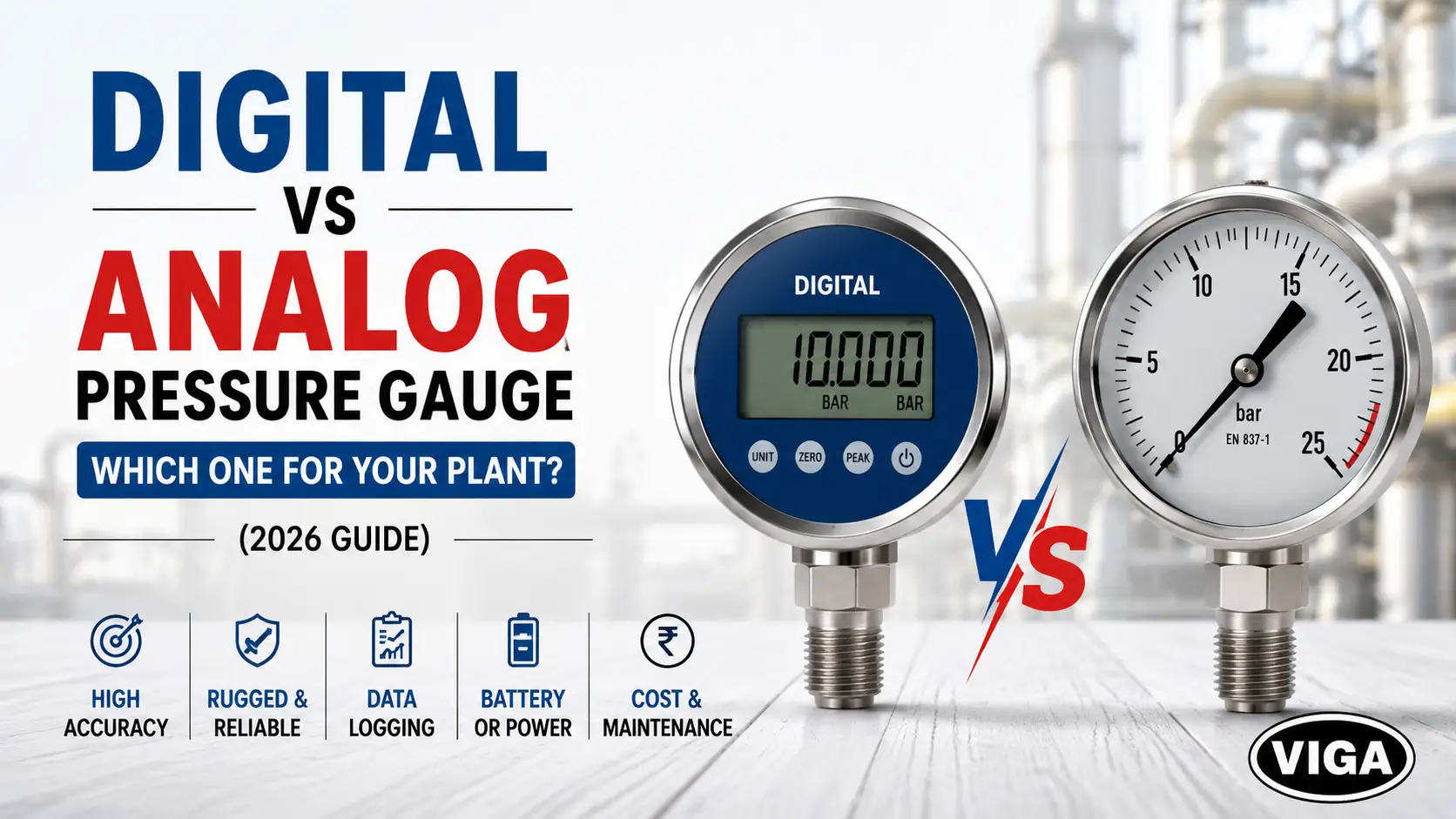
Digital vs Analog Pressure Gauge: Plant Engineers Guide
Digital vs Analog Pressure Gauge: Which One for Your Plant? (2026 Guide)
Digital isn’t automatically better. Replace a working dial with the wrong digital gauge and the plant finds out the expensive way — usually on a vibrating compressor skid, two monsoon seasons in, with a cracked display and a sensor that gave up.
The digital vs analog pressure gauge decision gets sold as old-versus-new, as if every needle on a header is overdue for retirement. That story moves inventory. It does nothing for the engineer at a pump discharge trying to spec something that will still be readable a year from now. The real choice turns on four things: what the gauge has to read, where it’s mounted, who reads it, and whether the number ever has to be written down.
Choose a digital pressure gauge for calibration, precise setpoints, and any point that needs logged data — top accuracy reaches ±0.05%. Choose a liquid-filled analog gauge for vibration, pulsation, high heat, or unpowered remote points, where it runs for years with no battery and no electronics to fail.
That capsule covers roughly 90% of purchase decisions. The rest of this guide is the why behind it — the digital pressure gauge advantages worth paying for, the analog gauge reliability that still wins corners of every plant, and exactly when to use a digital pressure gauge instead of reaching for the cheaper dial out of habit.
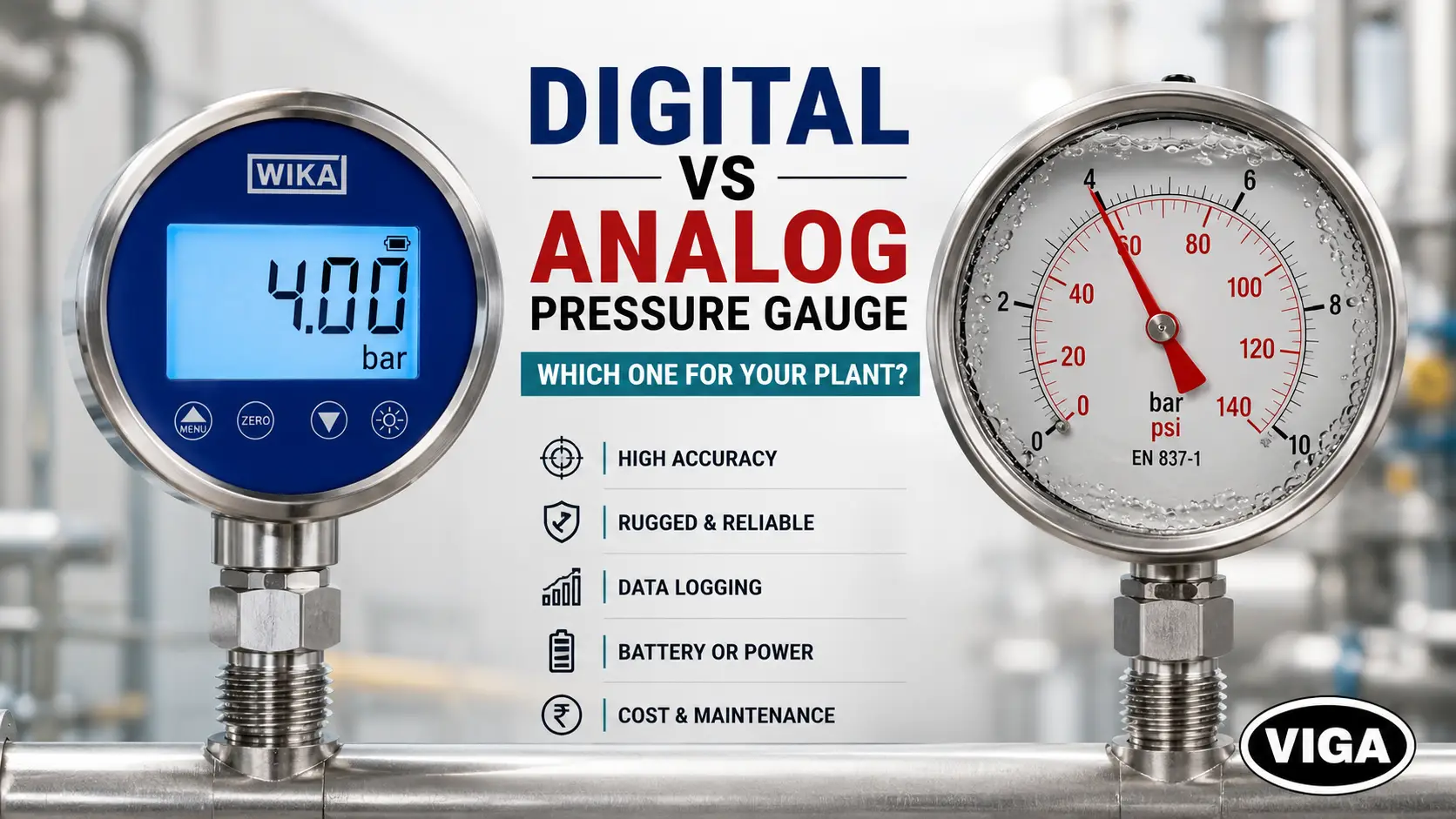
| Factor | Analog Gauge | Digital Gauge |
|---|---|---|
| Power needed | None | Battery or loop power |
| Typical accuracy | ±1.0% to ±2.5% of full scale (test grade: ±0.25%) |
±0.5% to ±0.1% (reference grade: ±0.05%) |
| How it reads | Pointer — trend visible at a glance | Numeric — precise, no parallax |
| Vibration & pulsation | High tolerance (liquid-filled) | Moderate — needs a snubber or damping |
| Data logging / peak hold | No | Yes — min, max, peak, recorded logs |
| Output signal | None (purely mechanical) | 4–20 mA / switch contacts available |
| Temperature range | Wide | Limited by display and battery |
| Upfront cost | Lower | Higher |
| Ongoing maintenance | Minimal | Battery changes + recalibration |
| Lives best on | Vibration, no-power, bulk monitoring | Calibration, precise setpoints, records |
Read that table and the split is obvious: digital buys precision and memory, analog buys ruggedness and independence. Procurement teams that pick one answer for the whole plant overpay on one side and under-spec on the other.
Bourdon Tube vs Pressure Sensor: What’s Actually Reading the Pressure
The two gauges behave differently because different things are moving inside them.
An analog pressure gauge runs on a Bourdon tube — a curved, flattened metal tube that straightens as pressure builds inside it. That movement is geared up to a pointer sweeping a printed dial. No electronics sit in the signal path. Pressure in, metal flexes, needle moves. Process dials follow EN 837-1, the standard that also fixes the accuracy classes (2.5, 1.6, 1.0, and the tighter test classes 0.25 and 0.1). Flood the case with glycerine or silicone and the same gauge laughs off vibration that would shake a dry pointer into a useless smear.
A digital pressure gauge drops the dial mechanism and uses a sensing element — usually piezoresistive or strain-gauge — to turn pressure into a small electrical signal. Onboard electronics condition it, compensate for temperature, and print a number on an LCD. Because the reading is calculated rather than mechanical, the same unit can hold a peak, log a trend, or push 4–20 mA to a control system. None of that happens without power, which is the quiet line every glossy spec sheet skips past.
Flexing metal versus a powered sensor — that single difference explains every win and every weakness below.
Why Vibrating Pump Skids Shatter Digital Displays
Mount a dry digital gauge on a reciprocating compressor or a pump discharge full of pulsation and the electronics never forgive it. The number jumps, the sensor takes fatigue it was never sized for, and the display ages in months. To prevent this equipment fatigue, understanding proper industrial gauge maintenance and calibration cycles is mandatory.
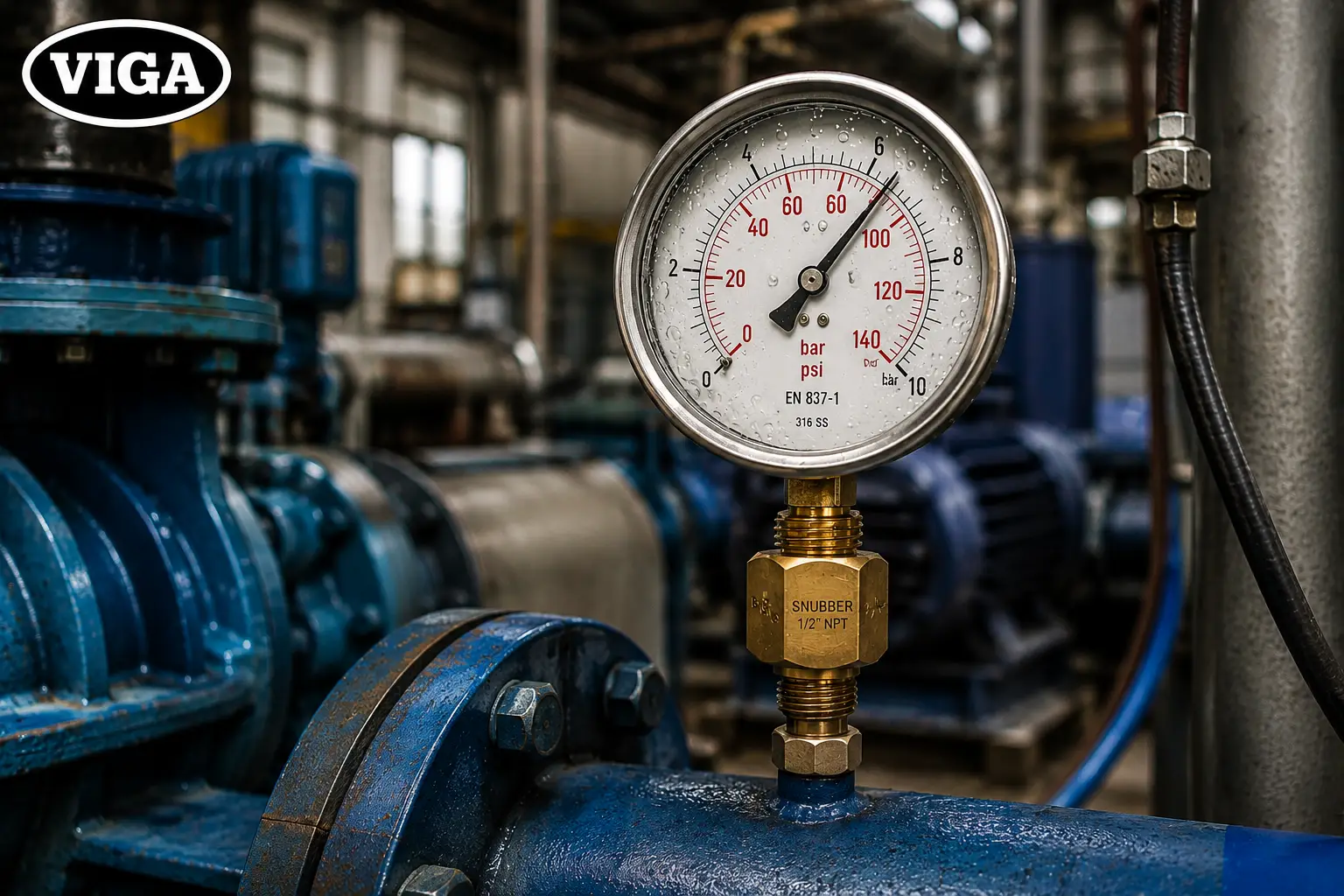
Take a reciprocating air compressor in a Faridabad auto-component unit. A plant that swapped its tired liquid-filled dials for sharp new digital gauges had three displays cracked or reading garbage inside two monsoon seasons — unfilled cases couldn’t absorb the hammering, and the sensors wore out under constant pulsation. The dials that had come off, glycerine-filled and a decade old, were still dead accurate on the test bench. What finally stayed on the machine were liquid-filled analog gauges with a snubber fitted — exactly what the old maintenance hands had specified before anyone went chasing displays.
This is where analog gauge reliability stops being nostalgia and becomes physics. The fill fluid damps the pointer, kills the flutter, and shields the movement from pulsation and shock. High ambient heat tells the same story — the kind of temperature that slows an LCD or drains a battery barely registers on a Bourdon tube. For vibrating, hot, wet, dusty corners of a plant, the dial isn’t the legacy option. It’s the correct one.
The Failure Mode That Simply Doesn’t Exist on a Dial
The most underrated line on an analog spec sheet is the one that isn’t printed: no battery, no power supply, no firmware. Nothing to discharge, freeze, or crash.
Then there is the gauge nobody looks at until it matters. A fire-water header at a Wazirpur rolling mill carried a battery digital gauge that had quietly died months earlier. The day a safety check actually needed it, the display showed nothing — no reading, no warning, just a dead point on a critical line. Its replacement was a plain analog dial: no battery to outlive, no power point to wire, correct every time someone finally walks up to it.
Multiply that across a plant. The dozens of “confirm it’s pressurised” points — utility headers, isolation valves, seasonal skids, remote lines — don’t need precision. They need to be right whenever someone reads them, at the lowest sensible cost. Analog owns that job. Boring, in instrumentation, is a compliment.
Why Calibration Benches Refuse to Run on Analog
Flip to the other side of the plant and the dial loses badly.
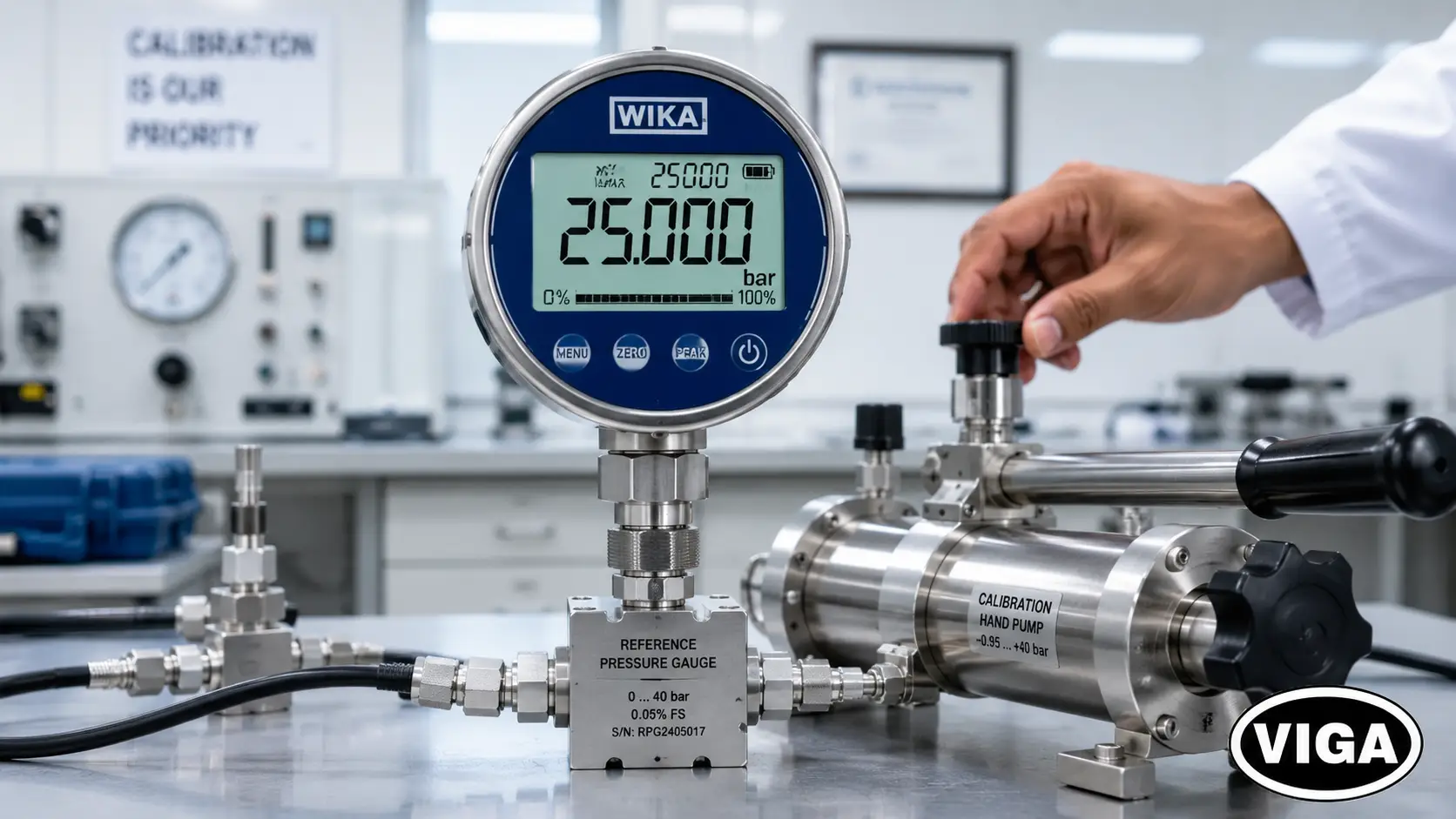
Anything involving calibration leans digital, and it isn’t close. A digital gauge for calibration reads in clean numeric resolution — no parallax, no two technicians arguing whether the needle is on the line or just past it. A different problem walks into VIGA’s Chawri Bazar counter every audit season: a procurement engineer from an Okhla formulation unit, fighting his own analog test gauges during a customer qualification. Two technicians, two readings off the same dial, parallax doing the damage and the audit clock running. A digital reference gauge ended the argument — one number, traceable, no interpretation.
The accuracy gap is real and worth understanding. Digital pressure gauge accuracy is usually quoted as a percentage of reading, not of full scale. On a 0–25 bar instrument sitting at 4 bar, that distinction is the difference between a number you can defend and a tolerance band wider than the reading itself. WIKA digital pressure gauges, the reference and test instruments VIGA supplies as an authorized distributor, reach down to ±0.1% and ±0.05% on that basis — which is exactly why calibration labs and instrument workshops standardise on digital and leave the dials on the equipment.
When the Gauge Has to Remember What Happened
The second decisive digital advantage is memory. A data logging pressure gauge captures what happens when nobody is watching — the spike at startup, the slow creep before a relief valve lifts, the cyclic peaks quietly wearing a system down.
Min/max and peak-hold turn one instrument into a small diagnostic tool. Commissioning a new line, chasing an intermittent fault, or proving to an auditor that a process stayed inside limits for eight hours — that captured data is worth more than a fistful of spot readings scrawled on a logsheet. An analog dial shows the present moment cleanly and remembers nothing the second the needle moves.
Output signals belong on this list too. When a reading has to reach a PLC or SCADA screen, a digital gauge with 4–20 mA or switch contacts does the job a mechanical dial physically cannot — often saving a separate transmitter on the bill of materials.
How Does Analog vs Digital Accuracy Actually Differ in the Field?
The analog pressure gauge vs digital accuracy comparison gets misread constantly, because the two are quoted on different bases.
Standard process dials sit at class 1.0 — ±1% of span — with utility gauges at 1.6 or 2.5. That sounds loose next to digital, until the comparison includes test-grade analog at ±0.25%, which holds its own against mid-range digital and needs no power to do it.
Digital’s edge is twofold. The headline numbers go tighter, down to ±0.05% on WIKA reference instruments. And the “% of reading” basis keeps accuracy meaningful across the lower two-thirds of the range, where an analog gauge quoted as ±1% of full scale carries that same absolute error whether the needle sits at 90% or 10% of the dial.
Settled honestly: for a precise, traceable, low-end-of-scale reading, digital wins on paper and on the bench. For a confirmation reading on a robust dial where ±1% is plenty, accuracy was never the issue — buying ±0.05% for a cooling-water line is paying for precision the application will never touch. One caveat binds both types: accuracy drifts. A digital sensor needs recalibration just as a Bourdon tube does. Neither is fit-and-forget when the number genuinely matters.
The Price Tag Lies: Real Cost Over a Gauge’s Life
A purchase manager comparing the cost of digital vs analog gauge on the quote alone is reading half the story.
Upfront, analog is cheaper — often by a wide margin on standard process gauges, and the gap widens buying in quantity for a plant-wide install. No electronics, no display, no battery to price in.
Digital costs more to buy, and the lifecycle adds line items analog never triggers. Battery life on a digital gauge is the obvious one: field units typically deliver around 1,500 to 3,000 operating hours, and auto power-off can stretch real service to a year or more on intermittent use. Loop-powered digital gauges dodge the battery entirely by drawing from the control loop. Either way, the maintenance plan has to carry a replacement cycle that a dial doesn’t have.
Where digital earns the premium back is in data and labour. A reference gauge that shortens calibration and ends reading disputes pays for itself in a lab. A logging gauge that pins an intermittent fault in a day saves a week of guesswork. A gauge feeding the control system removes a transmitter from the BOM. On the points where accuracy and records carry consequences, total cost of ownership often favours digital despite the sticker. On the hundred ordinary monitoring points where they don’t, analog’s low capex and near-zero opex win the math comfortably. The cheapest plant-wide outcome is almost always a mixed fleet, costed gauge by gauge.
Gauge-by-Gauge: What Goes Where on a Real Plant
Stripped of theory, here is how the call usually falls on actual equipment.
- Reciprocating compressors, pump discharge with pulsation, hydraulic shock — liquid-filled analog, every time. If a numeric reading is also required, pair digital with a proper snubber, but the dial is the safe default.
- Calibration labs, test benches, instrument workshops — digital reference gauge. Resolution and % of reading make this non-negotiable.
- Process points feeding SCADA or a PLC — digital with 4–20 mA output, or a transmitter beside a local dial for at-a-glance backup.
- Pharma, food, and clean utilities under audit — digital with data logging, to satisfy traceability and documentation.
- Compressed air headers, cooling water, general utility monitoring — standard analog. Robust, cheap, accurate enough.
- Fire water, isolation valves, remote or seasonal skids — analog. No battery means no dead gauge waiting on arrival.
- High ambient heat or harsh outdoor exposure — analog holds where electronics and batteries struggle.
The consistent read: the best pressure gauge type is the one matched to its mounting point, not the one with the newest screen. Most well-run plants deliberately carry both.
FAQ: Digital vs Analog Pressure Gauge
Q1. Are digital pressure gauges more accurate than analog?
Generally, yes. Field digital gauges reach ±0.25% to ±0.5%, and WIKA reference models go to ±0.05% — against ±1% for a standard dial. The gap narrows against test-grade analog at ±0.25%. Digital’s bigger practical edge is the “percentage of reading” basis, which keeps the error meaningful at the low end of the scale, where a full-scale analog spec is weakest.
Q2. How long does the battery last on a digital pressure gauge?
Field digital gauges commonly run around 1,500 to 3,000 operating hours, and auto power-off can extend real service to a year or more under intermittent use. Loop-powered digital units remove the battery question entirely by drawing from the control loop. Either way, build a replacement cycle into the maintenance plan — an analog gauge needs none.
Q3. Which type is better for calibration work?
Digital. A digital reference gauge offers the resolution, percentage-of-reading accuracy, and peak-hold the work depends on, with no parallax error between technicians. This is the one application where analog rarely competes, outside the very best test-grade dials.
Q4. Specifying the Right Gauge for Your Plant
The digital vs analog pressure gauge question has no single winner because the plant floor has no single condition. Digital wins where precision, data, and traceability decide outcomes. Analog wins where vibration, power, heat, and cost decide them. The teams that get it right stock both and place each where it belongs — and they lean on a supplier who can tell the difference before the gauge ships, not after it fails. You can speak directly with the technical team at VIGA to get a custom application audit for your plant facility.
That is the role VIGA (Vinod Gautam Sales) has played from Chawri Bazar, Delhi, for over two decades. The analog pressure and vacuum gauges manufactured by VIGA — built in India to standard and test accuracy classes, with liquid-filled options for vibration-prone service — cover the rugged, no-power, bulk-monitoring side of any installation. For high-accuracy, data-logging, and calibration needs, WIKA digital pressure gauges, supplied through VIGA as an authorized distributor, bring German-engineered precision to the points that earn it.
Browse the full analog and digital pressure gauge ranges at www.viga.in, or talk the application through with the technical team before you buy:
VIGA (Vinod Gautam Sales) 20, Chawri Bazar, Delhi – 110006 Phone: +91-11-43025959 / +91-11-41582888 Email: [email protected] Web: www.viga.in