
Draft Gauges Explained: Measuring Low Pressure in Boilers, Furnaces & HVAC Systems
What is a Draft Gauge?
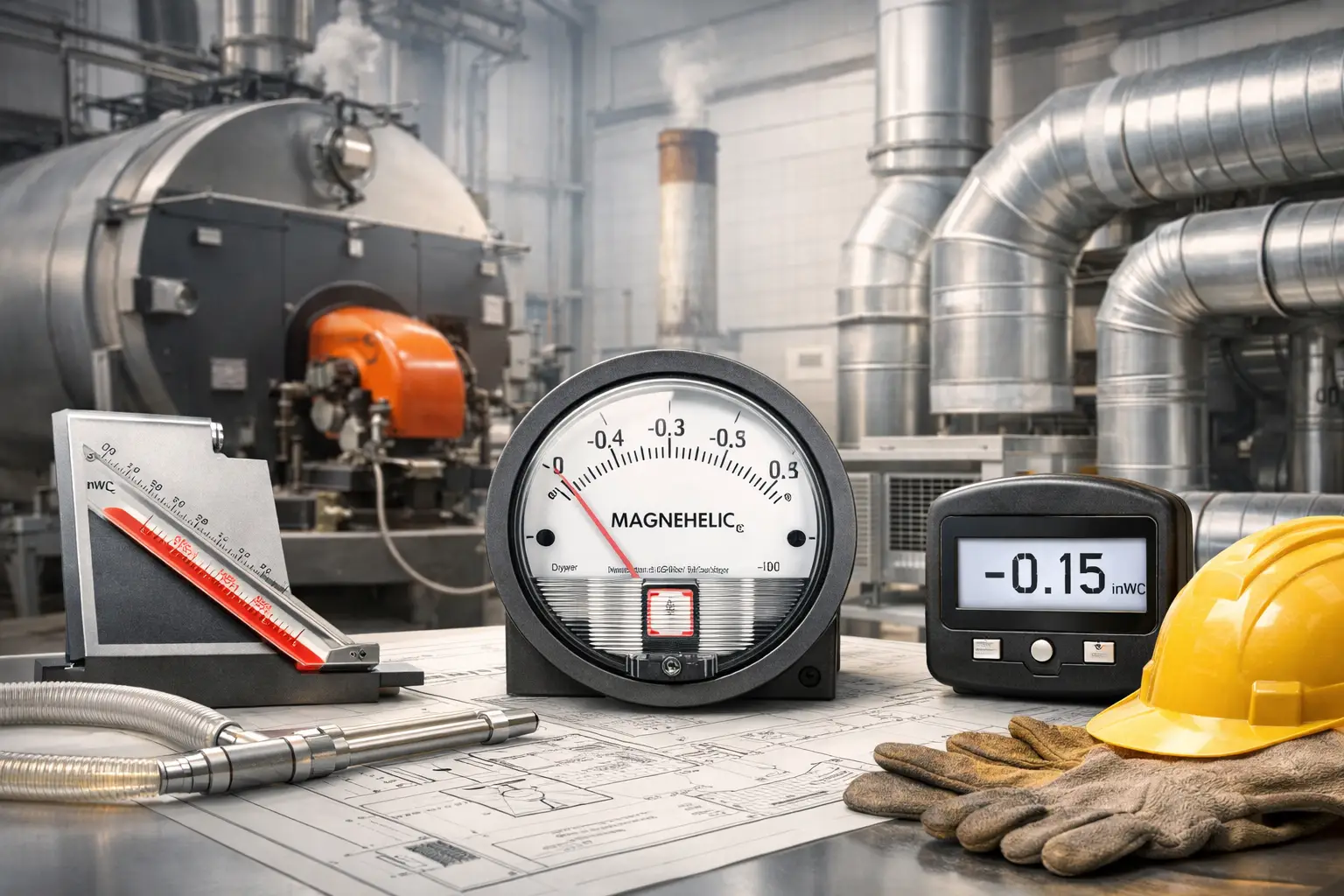
A draft gauge is a high-sensitivity instrument designed specifically to measure extremely low static pressure or differential pressure (draft) within combustion chambers, HVAC ducts, and stacks. Unlike standard pressure gauges, these devices track minute variations—typically measured in inches of water column (inWC), millimeters of water column (mmWC), or Pascals—to optimize air-fuel ratios, monitor filter loading, and ensure safe boiler operation.
In the industrial world, the most dangerous pressure isn’t always high pressure—it is often the invisible, microscopic pressure drop that suffocates a furnace or ruins HVAC efficiency. You cannot use a standard Bourdon tube gauge on a boiler stack because the pressure is simply too faint; it would sit at zero while your fuel bill climbs.
Whether you are troubleshooting a tripped burner or commissioning a cleanroom, understanding how draft gauges actually operate is critical for industrial safety and energy efficiency.
The Engineering Logic: What Actually is a Draft?
Before looking at the tool, look at the physics. “Draft” isn’t just wind; it’s the pressure difference that moves air or flue gases from one point to another. In a boiler, it’s the force pulling combustion gases up the stack. In HVAC, it’s the push moving conditioned air through a filter.
Standard gauges measure pounds per square inch (PSI). Draft gauges live in the world of the fractions of an inch. We are talking about forces so subtle that a gust of wind across a sensor tip can skew the reading.
There are three states you will monitor:
- Positive Draft: Pressure is higher than the atmosphere (common in forced draft fans).
- Negative Draft (Vacuum): Pressure is lower than the atmosphere (vital for induced draft boilers to prevent exhaust leaks).
- Neutral/Balanced Draft: Equilibrium, often found in specific zones of balanced draft boilers.
Expert Pro-Tip:
“Stop confusing static pressure with velocity pressure. A draft gauge measures static pressure (the bursting force). If you need to measure air speed (velocity), you must pair your draft gauge with a Pitot tube. Using the wrong setup creates meaningless data.”
Working Principles: Mechanics vs. Diaphragms
How do these devices catch such weak signals? It comes down to two main technologies: the classic fluid-based approach and the modern dry-diaphragm method.
Inclined Manometer (The “Old Faithful”)
Go into any power plant built before 2000, and you’ll see these. An inclined manometer stretches the vertical liquid column sideways. By tilting the tube, a 1-inch vertical rise looks like a 10-inch movement along the scale. This geometry amplifies the reading, making it visible to the human eye.
- Pros: No moving parts, highly reliable, calibration barely shifts.
- Cons: Messy fluids, must be perfectly level, hard to integrate into automation.
Diaphragm Draft Gauge (Magnehelic Style)
This is the industry standard today (think Dwyer Magnehelic). Inside the casing, a friction-free silicone diaphragm acts like a sensitive lung. When low pressure hits one side, the diaphragm flexes. That motion moves a magnet, which turns the pointer helix.
- Pros: Instant response, can hold significant overpressure without blowing up, easier to install.
- Cons: Mechanical wear over time; susceptible to vibration.
Digital Draft Gauges
Uses a piezo-resistive sensor to convert pressure into an electric signal. Essential if you need 4-20mA outputs for a DCS (Distributed Control System) or BAS (Building Automation System).
Critical Applications in Heavy Industry
You don’t install a low pressure gauge just for fun. It serves a specific safety and financial function in these three sectors.
Boiler Draft Gauge Optimization
Boiler efficiency is a math problem. You need the perfect amount of air (oxygen) to burn the fuel.
- Too much draft: You suck the heat right out of the stack. You are paying to heat the sky.
- Too little draft: The flame suffocates. You get incomplete combustion, soot buildup, and dangerous carbon monoxide (CO) accumulation.
- Safety Hazard: In a positive pressure furnace, a lack of draft can force flames out of the viewport, injuring the operator. A proper boiler draft gauge alerts you before this happens.
Furnace Draft Control
Similar to boilers, metallurgical furnaces require precise atmosphere control.
- Negative Pressure: Keeps toxic fumes inside the furnace.
- Uniform Heating: Proper draft ensures heat distributes evenly, preventing cold spots in the metal treatment process.
HVAC Air Flow & Filter Status
In commercial HVAC, the HVAC draft gauge is usually a differential pressure instrument. It measures the drop across a filter bank.
- Clean Filter: Low resistance (e.g., 0.1 inWC).
- Dirty Filter: High resistance (e.g., 1.0 inWC).
- The Logic: Operators mark a “red line” on the gauge. When the needle hits it, change the filters. It stops you from changing expensive filters too early or starving the fan by waiting too long.
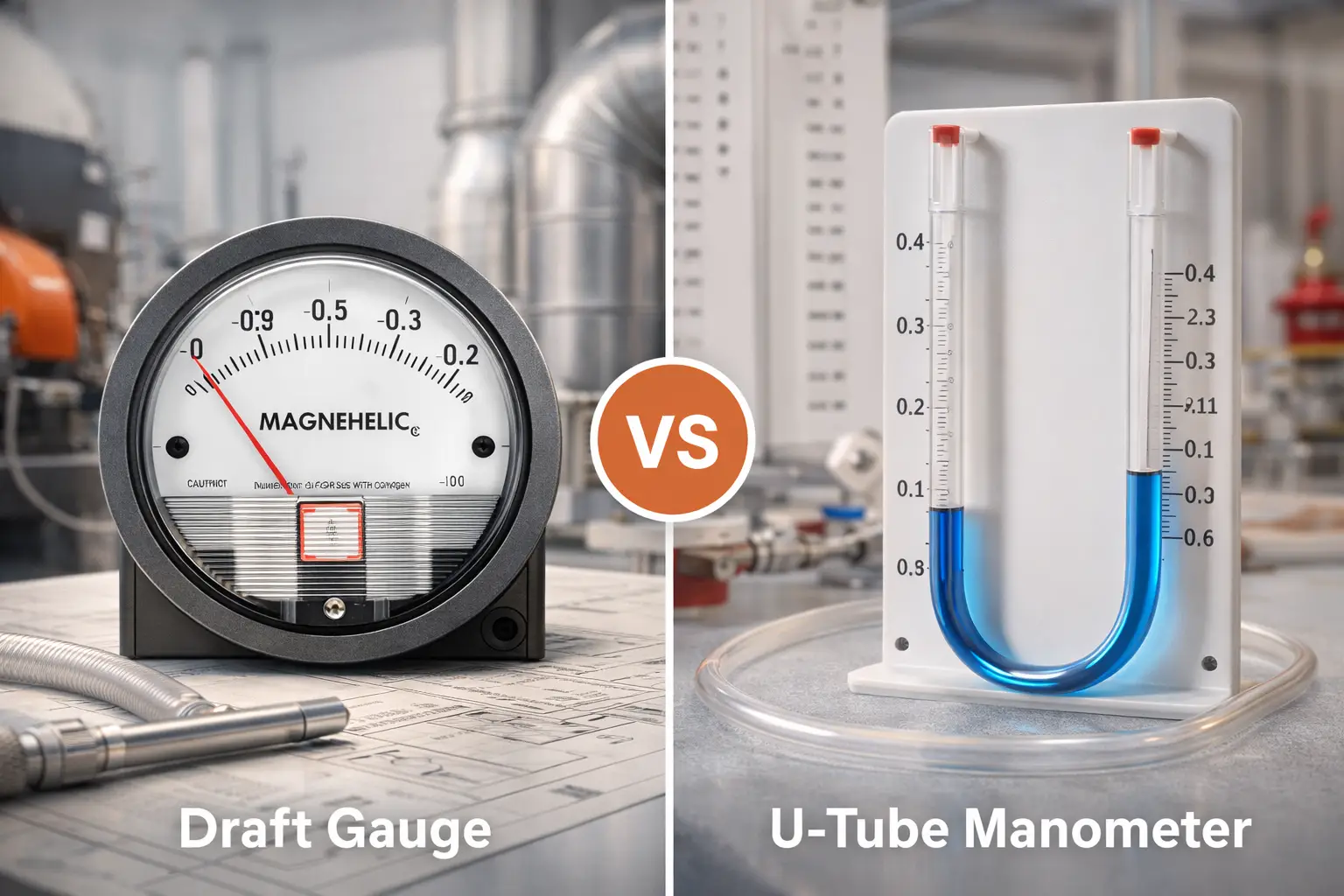
Comparison: Draft Gauge vs. Standard Manometer
Why spend money on a specific industrial draft gauge when a plastic U-tube is $20?
|
Feature |
Industrial Draft Gauge (Diaphragm) |
U-Tube Manometer |
Standard PSI Gauge |
|
Primary Use |
Furnaces, Filter Status, Critical Processes |
Lab work, spot checks, calibration |
Pumps, Hydraulics, Compressed Air |
|
Readability |
High (Large Dial, color-coded) |
Low (must read meniscus) |
Zero (cannot read low pressure) |
|
Durability |
High (Aluminum/Plastic Housing) |
Low (Glass/Plastic tubing cracks) |
High (Stainless/Brass) |
|
Response Time |
Immediate |
Sluggish (liquid inertia) |
Instant |
|
Maintenance |
Re-zero occasionally |
Refill fluid, level check |
Annual Calibration |
Understanding the Units (It’s Not Just Numbers)
Confusing units leads to blown seals. Since low pressure measurement instruments operate in a distinct range, you need to speak the language.
- Inches of Water Column (inWC or “wc):
- The Gold Standard in the US.
- Defined by how many inches the pressure can lift a column of water.
- Scale: 27.7 inWC = 1 PSI. That shows you how sensitive these are. 1 PSI is huge relative to a draft gauge.
- Millimeters of Water Column (mmWC):
- The standard for Metric/European markets (India, Germany, Japan).
- Roughly 10 mmWC = 100 Pascals (approx).
- Pascals (Pa):
- The scientific SI unit. Common in cleanrooms where 10 Pa or 15 Pa difference prevents contamination entry.
How to Select the Right Draft Gauge
Don’t just Google “Buy Draft Gauge” and pick the cheapest one. You’ll end up with a useless paperweight. Follow this selection logic.
The Range is Everything
Rule of Thumb: Your normal operating pressure should be at 50-75% of the full scale.
- If your furnace runs at 2.0 mmWC, buy a 0–5 mmWC gauge.
- Do not buy a 0–100 mmWC gauge. The needle will barely move off zero, and you won’t see small fluctuations.
Differential vs. Static
Do you need to know the pressure relative to the room (Static/Gauge Pressure) or the difference between two points (Differential Pressure)?
- Boiler stack: Usually Static (negative draft relative to atmosphere).
- Filter Bank: Differential (Pressure before filter minus pressure after filter).
Media Compatibility
Are you measuring clean air or dirty, hot flue gas?
- Clean Air: Standard silicone diaphragm is fine.
- Flue Gas: You may need a chemical-resistant diaphragm (Buna-N or Viton) and, crucially, a sediment trap to stop soot from entering the gauge lines.
Expert Pro-Tip:
“Mounting orientation matters more than you think. Mechanical draft gauges rely on gravity to balance the diaphragm linkage. If you mount a vertical gauge horizontally, your readings will be garbage. Always level the gauge first, then zero it.”
Professional Installation Protocols: Avoid Rookie Mistakes
Deploying a high-end industrial draft gauge is pointless if the impulse lines are plumbed incorrectly. Many expensive sensors output completely inaccurate data simply because basic fluid dynamics were ignored during installation.
Here is the mechanical reality of installing low pressure gauges in harsh environments.
The Sensing Line Geometry
Distance is the enemy. The longer the tubing (impulse line) between the process and the gauge, the more “lag” you introduce.
- Keep it Short: Mount the gauge as close to the measurement point as vibration allows.
- Slope it Down: If measuring gas, slope the line up from the gauge to the process so condensate drains back into the stack, not into your gauge. If measuring liquids, do the opposite.
- Avoid “U” Traps: Never allow a sag in the tubing. Liquid will pool there, blocking the pressure signal completely. It’s like pinching a straw.
Vibration Isolation
Mechanical draft gauges (like the inclined manometer or diaphragm type) are allergic to vibration. A shaking boiler casing will cause the needle to dance or, worse, shake the internal linkage out of calibration.
- Pro-Tip: If the duct work is vibrating, mount the gauge on a nearby structural column or a separate stanchion. Connect them with flexible surgical-grade tubing, not rigid copper pipe, to decouple the vibration.
Critical Component: The Sediment Trap
This is the single biggest failure point I see in coal-fired boilers and biomass furnaces. Flue gas is dirty. It carries soot, fly ash, and moisture.
If you run a direct line from a smokestack to a sensitive draft pressure gauge, you are essentially injecting dirt into the diaphragm.
- The Fix: Install a “drip leg” or sediment trap (T-connection with a plug) at the lowest point of the line immediately before the gauge.
- Maintenance: Open that plug once a month. You will be shocked at the black gunk that comes out. If that gunk had entered the gauge, you’d be buying a replacement today.
Advanced Troubleshooting: When “Zero” Isn’t Zero
Over time, all mechanical instruments drift. It is physics. The spring fatigues; the diaphragm gets stiff.
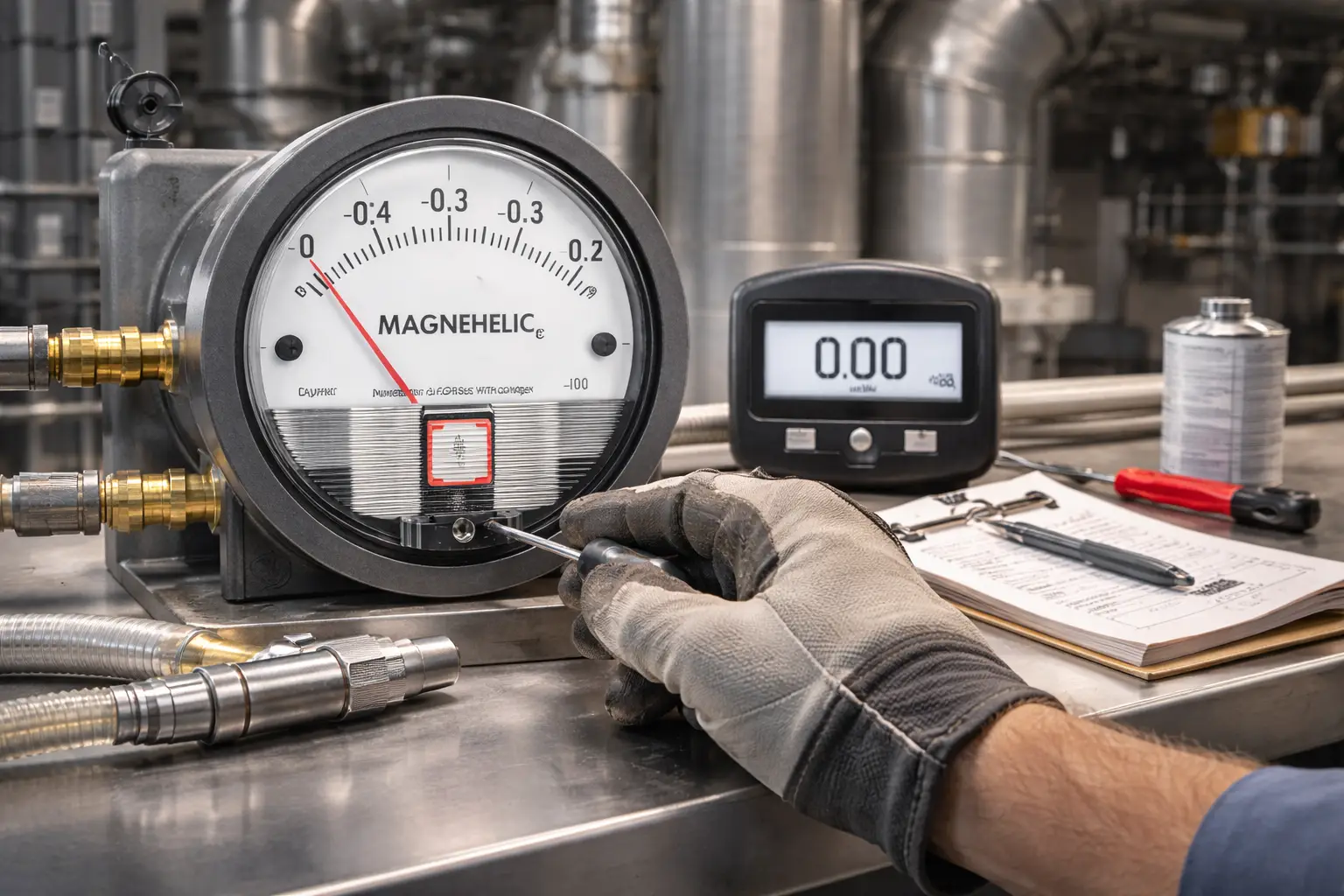
The Field Zero-Check Procedure
Do not trust a gauge that hasn’t been zeroed recently.
- Isolate: Close the shut-off valve between the process and the gauge.
- Equalize: If it’s a differential gauge, open the equalization valve (or vent both ports to the atmosphere).
- Inspect: The needle should hit exactly “0.”
- Adjust: If it reads +0.05 inWC, use the external adjustment screw to bring it back to the line.
- Note: If you have to turn the screw more than 5-10% of the scale, the gauge is likely damaged. Throw it out. You cannot calibrate away physical damage.
Diagnosing “Sluggish” Response
If your burner fires and the furnace draft gauge takes 5 seconds to move:
- Check the Line: You likely have a kinked tube or a blockage (spider nests are surprisingly common in outdoor vent lines).
- Check the Filter: If you used an in-line sintered filter to protect the gauge, it might be clogged.
- The “Leak” Test: Pressurize the line slightly and pinch it off. If the pressure drops instantly, you have a leak in the fitting. A leak on the low-pressure side of a vacuum system will give you a falsely “good” reading while the system is actually failing.
The Digital Transition: 4-20mA Integration
The industry is moving away from the operator walking around with a clipboard. We are moving to Distributed Control Systems (DCS).
Modern digital draft gauges often do double duty. They have a local readout for the floor operator and send a 4-20mA signal back to the control room.
Why this matters:
- PID Control: The signal feeds directly into the VFD (Variable Frequency Drive) of the ID Fan.
- The Loop: Draft pressure drops -> Sensor sends 12mA signal -> Controller speeds up the fan -> Draft stabilizes.
- The Human Element: Even with automation, keep a mechanical gauge installed right next to the electronic transmitter. Sensors drift. Electronics fail. The mechanical gauge is your “sanity check.” If the computer says 0.5″ but the dial says 2.0″, trust the mechanical physics until proven otherwise.
Final Calibration: Making the Invisible Visible
Draft gauges are the unsung heroes of the thermal processing and air handling world. They translate invisible forces into actionable data. Whether you are aiming to cut fuel consumption in a 50-ton boiler or keep a hospital operating room positively pressurized, the accuracy of your draft reading dictates the safety of your facility.
Invest in quality instruments. Select the correct range (keep it tight). Install them with sediment traps on combustion lines. When the needle sits right in that sweet spot, you know your system breathes easy.
FAQ: Common Questions on Low Pressure Measurement
Q1. Can I use a draft gauge to measure water pressure?
Generally, no. Draft pressure gauges are designed for air and non-corrosive gases. Liquid water can damage the internal diaphragm mechanism or cause corrosion. Furthermore, the pressure ranges in water systems usually exceed the sensitive inches-of-water scales used in draft gauges. For water, get a wet-wet differential pressure transducer or a standard Bourdon gauge.
Q2. How often should I calibrate a boiler draft gauge?
In critical industrial applications, a “zero check” should happen every shift or weekly. Full calibration against a master standard should occur annually. However, if the gauge experiences a pressure spike (over-range) or physical shock/vibration, verify calibration immediately.
Q3. My draft gauge reading is fluctuating wildly. What’s wrong?
This is likely due to turbulence in the duct or stack. It doesn’t mean the gauge is broken; it means the air is “noisy.”
- Fix: Install a snubber (damping orifice) in the impulse line. This restricts the airflow slightly to smooth out the needle movement without affecting the final accuracy.
Q4. What is the difference between Magnehelic and Photohelic gauges?
A Magnehelic is purely an indicator—it shows you the pressure visually. A Photohelic includes electrical switches/relays. You use a Photohelic when you want the gauge to trigger an alarm or shut down a fan if the pressure gets too high or too low.
Q5. Where is the best place to install the sensing tap for a furnace draft gauge?
The tap should be located in the furnace wall, ideally near the roof or slightly below, away from the direct impact of burner flames or air jets. Placement in a “dead zone” gives a truer static pressure reading than placing it directly in a high-velocity stream.
Related Articles
Loading articles…

