

Solenoid Valve Troubleshooting Guide: Fix Common Faults Instantly
Solenoid Valve Not Opening or Closing? Complete Troubleshooting Guide (Uflow, Indfos & All Brands)
70% of solenoid valves pulled out of Indian plants as “dead” are not dead at all. The valve was fine. Something else in the loop killed the response. The replacement gets installed, and the same fault returns within days on the new unit.
That number is not theoretical. It comes from two decades of opening up “failed” Uflow and Indfos valves on the workbench across Faridabad, Okhla, and Noida — running them through bench tests and watching most perform exactly to spec. The fault was always somewhere else.
Faridabad, second shift, a few months back. A 2/2 solenoid on a cooling water line had stopped responding to the PLC command. The shift supervisor had a new Uflow valve in hand, spanner ready, about to break the line and swap. A fifteen-minute walkthrough later, the original valve was back in service. A fouled Y-strainer upstream had collapsed the line pressure below the valve’s minimum operating differential. The valve was electrically perfect, mechanically clean, and doing exactly what it was built to do — refuse to actuate when there isn’t enough pilot pressure to lift the diaphragm.
That’s the pattern. The valve gets blamed. The actual fault sits somewhere else in the system — usually in a place nobody thought to look.
The diagnostic sequence below runs through every probable cause in order. Works for Uflow, Indfos, every brand on the market. Run the checks in sequence. Most faults surface by step 3.
CRITICAL FIELD DIRECTIVE: Before pulling out tools, isolate the fault path by placing your specific issue into one of these three distinct mechanical buckets. This prevents cross-contamination of diagnostic steps.
Field Observation (Symptom) | Probable Failure Vector | Initial Diagnostic Path |
Total Electrical Silence: No click, no low hum, zero mechanical travel when energized. | Control circuit power drop or a fractured internal coil winding. | Proceed directly to Step 1 (Electrical Path Check) |
Audible Coil Hum/Buzz: Enclosure gets warm, but the plunger refuses to execute its stroke. | Sub-optimal differential line pressure ($\Delta P$) or physical debris blockages. | Proceed directly to Steps 3 & 4 (Fluid Dynamics Path) |
Continuous Process Leakage: Valve opens correctly but fails to achieve total isolation when de-energized. | Fatigue in return spring, internal seat scoring, or hardened rubber diaphragm. | Proceed directly to Step 6 (Seal & Core Maintenance) |
Hunting for Phantom Power Drops at the Coil
Most engineers learn this the hard way. The first instinct on a non-responding valve is to suspect the coil itself. Reality: in most cases the coil is healthy. The supply to the coil has failed somewhere upstream.
Check the panel first. Then the wiring. Then the coil terminals. That order matters.
Common culprits on the supply side:
— Blown fuse on the control circuit (a 1A or 2A glass fuse nobody thinks to open the panel for) — Chattered contacts on the actuating relay or contactor — Loose terminal on the panel-side strip — continuous vibration loosens screw terminations over time — PLC output that has stopped firing — could be logic, could be a failed output card — An auxiliary contact on a downstream interlock that has opened the circuit
Voltage fluctuations on Indian plant supplies are a real factor here. A 230V AC coil running on a supply that sags to 180V at peak load won’t generate enough magnetic force to lift the plunger — even though the multimeter reading shows “voltage present.” The coil needs voltage within roughly ±10% of its rated value. Below that, it hums and stalls.
Inrush current matters too. AC solenoid coils draw 3 to 7 times their holding current at the instant of energization. A supply circuit that can hold steady at the holding current but droops under inrush will cause the valve to chatter or fail to pick up at all.
Live Loop Diagnostics Sequence
1.Verify Live Loop Control Voltage:
Phase 1: Multi-meter Under Demand.
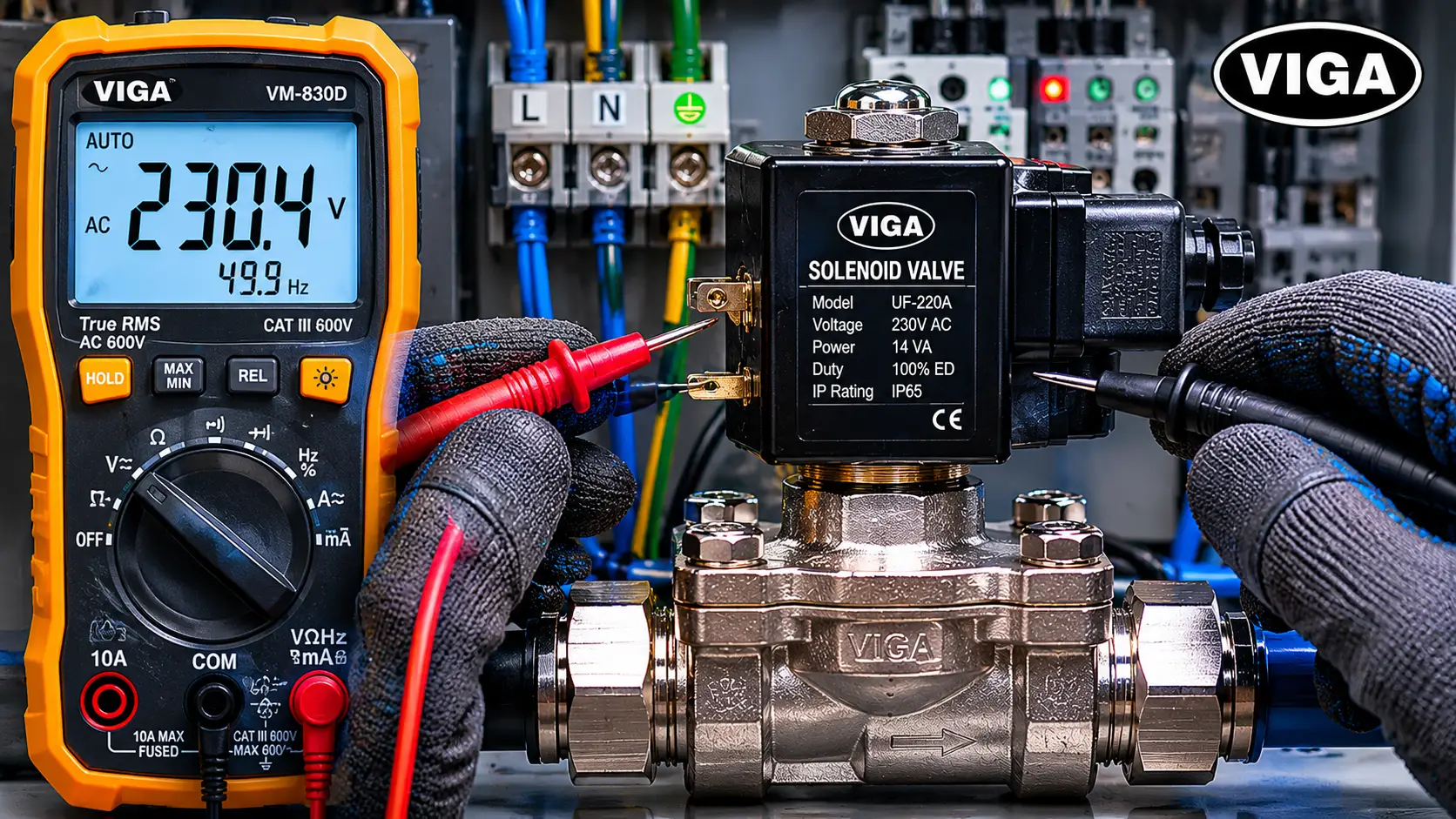
Keep the system under active PLC command. Set your multimeter to AC or DC Volts matching the coil spec. Probe directly at the coil lead terminations. The line reading must sit within $\pm 10\%$ of the rated voltage. In many Indian plants, a 230V AC supply that sags down to 180V during peak load hours will cause the coil to hum and stall out entirely.
2.Profile Winding Integrity:
Phase 2: Cold Resistance Check.
De-energize the entire circuit loop and isolate the coil from the power line. Turn your multimeter to Ohms ($\Omega$) and measure across the clean pins:
- 24V DC Coils: Safe structural range is 40 to 80 $\Omega$
- 110V AC Coils: Safe structural range is 200 to 400 $\Omega$
- 230V AC Coils: Safe structural range is 800 to 1,500 $\Omega$
Algorithmic Diagnosis: A zero or near-zero reading points to an Internal Short Circuit. An infinite open-loop ($\infty$) reading screams a Broken Winding. If both values test clean, move directly to the fluid dynamics path below.
The Cooked Coil — Reading the Damage
Coil burnout in Indian plant conditions has four standard causes. Knowing them matters because if the replacement coil is failing the same way as the original, the application itself is the problem not the coil quality.
The four killers: Sustained over-voltage. Plant supply running consistently above rated coil voltage, especially during low-load hours when supply tends to rise. Ambient above the coil’s thermal class. A Class B coil rated to 130°C in an enclosure that hits 90°C ambient with self-heating on top will cook within months. Class F (155°C) or Class H (180°C) coils handle Indian summer heat far better. Moisture ingress through encapsulation cracks. Condensation gets into the winding, the coil slowly shorts internally. Continuous duty on an intermittent-rated coil. Some economy coils are rated for 30-minute or 1-hour duty cycles. Run them continuously and they slowly cook themselves to death.
A burnt coil announces itself visually before the meter confirms it. Discolouration around the terminal area. Faint burnt-plastic smell on the encapsulation. Sometimes coil swelling — physical deformation of the housing from sustained heat. Occasionally a coil is warm to the touch when de-energized, which means it has shorted internally and is drawing leakage current. That coil needs to come out before it sets adjacent components on fire.
Replacement is straightforward on most modern Uflow and Indfos pneumatic valves. Single retaining nut or clip. Coil slides off the armature tube. Valve body stays in place, no process disconnection, no fluid loss.
Match voltage, frequency (for AC coils), and current rating. Match the thermal class to the ambient — don’t drop a Class B coil back into a hot enclosure that just cooked the last one.
Line Scale, Rust, and the Stuck Plunger
A valve that hums but won’t lift the plunger is nearly always either this step or the next. Start here because it’s faster to verify visually.
Contamination inside the valve body is the second most common solenoid valve failure mode in Indian industry. Particularly aggressive in:
Compressed air lines where moisture in the receiver has carried rust particles downstream Cooling water systems with line scale from inadequate water treatment Hydraulic circuits where degraded oil carries wear particles from worn pumps Steam condensate lines with iron oxide and scale deposits
Signature symptom: the valve worked perfectly for months, then went sluggish gradually, then stopped responding entirely. Sudden day-one failure is almost never contamination. Slow degradation almost always is.
Clearing Without Full Disassembly
Sometimes the valve clears with the override and a pressure cycle. Isolate the line. Engage the manual override several times in succession while a low flow bleeds through. Often dislodges loose debris from the seat area.
If that doesn’t clear it:
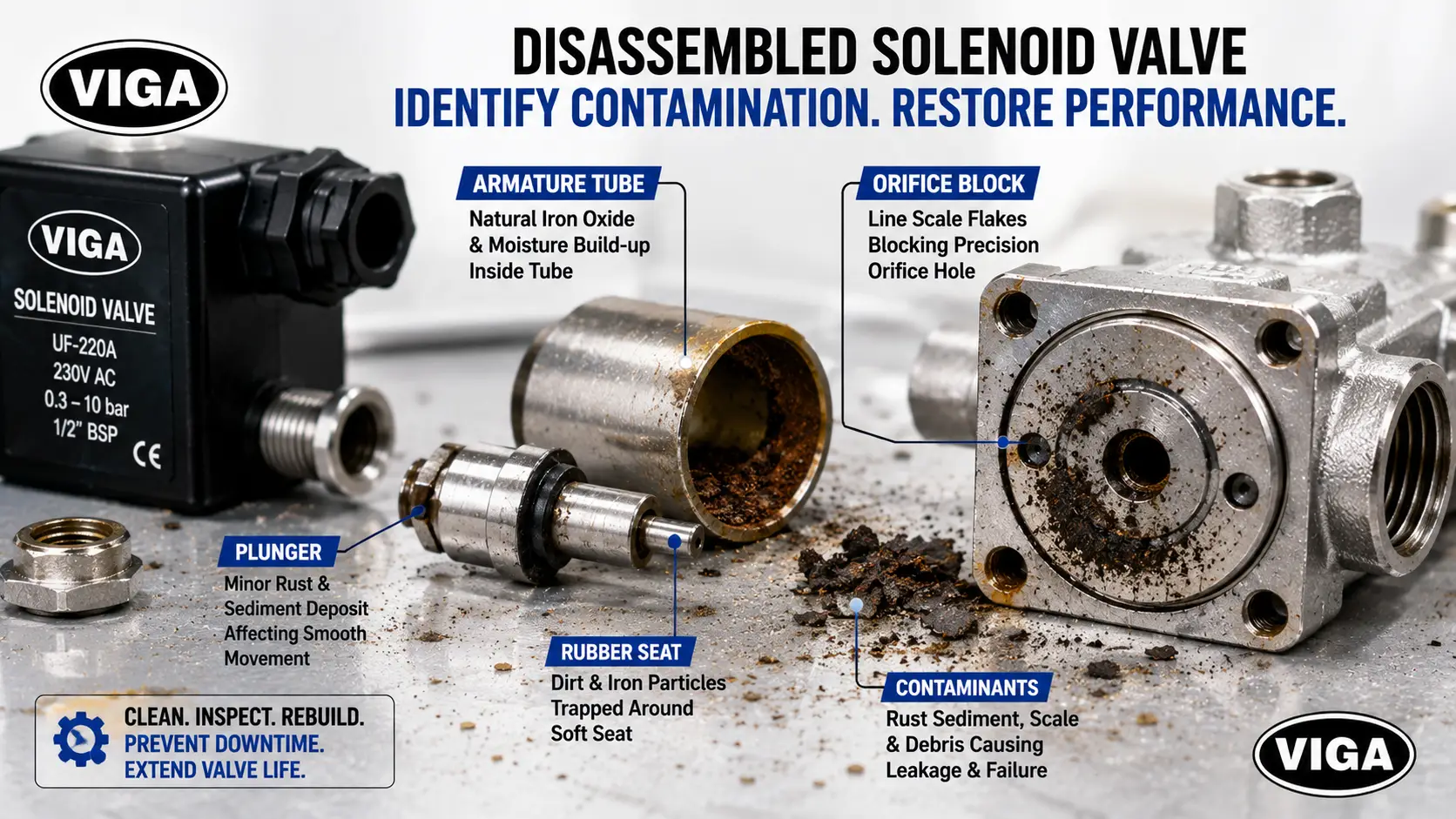
Isolate the valve, depressurize Pull the coil off the armature tube Lift out the plunger Inspect the seat, the orifice, and the plunger face
Visible particles line scale flakes, rust grains, sediment explain the symptom. Soft brush. Clean compressed air to clear the orifice.
⚠️ CRITICAL MAINTENANCE DIRECTIVE: When clearing out line scale or rust deposits from the armature tube, never scrape the internal orifice with steel wire brushes or metallic screwdrivers. A micro-scratch or score mark on the soft seating surface causes irreversible internal bypassing. Once scored, the valve body cannot be serviced—it must be replaced. Always use soft-bristled nylon brushes and low-pressure dry air.
Recurring contamination is a system problem, not a valve problem. Replace or install the upstream Y-strainer. A 100-mesh strainer ahead of the solenoid valve stops 90% of recurring contamination calls. Cleaning the same valve every six weeks is wasted maintenance hours.
Differential Pressure — The Spec Nobody Reads
This step catches the failures that look impossible. Coil tests clean. Body is clean. Valve hums when energized. Still won’t open.
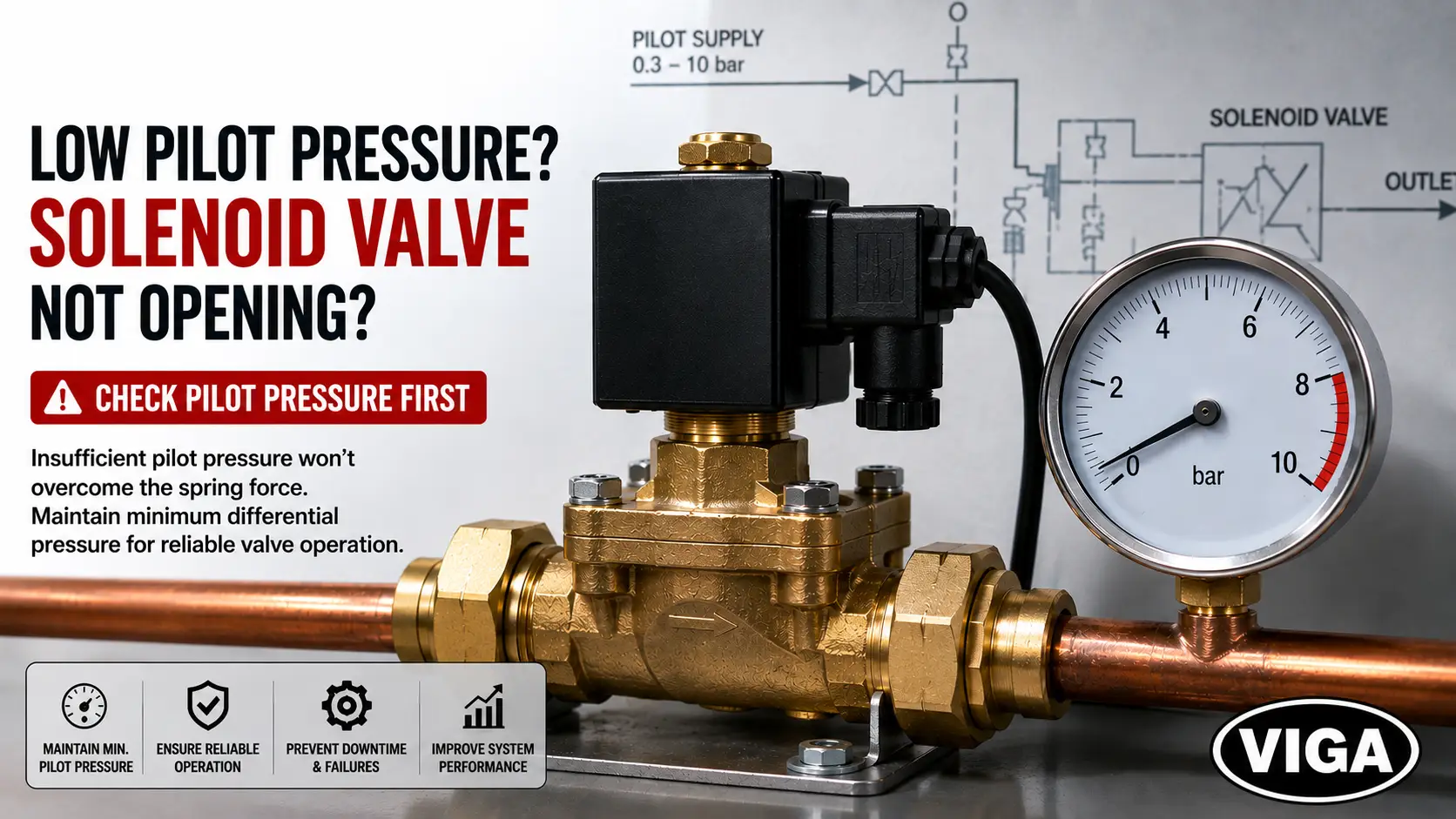
The answer is on the datasheet. Minimum operating pressure differential. Most pilot-operated solenoid valves need a minimum pressure across the valve to actuate the main diaphragm or piston.
THE PILOT LEVERAGE THRESHOLD: If your asset is a pilot-operated assembly, it is physically incapable of working on pure electrical input. It harvests energy from the fluid line itself, requiring a strict minimum pressure drop ($\Delta P$) between the inlet and outlet ports to pop the main diaphragm open.
- 1/4″ to 1/2″ Port Openings: Require a steady minimum of 0.3 to 0.5 bar $\Delta P$.
- 1″ Port Openings: Require a steady minimum of 0.5 to 1.0 bar fluid leverage.
- 2″ and Larger Openings: Require a massive 1.0 to 2.0 bar differential to move the heavy piston.
Engineering Solution: If your process application involves gravity fed tanks, low-pressure vent configurations, or deep vacuum loops, pilot-operated specs are fundamentally incorrect. You must upgrade to a Direct-Acting Solenoid Valve, which functions flawlessly down to 0.0 bar. The valve hums and stays closed. Completely normal behaviour, completely misdiagnosed as valve failure.
This was the Faridabad case at the top of this guide. Y-strainer fouled, upstream pressure collapsed, differential dropped below the valve’s 0.5 bar minimum, valve refused to actuate. A brand-new replacement would have done exactly the same thing.
Pressure differential drops show up in predictable scenarios:
— After a filter or strainer fouls and creates upstream restriction — Pump performance degrades over operating hours — Low-flow operating modes where system pressure naturally drops — Vent lines, drain applications, vacuum service — anywhere pressure is occasionally zero
For applications where pressure routinely sits at or near zero, direct-acting solenoid valves are the correct specification. They actuate from zero differential. A pilot-operated valve installed where pressure drops to zero will fail every time pressure is low, and no maintenance fixes that. The valve type itself is wrong.
🧠 Solenoid Valve Diagnostic Calculator
Input your field measurements below for an immediate mechanical diagnosis.
The Override Lever Nobody Reset
Sounds trivial. Catches a surprising percentage of phantom faults.
The manual override on most industrial solenoid valves is a small slotted screw or lever, usually on the underside or one face of the valve body. Used during commissioning and maintenance to actuate the valve without coil power.
The scenario plays out the same way every time. Maintenance work was done last week. Override was engaged to drain a section or test the system. Work completed, tools packed, shift handover. Nobody disengaged the override.
Now the valve appears to stay open regardless of PLC command. Or it behaves erratically. Or it refuses to respond predictably to the electrical signal. The shift team starts pulling tools to remove it.
Look at the valve body. Find the override. Check its position against the marked positions on the casting. Return it to neutral. Done.
Worth running this check early on any valve behaving in a “stuck open” pattern — particularly if maintenance was recently performed on the surrounding system.
Seat Scoring, Hardened Diaphragms, Dead Springs
Solenoid valves wear out. The seals, diaphragms, springs, and seat surfaces all have a finite service life. When wear advances far enough, the valve develops symptoms that mimic other faults slow operation, partial closure, internal leakage, failure to seat fully.
Visual inspection during coil removal reveals most of it. What to look for: Diaphragm condition. Cracking, hardening, surface tears replace via service kit. Seat seal. Flattened, deformed, brittle replace via service kit. Seat surface itself. Should be smooth and unmarked. Pitting or scoring across the seat means permanent leakage even with new seals. At this point the valve body itself needs replacement. Return spring. Hand-test the spring force. Weak or broken springs cause slow closure or partial closure. Pole-face contamination. Rust deposits or dirt on the magnetic pole face reduce holding force and cause the plunger to chatter or release prematurely. Shading coil/ring (on AC valves). A failed shading ring causes audible 50Hz buzz and intermittent operation.
For most current-production Uflow and Indfos models, service kits with seals, diaphragms, and springs are available through authorized channels. Solenoid valve seal replacement is a routine maintenance skill in pharma utilities, food processing plants, and HVAC systems where the same valves cycle continuously for years.
Economic question: rebuild or replace.
Below a certain valve size and price point, rebuild isn’t worth the labour. Total time — isolation, disassembly, parts ordering, reassembly, recommissioning — exceeds the cost of a new valve. For larger valves, specialty models, or valves in difficult-to-access positions, rebuild makes sense.
When the Valve Was Wrong From Day One
Last check. Hardest fix. Worth ruling in or out before declaring victory.
Some valves keep failing because they were never the right valve for the application. Replacement after replacement, same model, same failure mode, same position. After two or three cycles of this, the question isn’t “what killed the valve” it’s “is this even the right valve for this duty?”
Common mismatches that show up across Indian plants: Pilot-operated valve installed where line pressure routinely drops to or near zero 2/2 valve specified where the application actually needs 3/2 with exhaust to atmosphere NBR-sealed valve handling a fluid that attacks NBR phosphate ester hydraulics, certain chemicals, sustained high-temperature service Valve sized for typical flow but undersized for peak demand Coil voltage class incompatible with the actual panel supply (a 220V AC coil on a 230V supply where surges hit 250V repeatedly) Continuous duty cycle on an intermittent-rated valve Inadequate IP rating for an outdoor or washdown location
The signature is repeated failure of the same valve type in the same position. Lasted three months. Replacement lasted three months. Replacement of the replacement lasted three months.
At this point the diagnostic moves from valve to specification. Pull the application data: fluid, temperature range, pressure range, flow rate, duty cycle, panel voltage, ambient temperature, IP requirement. Compare against the valve datasheet. The mismatch usually surfaces within ten minutes of methodical comparison.
FAQ
Q1. Why does the solenoid valve hum but not open?
The hum confirms the coil is energized — current is flowing, magnetic field is being generated. The plunger isn’t completing the lift. Two causes account for the majority of cases: insufficient differential pressure (pilot mechanism can’t generate enough force to lift the main diaphragm) or mechanical obstruction in the seat area. Check inlet pressure first. If it’s below the valve’s stated minimum on the datasheet, that’s the answer. If pressure is adequate, the valve body has contamination.
Q2. Can a solenoid valve actually be repaired, or does it always need replacement?
Most faults are repairable. Coils replace independently of the valve body. Seal kits and diaphragm kits are available for nearly all current-production Uflow and Indfos models. Internal cleaning resolves contamination cases. The genuine replacement-only situations are seat scoring beyond polishing, cracked valve bodies, and obsolete models where service parts are no longer manufactured.
Q3. How long should a solenoid valve actually last in Indian plant conditions?
In correctly specified service, 5 to 8 years before significant intervention is needed. High-cycle service valves switching tens of thousands of times per day sees coil wear within 2 to 4 years. Seal life depends on the process fluid and operating temperature. Wrong specification dramatically shortens service life: a misspecified valve fails within months regardless of brand quality.
Q4. What causes solenoid valve coils to burn out repeatedly?
Four standard causes: sustained over-voltage on the supply, ambient above the coil’s thermal class, moisture ingress through cracked encapsulation, and continuous duty on an intermittent-rated coil. If a single coil position keeps burning replacement coils, the problem is environmental or specification — not coil quality.
Q5. Should the manual override be used during normal operation?
No. The override is a maintenance and emergency feature only. Leaving it engaged during normal operation bypasses the control logic entirely and creates confused troubleshooting downstream. Always reset to neutral after maintenance, and confirm normal automatic response before signing off on the work.
Q6. Why is a brand new valve also failing the same way?
When the replacement fails identically to the original, the valve was never the cause. The fault is in the surrounding system — pressure, supply voltage, contamination upstream, ambient temperature, or wrong specification for the application. Step 7 in the sequence above handles this case. Stop replacing the valve and start diagnosing the application.
Authorized Distribution & Emergency Breakdown Support
For plants in Delhi NCR needing replacement solenoid valves, replacement coils, or service kits — VIGA (Vinod Gautam Sales) is an authorized distributor for Uflow and Indfos along with several other industrial automation brands.
The Uflow range sits in working depth on the shelf — 2/2, 3/2, 5/2 and 5/3 configurations across the sizes that move fastest in Indian plants. Indfos goes alongside, both the solenoid valve range and the pressure switch line. Replacement coils get binned separately by voltage class — 24V DC, 110V AC and 230V AC, because those are the ones field engineers ask for most when something burns out at 9 PM and the next shift needs the line running by morning. Seal kits and service parts for current-production models stay in stock as well, since plants in NCR order them on a regular replacement cycle. Both direct-acting and pilot-operated variants are kept — the application decides which type is right, and a working distributor needs to handle both ends of that decision.
Vinod Gautam Sales (VIGA) operates out of 20, Chawri Bazar, Delhi — 110006. Phone lines are +91-11-43025959 and +91-11-41582888. Email goes to [email protected] or [email protected]. Fax — still used by a few plants for purchase orders — is +91-11-23288888. The website is viga.in.
For breakdown situations, the phone works faster than email. The team has live visibility on stock and can confirm dispatch in minutes. Delhi orders get same-day delivery on stocked items. Noida, Gurgaon, Faridabad, Ghaziabad and the rest of NCR get next-day, or same-day if the order comes in early enough in the morning.
VIGA is an authorized distributor for Uflow, Indfos, Switzer, WIKA, Mass Instruments, Shavo, Electropneumatics, and Pilot across Delhi NCR.