Author name: admin

Master Gauge Calibration
Blog

Master Gauge Calibration: Standards & Metrology Explained [2026]

Master Gauges Explained: Accuracy Standards, Calibration Process & Industrial Applications What is a master gauge?  A master gauge is a high-accuracy, laboratory-grade instrument used strictly as a certified baseline to test, calibrate, or verify ordinary working gauges. Boasting accuracy classes typically better than ±0.1%, it serves as the absolute foundation for metrological traceability, ensuring everyday plant instruments output true, standardized readings. Reliable industrial process data requires exact metrological traceability. Facilities like oil refineries and pharmaceutical plants rely on instruments that inevitably experience mechanical fatigue , vibration, and thermal drift over time. They will fall out of calibration. Without a rigorously maintained master standard backing up those frontline sensors, quality control falls apart. Your working gauges are only as reliable as the reference tool proving their value. Master Gauge vs. Working Gauge: Understanding the Test Uncertainty Ratio (TUR) Working process gauges are permanently installed across industrial pipelines, operating in harsh conditions with frequent pressure spikes. Operators install them permanently. Spikes in process pressure abuse them. You never expect perfection from them. A master gauge operates completely differently. Instrumentation engineers keep this unit in padded cases inside temperature-controlled rooms. You never attach it directly to dirty, pulsating lines. When establishing your baseline standard, you must strictly follow the Test Uncertainty Ratio (TUR). Metrologists typically demand a 4:1 ratio. This means the calibration master gauge used to certify a line gauge must be at least four times more accurate than the instrument being tested. Equipment Designation Comparison To make sense of the pecking order in a typical calibration lab setup, check the performance standards outlined in the table below. Designation Category Accuracy Tolerance Primary Application Focus Calibration Frequency Requirement Working Process Gauge ±1.0% to ±2.0% Live industrial process monitoring Annually to bi-annually (based on wear) Reference Pressure Gauge ±0.25% to ±0.5% Secondary field checks or line troubleshooting 6 months to 1 year (Lab validated) Master Gauge ±0.05% to ±0.1% Absolute metrological standard inside labs Heavily regulated (often 3 to 6 months) Deadweight Tester ±0.015% Certifies the master gauges themselves Strict intervals (National Standards body) Expert Pro-Tip: Don’t assume a digital master pressure gauge is automatically telling the truth just because its LED screen displays five decimal places. Instrument resolution does not equal functional accuracy. An erratic internal sensor hiding behind high resolution creates a false sense of security. Always cross-check the gauge’s historical hysteresis loop during certification to prove true linearity. Pressure Gauge Accuracy Standards: ASME B40.100 vs. EN 837 You cannot treat gauge performance specifications like light reading. They dictate exact engineering constraints. In B2B instrumentation, relying on a vague “it works fine” approach triggers immediate non-conformance penalties. Organizations heavily debate the performance brackets between European standard EN 837 and the American standard ASME B40.100. Let’s break down exactly what defines legitimate pressure gauge accuracy classes. What are ASME Grade 3A and 4A Master Gauges? A high-grade industrial master gauge is not cheap, and for good reason. Its internal mechanics feature thermally treated beryllium copper or Inconel Bourdon tubes specifically annealed to prevent permanent elastic deformation. According to ASME B40.100: Grade 3A: Delivers ±0.25% of full-scale accuracy. Usually deployed as a high-end reference pressure gauge. Grade 4A: Represents the absolute top tier for analog gauges, demanding ±0.1% accuracy. Here is the real trick behind full-scale accuracy. If you own a Grade 3A, 10,000 PSI test gauge, its error allowance spans exactly ±25 PSI at any point along that dial. The math changes significantly based on the chosen measurement range. Therefore, never test low-pressure systems with high-pressure master gear. Traceability: NABL and ISO/IEC 17025 Calibration Standards Metrological compliance requires strict documentation. Deploying high-tier calibration equipment is ineffective without certified technicians executing the process. Calibration traceability falls back on national labs validating secondary metrology labs. ISO Calibration Standards establish global protocol for laboratory competency. Under ISO/IEC 17025, specific parameters detailing ambient humidity limits, laboratory temperatures, and test liquid properties ensure zero outside interference occurs during gauge alignment. In India, local labs rely on NABL (National Accreditation Board for Testing and Calibration Laboratories) standards to certify these processes meet exact international compliance benchmarks. This legal chain of custody keeps massive safety-critical facilities operational. Step-by-Step Master Gauge Calibration Process How does an elite lab bring a failed unit back into alignment? You follow the numbers blindly and execute the pressure gauge calibration steps manually. Calibration acts as a scientific comparative method. You place a test subject alongside a known standard and apply a controlled stimulus to both. You note the exact variance. Thermal Acclimatization Technicians cannot take equipment out of a freezing van, put it on a test bench, and test it immediately. Metallic elements expand and contract based on temperature differences, introducing false errors into the dial readings. Metrology labs leave high accuracy pressure gauges inside specific environment cabinets for hours to ensure parts equalize to exactly 68°F (20°C). Contamination Mitigation Media incompatibility destroys precise sensors. A technician calibrating oxygen plant hardware using standard hydraulic oil invites instant, violent combustion if they reintroduce that contaminated hardware back to the site. Elite laboratories segregate dry block (nitrogen gas) benches from wet (mineral oil, distilled water) pneumatic benches. Executing the Ascending and Descending Profile This phase takes actual time. The tech increases system pressure by 20% increments (Zero, 20%, 40%, 60%, 80%, 100%). They write down the dial output versus the exact output displayed by the master pressure gauge. Then, they step down backwards from 100% to zero.Why run the test up and then back down? You check for hysteresis—an invisible lagging friction hidden inside the sensing gears where the down-stroke reads completely differently than the up-stroke. Expert Pro-Tip: To defeat internal friction in mechanical analog gauges, experienced metrologists give the outer rim a light tap with a rubber mallet or bare knuckle before documenting a value at each increment point. This completely settles the tiny internal pinions and provides a true indication of the raw tension in the Bourdon tube. Adjusting Spans and Zeroing Output If a discrepancy breaks the defined accuracy class limitations, adjustments occur. Most dial units have an external zero adjustment knob or micrometer pointer. Internal linkage

SS Pressure Gauges
Blog

SS Pressure Gauges: Accuracy & Buying Guide [2026]

SS Pressure Gauges: Types, Accuracy, Applications & How to Choose the Right One So, what exactly is an SS Pressure Gauge? At its core, a Stainless Steel (SS) pressure gauge is a heavy-duty industrial tool built specifically to track liquid or gas pressure inside brutal, highly corrosive, or ultra-clean sanitary environments. While cheaper brass or carbon steel units fall apart quickly, true SS gauges rely on 304 or 316-grade internals to completely block out rust, survive harsh chemical washdowns, and handle wild temperature swings. This makes them the absolute standard for metrological traceability in the chemical, food processing, and oil sectors. Process control isn’t just about reading a number on a dial. It’s about safety. It’s about efficiency. Pick the wrong pressure instrument, and you risk leaks, false readings, or catastrophic failure. Pick the right Industrial SS Pressure Gauge, and you buy years of reliability. You might be an engineer looking to spec out a new skid, or a procurement manager staring at a spreadsheet of wildly different prices. This guide cuts through the noise. We aren’t looking at generic definitions here. We are breaking down exactly what specs matter, where 316 beats 304, and why your choice of “fill fluid” could destroy your measurement accuracy in cold weather. Let’s get into the mechanics. Why the Obsession with Stainless Steel? (SS vs. Brass vs. Carbon) Most general-purpose gauges use a brass Bourdon tube and socket. It’s cheap. It works fine for air and water in your garage. But industrial plants are brutal. If you introduce ammonia, aggressive solvents, or saltwater to brass, it corrodes immediately. Carbon steel is tough but rusts if you look at it wrong. This is where the SS Pressure Gauge wins. The Real-World Advantages: Fights Off Corrosion: Easily survives direct contact with aggressive acids and heavy alkalis. Strict Hygiene Compliance: The absolute go-to for Food & Beverage lines running intense SIP/CIP washdowns. Extreme Temp Survival: Keeps working accurately in freezing or boiling conditions where standard brass simply fails. Raw Durability: Takes physical hits and mechanical system shocks way better than softer alloy metals. Expert Pro-Tip: Be incredibly careful of vendors pushing “Case-Only” stainless gauges. It’s a common industry trick where you get a shiny stainless steel outer shell, but the actual internal wetted parts doing the heavy lifting are just cheap brass. Always specify “All SS” or “SS Wetted Parts” to ensure the tube and socket are corrosion-resistant. The Metallurgy Match-Up: SS 304 vs. SS 316 Not all stainless is created equal. The price difference between a SS 304 Pressure Gauge and a SS 316 Pressure Gauge can be significant. Knowing the difference saves budget or prevents accidents. Feature SS 304 / 304L SS 316 / 316L Chemical Composition Chromium + Nickel Chromium + Nickel + Molybdenum Corrosion Resistance Excellent for oxidation and moderate chemicals. Superior resistance to chlorides, saltwater, and harsh acids. Price Point Mid-Range (Standard) High-End (Premium) Ideal Application Hydraulics, Food Processing, General Air/Gas. Marine (offshore), Oil & Gas, Chlorine service. If you are pumping seawater or processing chlorinated chemicals, you need the Molybdenum found in SS 316. If you stick 304 stainless in saltwater, you will get pitting corrosion. For standard manufacturing or potable water, SS 304 is plenty. Types of SS Pressure Gauges by Mechanics Bourdon Tube Pressure Gauge This is the workhorse. Inside the gauge is a C-shaped tube made of stainless steel. As pressure rises, the tube straightens out (flexes), moving a mechanical linkage that turns the needle. Best for: Medium to High pressures (1 bar to 1000 bar). Weakness: Susceptible to clogging if the media is thick or sludge-like. Diaphragm Seal Gauge Instead of a tube, pressure pushes against a corrugated stainless steel diaphragm. Best for: Low pressure (mbar ranges) or viscous/pasty fluids (paint, slurry). Why use it: The diaphragm creates a barrier. Nothing enters the gear mechanism. Differential Pressure Gauge This measures the difference between two points in a system. Best for: Monitoring filter health (pressure before filter vs. after). Liquid Filled SS Pressure Gauge vs. Dry Gauge Walk into a compressor room, and you’ll see half the gauges filled with a thick, clear liquid. It’s usually Glycerin or Silicone Oil. Dry Gauges These contain just air. They are cheaper and easier to repair. However, if the machine vibrates, the needle shakes violently. This makes the reading impossible to see and wears out the internal gears rapidly. Liquid Filled Gauges The casing is filled with liquid to dampen vibration. The liquid acts as a shock absorber for the needle. Glycerin: The standard fill. Great for room temperature. Dampens vibration well. Silicone: Essential for extreme temperatures (icing conditions). Glycerin turns to sludge/gel below -17°C, which freezes the needle. Silicone stays fluid. Expert Pro-Tip: Buying a Liquid Filled SS Pressure Gauge? Check the top of the rubber plug. Most have a small “nipple” you must snip off after installation to vent the case. If you don’t “burp” the gauge, internal pressure build-up from temperature changes will offset your zero point! Accuracy Class & How to Read It When you buy SS Pressure Gauge stock, accuracy isn’t just a suggestion; it’s a strict tolerance standard. It is typically expressed as a percentage of the Full Scale (FS). Accuracy Class Tolerance (+/-) Typical Use 0.25% / 2A Extremely tight Calibration Standards / Labs 1.0% / 1A High Accuracy Critical Process Control 1.6% Standard Industrial General Pumps, Hydraulics, Pneumatics 2.5% Low Accuracy HVAC rough indications, Fire Extinguishers Scenario: If you have a 100 bar gauge with Accuracy Class 1.6%, the reading can be off by ±1.6 bar anywhere on the dial. If you need precise control at 5 bar, using a 100 bar gauge is a terrible idea. How to Choose the Right SS Pressure Gauge Sourcing the right industrial SS Pressure Gauge involves answering five specific questions. Don’t guess. Pressure Range Selection (The 2x Rule) Never pick a gauge where your operating pressure hits the maximum limit. It puts stress on the Bourdon tube.Rule of Thumb: Your normal operating pressure should be 50% to 75% of the gauge’s full scale. Working at 100 Bar? Buy a 0-160 Bar or 0-200 Bar gauge. Connection Location Bottom Entry Pressure Gauge: Mounts vertically on top of a pipe. Most common. Back Mount

Glycerine Filled Pressure Gauges
Blog

Glycerine Filled Pressure Gauges: Working & Buying Guide

Glycerine Filled Pressure Gauges: Working Principle, Benefits & Industrial Uses What is a Glycerine Filled Pressure Gauge? Glycerine filled pressure gauges are specialized mechanical measuring instruments injected with a viscous liquid (usually 99.7% pure glycerine) to act as a damping agent against extreme vibration and pulsation. By submerging internal components like the Bourdon tube and movement gears, these gauges stabilize the pointer, eliminate mechanical wear, prevent condensation build-up, and provide highly accurate readings in harsh environments where standard dry gauges would fail catastrophically. Why Your “Dry” Gauge Keep Failing In high-energy environments like active hydraulic pumps, a standard dry gauge needle often vibrates so violently that reading the exact PSI becomes impossible. Within weeks, the constant pulsation strips the internal gears, leaving the instrument completely dead. The pointer has fallen off, or the internal gears are stripped smooth. This is the standard reality for dry gauges in high-energy environments. They aren’t built for the fight. Glycerine filled pressure gauges are the answer to this chaos. They aren’t just a luxury; for most industrial applications involving pumps, compressors, or heavy vibration, they are an engineering necessity. Here is the exact mechanical breakdown of why these liquid-filled gauges are the industry standard. The Working Principle: Viscosity as a Shield At its heart, this is still a Bourdon tube pressure gauge. The physics of pressure sensing haven’t changed. Pressure enters the socket, the C-shaped tube tries to straighten out, and that movement is transferred to a sector gear that turns the pointer. The difference lies in the environment inside the case. With liquid-filled models, manufacturers seal the entire outer casing watertight—usually hitting a strict IP65 rating—and pump it full of glycerine. Since that fluid is naturally thick and syrupy, it instantly fights back against any sudden mechanical jerks or vibrations. So, what exactly does this fluid accomplish inside the dial? Acting as a Damping Mechanism: The thick liquid physically slows down how fast the internal sector gear and pinion can whip around. Don’t worry, it doesn’t mess with your accuracy—the needle still lands exactly where it should—but it completely kills that annoying jitter. Providing Hydrostatic Lubrication: Because the delicate internal gears are permanently taking an oil bath, friction drops to almost zero. This stops the brutal metal-on-metal grinding that normally shreds dry gauges. Corrosion Barrier: The fill fluid displaces air. No air means no moisture. No moisture means your internal copper or stainless steel mechanism won’t oxidize or corrode in humid plant environments. Expert Pro-Tip:“Don’t just assume ‘liquid filled’ means glycerine. If you see a gauge that is yellowing or getting cloudy over time, cheap manufacturers often cut the glycerine with water. A true Industrial Liquid Filled Pressure Gauge uses pharmaceutical-grade glycerine to ensure it remains clear and non-corrosive for years.” Glycerine Filled vs. Dry Pressure Gauges: The Showdown This is the most common question in instrumentation. Is the extra cost worth it? If your equipment sits still and has zero pulsation (like a stagnant water tank), a dry gauge is fine. For everything else, look at the data. Comparison: Dry Gauge vs. Glycerine Filled Gauge Feature Dry Pressure Gauge Glycerine Filled Pressure Gauge Vibration Handling Poor. Needle flutters; hard to read. Excellent. Needle remains steady. Life Expectancy Short in high-vibration zones (wear & tear). Long. Fluid reduces mechanical stress. Moisture Resistance Low. Prone to fogging/condensation inside lens. High. Sealed case eliminates internal fogging. Temperature Range Wide range (air doesn’t freeze easily). Limited by fluid viscosity (Glycerine thickens at -4°F). Cost Low (Economy option). Moderate (Premium but lowers replacement costs). Primary Failure Mode Gear stripping or pointer detachment. Case leakage or fluid discoloration. The “Other” Fluid: Glycerine vs. Silicone Not all liquid filled gauges are the same. While glycerine is the industry standard for 90% of applications, it has a fatal flaw: temperature. Glycerine gets thick like molasses when it gets cold (below 20°F / -6°C). It effectively freezes the gauge mechanism, causing it to read slow or not at all. Enter Silicone. If you are specifying gauges for outdoor Alaskan oil fields or extreme heat ovens, you need Silicone Filled Pressure Gauges. Silicone maintains a consistent viscosity across a massive temperature range. Decision Matrix: Standard Room Temp (Pumps/Hydraulics): Stick with Glycerine. It’s cheaper and dampens vibration better. Extreme Cold / Outdoor (Ice): Use Silicone. Oxidizing Media: NEVER use glycerine on Oxygen or Chlorine service gauges. Glycerine can react explosively with strong oxidizing agents. In these cases, you must use dry gauges cleaned for oxygen service or specialized Halocarbon fill. Buying Guide: Specifications That Matter When you go to buy a glycerine filled pressure gauge, ignoring the specs will lead to a return authorization form. Do not just ask for “0-100 PSI.” You need more detail. Dial SizeCommon industrial sizes are 2.5″ (63mm) and 4″ (100mm). 2.5″ (63mm): Standard for filters, regulators, and small pneumatic lines. 4.0″ (100mm): Required for main headers, pump skids, and process piping where visibility from a distance is required. Connection Location Bottom Entry (Lower Mount): The standard. Threads stick out the bottom. Back Mount (Center Back or Lower Back): Threads stick out the back. Vital for panel-mounted gauges. Thread Type (The Trap)This causes the most headaches. NPT (National Pipe Taper): The standard in the USA. Tapered threads seal on the flanks. BSP / G (British Standard Pipe): Common in Europe and Asia. These require a gasket/washer to seal. Warning: An NPT gauge will screw into a BSP port about 2 turns and then bind. If you force it, you destroy the threads. Material CompositionA brass internal (wetted parts) is standard for water and air. However, if you are in chemical processing or oil & gas, you need a Stainless Steel Glycerine Filled Gauge(usually 316SS). This prevents the process media from eating the Bourdon tube. Expert Pro-Tip:“Watch out for the ‘Burp’ plug! Most liquid filled gauges come with a small rubber lever or tip on the top fill plug. After installation, you MUST cut or flip this tip. Why? Changes in altitude or temperature build up pressure inside the sealed case, creating an offset error. Cutting the tip ‘vents’ the case to the atmosphere, re-zeroing the gauge mechanics.” Core Industrial Applications Where will you find these gauges

Draft Gauge
Blog

Draft Gauge Calibration & Troubleshooting Guide [2026]

Draft Gauges Explained: Measuring Low Pressure in Boilers, Furnaces & HVAC Systems What is a Draft Gauge? A draft gauge is a high-sensitivity instrument designed specifically to measure extremely low static pressure or differential pressure (draft) within combustion chambers, HVAC ducts, and stacks. Unlike standard pressure gauges, these devices track minute variations—typically measured in inches of water column (inWC), millimeters of water column (mmWC), or Pascals—to optimize air-fuel ratios, monitor filter loading, and ensure safe boiler operation. In the industrial world, the most dangerous pressure isn’t always high pressure—it is often the invisible, microscopic pressure drop that suffocates a furnace or ruins HVAC efficiency. You cannot use a standard Bourdon tube gauge on a boiler stack because the pressure is simply too faint; it would sit at zero while your fuel bill climbs. Whether you are troubleshooting a tripped burner or commissioning a cleanroom, understanding how draft gauges actually operate is critical for industrial safety and energy efficiency. The Engineering Logic: What Actually is a Draft? Before looking at the tool, look at the physics. “Draft” isn’t just wind; it’s the pressure difference that moves air or flue gases from one point to another. In a boiler, it’s the force pulling combustion gases up the stack. In HVAC, it’s the push moving conditioned air through a filter. Standard gauges measure pounds per square inch (PSI). Draft gauges live in the world of the fractions of an inch. We are talking about forces so subtle that a gust of wind across a sensor tip can skew the reading. There are three states you will monitor: Positive Draft: Pressure is higher than the atmosphere (common in forced draft fans). Negative Draft (Vacuum): Pressure is lower than the atmosphere (vital for induced draft boilers to prevent exhaust leaks). Neutral/Balanced Draft: Equilibrium, often found in specific zones of balanced draft boilers. Expert Pro-Tip:“Stop confusing static pressure with velocity pressure. A draft gauge measures static pressure (the bursting force). If you need to measure air speed (velocity), you must pair your draft gauge with a Pitot tube. Using the wrong setup creates meaningless data.” Working Principles: Mechanics vs. Diaphragms How do these devices catch such weak signals? It comes down to two main technologies: the classic fluid-based approach and the modern dry-diaphragm method. Inclined Manometer (The “Old Faithful”) Go into any power plant built before 2000, and you’ll see these. An inclined manometer stretches the vertical liquid column sideways. By tilting the tube, a 1-inch vertical rise looks like a 10-inch movement along the scale. This geometry amplifies the reading, making it visible to the human eye. Pros: No moving parts, highly reliable, calibration barely shifts. Cons: Messy fluids, must be perfectly level, hard to integrate into automation. Diaphragm Draft Gauge (Magnehelic Style) This is the industry standard today (think Dwyer Magnehelic). Inside the casing, a friction-free silicone diaphragm acts like a sensitive lung. When low pressure hits one side, the diaphragm flexes. That motion moves a magnet, which turns the pointer helix. Pros: Instant response, can hold significant overpressure without blowing up, easier to install. Cons: Mechanical wear over time; susceptible to vibration. Digital Draft Gauges Uses a piezo-resistive sensor to convert pressure into an electric signal. Essential if you need 4-20mA outputs for a DCS (Distributed Control System) or BAS (Building Automation System). Critical Applications in Heavy Industry You don’t install a low pressure gauge just for fun. It serves a specific safety and financial function in these three sectors. Boiler Draft Gauge Optimization Boiler efficiency is a math problem. You need the perfect amount of air (oxygen) to burn the fuel. Too much draft: You suck the heat right out of the stack. You are paying to heat the sky. Too little draft: The flame suffocates. You get incomplete combustion, soot buildup, and dangerous carbon monoxide (CO) accumulation. Safety Hazard: In a positive pressure furnace, a lack of draft can force flames out of the viewport, injuring the operator. A proper boiler draft gauge alerts you before this happens. Furnace Draft Control Similar to boilers, metallurgical furnaces require precise atmosphere control. Negative Pressure: Keeps toxic fumes inside the furnace. Uniform Heating: Proper draft ensures heat distributes evenly, preventing cold spots in the metal treatment process. HVAC Air Flow & Filter Status In commercial HVAC, the HVAC draft gauge is usually a differential pressure instrument. It measures the drop across a filter bank. Clean Filter: Low resistance (e.g., 0.1 inWC). Dirty Filter: High resistance (e.g., 1.0 inWC). The Logic: Operators mark a “red line” on the gauge. When the needle hits it, change the filters. It stops you from changing expensive filters too early or starving the fan by waiting too long. Comparison: Draft Gauge vs. Standard Manometer Why spend money on a specific industrial draft gauge when a plastic U-tube is $20? Feature Industrial Draft Gauge (Diaphragm) U-Tube Manometer Standard PSI Gauge Primary Use Furnaces, Filter Status, Critical Processes Lab work, spot checks, calibration Pumps, Hydraulics, Compressed Air Readability High (Large Dial, color-coded) Low (must read meniscus) Zero (cannot read low pressure) Durability High (Aluminum/Plastic Housing) Low (Glass/Plastic tubing cracks) High (Stainless/Brass) Response Time Immediate Sluggish (liquid inertia) Instant Maintenance Re-zero occasionally Refill fluid, level check Annual Calibration Understanding the Units (It’s Not Just Numbers) Confusing units leads to blown seals. Since low pressure measurement instruments operate in a distinct range, you need to speak the language. Inches of Water Column (inWC or “wc): The Gold Standard in the US. Defined by how many inches the pressure can lift a column of water. Scale: 27.7 inWC = 1 PSI. That shows you how sensitive these are. 1 PSI is huge relative to a draft gauge. Millimeters of Water Column (mmWC): The standard for Metric/European markets (India, Germany, Japan). Roughly 10 mmWC = 100 Pascals (approx). Pascals (Pa): The scientific SI unit. Common in cleanrooms where 10 Pa or 15 Pa difference prevents contamination entry. How to Select the Right Draft Gauge  Don’t just Google “Buy Draft Gauge” and pick the cheapest one. You’ll end up with a useless paperweight. Follow this selection logic. The Range is Everything Rule of Thumb: Your normal operating pressure should be at 50-75% of the full scale. If your furnace runs at 2.0 mmWC, buy

Pneumatics Actuator
Blog

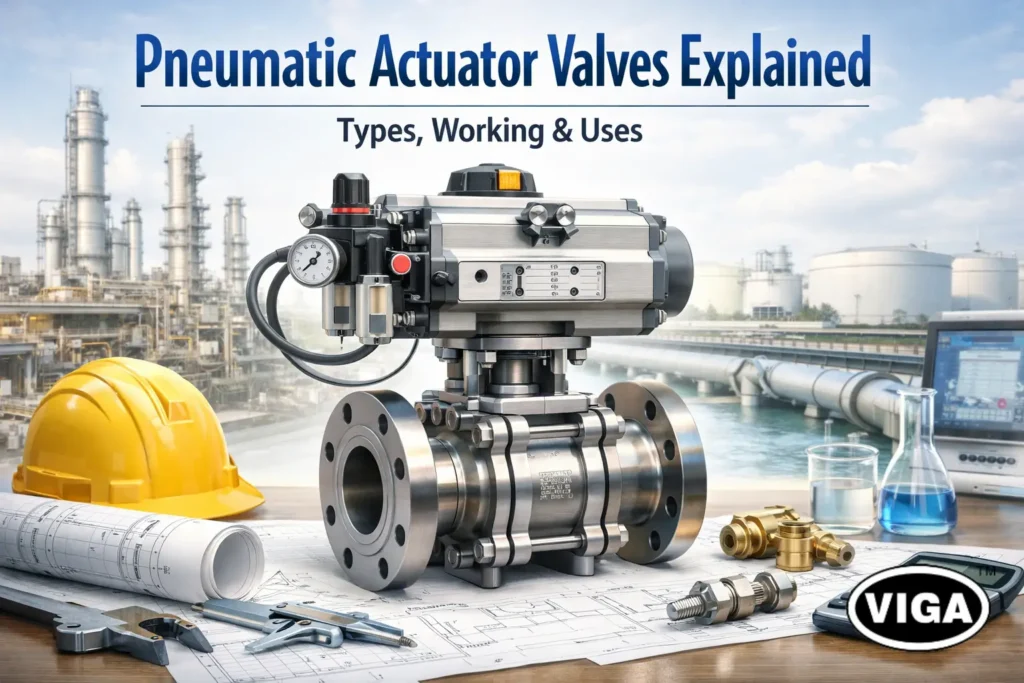
Pneumatics Actuator Valves Explained | Types, Working & Uses

From Switch to Motion — How Pneumatic Actuator Valves Bring Automation Alive! A control signal traveling down a copper wire is just information. It has no muscle. It cannot stop thousands of gallons of water rushing through a treatment plant or shut down a high-pressure steam line in a fraction of a second. To turn that low-voltage data into physical action, industrial automation relies on the brute force of compressed air. Pneumatics actuator valves act as the conversion point between the digital control logic of a PLC and the heavy mechanical reality of piping systems. While electric servos grab the headlines for precision in robotics, the process industries—Oil & Gas, Chemical, Water, and Food Processing—run almost entirely on pneumatic actuation. This preference isn’t about nostalgia. It is about physics. Compressed air systems provide a density of force, speed of response, and inherent safety that electrical systems struggle to match at scale. For the engineer or plant manager, understanding these components is not just about knowing how to open a pipe; it is about understanding the primary safeguard between efficient production and operational failure. This technical guide dissects the mechanics of pneumatic valve automation, from the torque curves of scotch yoke actuators to the critical sizing calculations required to prevent stall conditions in the field. What Are Pneumatics Actuator Valves? Technically, there is no single component called a “pneumatic actuator valve.” It is an assembly—a marriage of three distinct pieces of hardware that must be compatible to function. The Valve Body: The wetted part that controls the media (Ball, Butterfly, Globe, or Gate). The Pneumatic Actuator: The aluminum or steel engine that sits on top, converting air pressure into torque (rotary) or thrust (linear). The Mounting Hardware: A critical, often overlooked link. This includes the mounting bracket and the drive coupling. These must strictly adhere to ISO 5211 standards to ensure the actuator turns the valve stem rather than shearing it off. When these three act in concert, driven by a pilot signal, they form the automated unit. Unlike a manual valve requiring an operator’s physical presence, or a solenoid valve which is limited to small diameters (typically under 2 inches), a pneumatic actuator valve system uses the facility’s “fourth utility”—compressed air—to drive large industrial loads with high reliability. The system scales effectively. The same 80 PSI air supply can actuate a tiny 1/2-inch sampling valve or a massive 48-inch pipeline shut-off valve; the only difference is the surface area of the piston inside the actuator. How Pneumatics Actuator Valves Work (Step-by-Step) The operating principle relies on the relationship: Force = Pressure × Area. Since plant air pressure is generally fixed (typically oscillating between 80 and 100 PSI), manufacturers generate more force by increasing the surface area of the internal pistons. The sequence of operation typically follows this path: Signal Initiation: The PLC (Programmable Logic Controller) or DCS (Distributed Control System) sends a command. This is usually a 24VDC discrete signal (for open/close) or a 4-20mA analog signal (for modulating control). Pilot Actuation: This electrical signal energizes a coil in the solenoid valve—commonly a 5/2-way or 3/2-way valve mounted directly to the actuator via a NAMUR interface. Air Injection: The solenoid spool shifts, directing air into the actuator’s pressure chamber. Energy Conversion: As the chamber fills, air pressure builds against the piston face. Once the force generated exceeds the “breakaway torque” of the valve (plus the friction of the actuator itself), movement begins. Motion Transfer: In Rack and Pinion designs, the pistons push outward, rotating a central gear. In Linear designs, the piston pushes a stem directly down. Cycle Completion: As the valve reaches its travel limit (open or closed), the air pressure maintains the position (in double-acting units) or compresses a spring bank (in single-acting units). Single-Acting (Spring Return) vs. Double-Acting This is the most critical logic distinction in the specification process. Double-Acting (DA): Uses air to open and air to close. It gives the operator control over both strokes and is physically smaller and cheaper because there are no springs taking up internal volume. However, upon air failure, the valve acts unpredictably—it stays where it is, or drifts with flow pressure. Single-Acting (Spring Return / SR): Uses air to power the valve in one direction (usually compressing a heavy internal spring). When air supply is cut—intentionally or via accident—the mechanical spring energy drives the valve back to its “fail” position (Fail Close or Fail Open). This mechanical guarantee makes SR actuators the mandatory choice for active safety systems. Types of Pneumatic Actuator Valves Not all motion is the same. Engineers categorize these valves based on the mechanical movement required to cycle the flow. 1 Based on Actuator Motion Rotary Actuators (Quarter-Turn) Used for ball, butterfly, and plug valves. Rack and Pinion: The industry standard for sizes up to 12 inches. It provides linear torque output—meaning the force is consistent throughout the entire 90-degree rotation. Scotch Yoke: Designed for heavy-duty torque. The internal mechanics allow the piston to exert maximum leverage at the beginning (break) and end (seat) of the stroke, where valves usually stick. They typically experience a torque dip in the middle of the stroke (“run” torque), which must be calculated carefully against flow velocity. Vane Actuators: A niche design involving a paddle that swings in a chamber. They are very compact and use less air but struggle with high-pressure leaks over time. Linear Actuators (Rising Stem) Used for globe, gate, and diaphragm valves. Pneumatic Diaphragm: Recognizable by the large “mushroom” top. They use a flexible rubber sheet rather than a hard piston. This creates almost zero friction, making them the superior choice for control loops where minute position changes (hysteresis) matter. Piston Cylinder: Used for high-thrust applications, such as gate valves or high-pressure globe valves where a rubber diaphragm would burst. 2 Based on Valve Body Ball Valves The workhorse of on/off automation. Because the ball “wipes” against the seat during rotation, it handles dirty media well. The torque requirement is moderate but can spike if the valve sits static for weeks (“stiction”). Butterfly Valves Common in large water lines and HVAC. They require high torque relative to their size,

Moisture Separator
Blog

Moisture Kills Compressors! How a Moisture Separator Protects Them

The Hidden Enemy Inside Compressed Air Compressed air systems have an unavoidable flaw: they generate water. On a standard 80°F (27°C) day with average humidity, a 100 HP compressor brings in enough atmospheric water vapor to produce nearly 18 gallons of liquid condensate per shift. If that water isn’t intercepted immediately, it travels downstream to rust out steel piping, wash away essential tool lubrication, and destroy pneumatic valve seals. For plant managers and system designers, the “dryness” of the air at the intake doesn’t matter. What matters is the removal strategy after compression. The Moisture Seperator is the first line of mechanical defense in this battle. Unlike complex air dryers that remove invisible vapor, a moisture separator tackles the bulk liquid—the heavy flood of water that overwhelms filters and ruins production cycles. Running a compressed air system without one is an open invitation to equipment failure. What Is a Moisture Seperator in Compressed Air Systems? A Moisture Seperator (often listed in parts catalogs as a Moisture Separator) is a vessel installed directly in the discharge piping of a compressor. It is a mechanical removal device designed to physically separate bulk liquids, oil aerosols, and solids from the air stream using inertia and gravity. It is critical to understand the distinction: A moisture seperator removes liquid water; it does not lower the dew point. In an air system schematic, the separator sits between the compressor (specifically the aftercooler) and the air treatment assembly (dryers and filters). It serves as the “roughing” filter, removing the largest volume of contaminants so that delicate downstream equipment can function properly. How Moisture Forms Inside Air Compressor Systems To fix the problem, you have to understand the physics creating it. Water in compressed air is not an accident; it is a direct result of thermodynamic laws. Concentration: A compressor takes a large volume of air—roughly 8 cubic feet of ambient air to make 1 cubic foot of compressed air at 100 PSI—and squeezes it. That compression process concentrates the invisible water vapor present in the atmosphere. Heat vs. Cooling: During compression, the air gets hot (often leaving the pump element above 200°F). Hot air can hold significant amounts of water vapor. The Dew Point Crash: As the air leaves the compressor and enters the distribution piping or the aftercooler, it cools rapidly. Cold air cannot hold as much vapor as hot air. The excess moisture has nowhere to go, so it changes phase from gas to liquid condensate. This phase change typically happens right at the compressor outlet. If a compressed air moisture separator is not positioned here to catch the liquid immediately, that condensate is blown down the pipe at 100+ PSI. How a Moisture Seperator Works (Step-by-Step) The vast majority of industrial separators utilize “cyclonic” or “centrifugal” action. They have no moving parts inside the housing, which makes them durable and reliable if sized correctly. Directional Intake: Compressed air enters the housing through a directional vane or contoured inlet. This geometry forces the linear airflow into a high-velocity spiral. Centrifugal Force: As the air spins violently inside the housing, distinct g-forces are created. Water droplets, oil mist, and dirt are significantly denser than the air itself. The spin flings these heavy contaminants outward against the housing wall. Friction and Gravity: Once the water hits the metal wall, friction kills its velocity. The droplets combine into larger drops and slide down to the “sump” (the collection area at the bottom of the bowl) via gravity. The Vortex Finder: A specialized tube located in the center of the housing allows the dry air—which stays in the middle of the vortex due to lower density—to rise and exit the outlet port. Baffle Protection: Most units have a baffle near the bottom to ensure the turbulent air doesn’t dip into the sump and re-absorb (re-entrain) the dirty water already collected. Types of Moisture Separators Used in Industry Different flow rates and applications call for specific separation technologies. 1 Mechanical Moisture Separators Centrifugal Type: The standard design described above. It offers low pressure drop and high efficiency (removing 99% of bulk liquid) assuming steady airflow. It relies on velocity to create the “spin,” so correct sizing is non-negotiable. Baffle (Impingement) Type: These rely on a tortuous path rather than a spin. The air is forced to make sharp turns around internal plates. The water momentum carries it straight into the plate where it drains off. These are excellent for variable flow rates but often create a higher pressure drop (energy penalty) than centrifugal types. 2 Coalescing Moisture Separators Strictly speaking, coalescers are filters, but they are often grouped into this category. They utilize a borosilicate glass matrix to capture oil aerosols and fine mists that mechanical separators miss. Engineering note: A coalescer creates a barrier. If hit with a slug of bulk water, a coalescing element will saturate, causing a massive pressure spike. It must always be installed downstream of a mechanical moisture seperator. 3 Moisture Seperator vs Air Dryer These terms are not interchangeable. Moisture Seperator: Removes liquids. Leaves the air at 100% relative humidity. Air Dryer (Refrigerant/Desiccant): Removes vapor. Reduces relative humidity. A system needs both. A separator without a dryer creates “wet” air as soon as the pipe cools further. A dryer without a separator will flood and fail. Why Moisture Is Dangerous for Compressors & Pneumatic Equipment Condensate in the lines is more than just water; it is often an acidic slurry of water, atmospheric hydrocarbons, and compressor oils. This mixture is aggressive. Pneumatic Automation Failure: High-speed solenoids and actuators rely on factory-applied grease. Water washes this grease away. The result is “stick-slip” friction, causing valves to jam and cylinders to seize. Corrosion Scale: Iron and steel piping corrodes rapidly in the presence of warm, oxygen-rich water. This rust eventually flakes off, traveling downstream to clog fine orifices and blast nozzles. End-Product Spoilage: In spray painting, a single droplet of oil/water creates “fisheye” craters. In food packaging, it contaminates the sanitary environment. Freezing: In outdoor facilities, accumulated condensate freezes in winter. This blocks flow and can burst expensive rigid piping or housing bowls. Benefits of Installing a Moisture Seperator The

Solenoid Valves
Blog

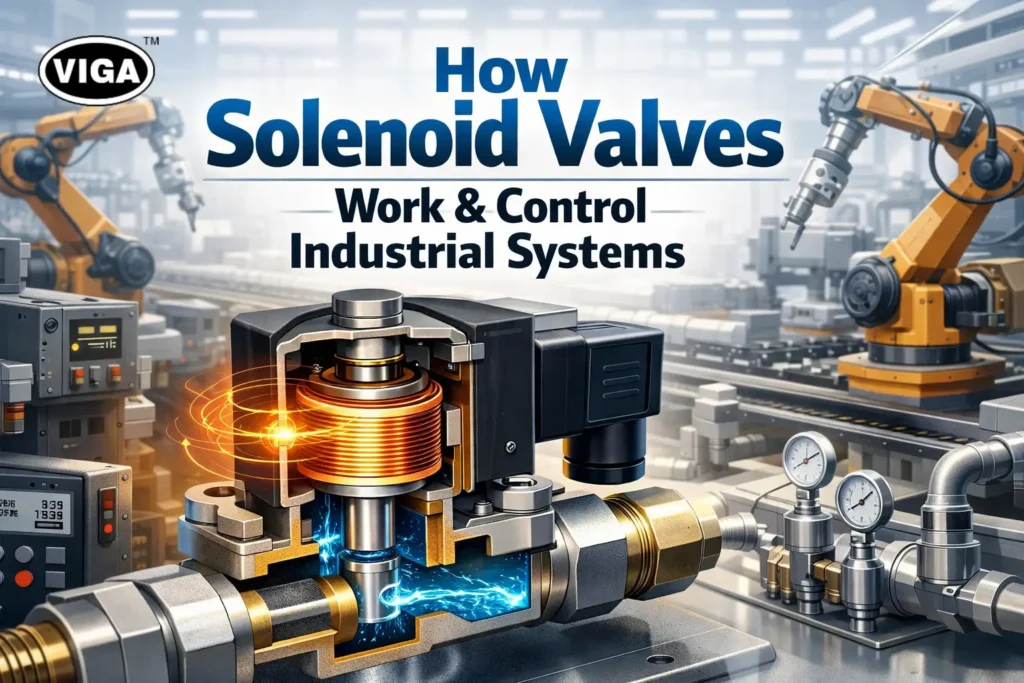
How Solenoid Valves Work & Control Industrial Systems

One Tiny Coil That Controls the Whole System — Inside the World of Solenoid Valves! The Power of a Tiny Coil The efficiency of every modern factory, laboratory, and mechanized facility stands or falls based on one often-overlooked, small piece of hardware: the Solenoid Valve. Look, the reality is simple. As control systems professionals, install a vast, intricate automation architecture—network protocols, advanced PLCs, sophisticated sensor packages—and what brings all that expensive logic down? Usually, a three-inch component. By faithfully and reliably standing as the precise point where electrical thought instantly translates into powerful mechanical force. See the stories about entire automotive final assembly lines coming to a screeching, emergency halt, only to find the root cause was one tiny coil on an upstream cylinder’s air valve that decided to stop taking current. The economic loss of that stoppage makes the choice of the correct component paramount, underscoring its foundational role in all Industrial Automation. This small device is far more than an on/off switch; it’s the high-speed flow control valve that governs literally everything that moves, making it indispensable for system reliability and performance. Getting its application wrong means you’ve built your highly tuned race car on square tires. What Is a Solenoid Valve? So, what is a solenoid valve, at its core? It’s the ultimate electro-mechanical actuator, designed for rapid, remote control over the flow of any type of media. In plain terms, it uses the science of magnetism to operate a physical plug (a seal or diaphragm) that allows fluid, air, or gas to flow through a specific line. To simplify the expertise: Think of a solenoid valve as an intelligent gatekeeper, controlled entirely by a weak electrical pulse. This is an absolutely crucial component within any fluid control systems, where we’re managing materials that might be hazardous, expensive, or under extreme pressure. Two main parts in any good solenoid assembly, establishing its nature as an electromagnetic valve: The Coil (The Logic): This is the core. It is the tightly wound magnet wire. It receives its digital command (typically from 12VDC to 240VAC). This coil, when energized, immediately converts electrical current into usable magnetic force. The Valve Body (The Actuator): This is the metal or composite structure containing all the hydraulic bits: the fixed ports, the sealing orifice, the spring, and the internal ferromagnetic steel rod known as the plunger or armature. In pneumatic systems, solenoids handle high-pressure air used to operate actuators; conversely, they are used for simple on/off commands on a municipal water line. That universality, allowing one design principle to cover everything, is its main engineering strength. How a Solenoid Valve Works The key to mastering this hardware lies in fully grasping the simple physics driving the solenoid valve working principle. The objective is to produce enough electromagnetic force to swiftly defeat the combined hydraulic pressure and the spring’s stiffness—all without a huge power draw. Let’s trace the power flow in a standard Normally Closed (NC) valve configuration. This should provide the solenoid valve coil working explained clarity you need: Resting State: Without power, the engineered return spring is actively pushing the plunger downwards, keeping the durable seal tightly compressed onto the flow orifice. The hydraulic force of the media line is also working in the same direction, further securing the closed seal. Flow is firmly blocked. Electrical Activation: The PLC sends an “open” signal. The solenoid valve coil immediately receives its specific operating current. Magnetic Field Genesis: Instantly, current flow transforms the coil into a temporary electromagnet. The goal isn’t gentle power—the solenoid must rapidly develop a powerful magnetic pull concentrated on the center of the coil’s core. The Plunger Movement: This immense magnetic pull vertically overcomes the tension of the return spring (which is quite strong) and simultaneously defeats the internal hydraulic pressure. The plunger is pulled forcefully upwards, a purely physical translation of energy. The Flow Open Process: As the plunger ascends, it pulls the sealing mechanism away from the valve seat, clearing the path. Media immediately flows from the input to the output. This is precisely how solenoid valves control flow at its critical juncture. Deactivation (Close Command): The electrical current is instantly removed. The magnetic field immediately and entirely collapses. Without that counteracting magnetic force, the dedicated return spring immediately snaps the plunger back down, seating the seal perfectly and restoring the flow barrier. The near-zero latency of this operation makes it perfect for fast-action valve actuation. Why Solenoid Valves Are the Backbone of Automation In the running automated processes, the speed, precision, and simplicity that solenoids offer have no effective parallel for basic binary (on/off) media control. Without them, Industrial Automation it would grind to a clumsy halt. Exceptional Response Time: The best solenoid valve units are built to shift and seal in under 20-30 milliseconds. Compare that to the two-second operation time of a standard pneumatic actuator moving a larger butterfly valve! That high-speed sequencing capability is fundamental to keeping high-output machinery running effectively. Simple Remote Control Interface: A great strength of the solenoid valve in automation is its easy interface. Your sophisticated $100,000 process controller can reliably command thousands of individual, low-voltage solenoid valves using simple digital output cards. This makes distributed, large-scale flow control management highly affordable. The Crucial Safety Interlock: This is a safety factor. NC Solenoid Valves provide the simplest and most cost-effective fail-safe condition possible: no power equals no flow. Linking these devices directly to an emergency stop or safety circuit ensures that if all power is dropped, hazardous motion, pressure, or chemical supply lines are automatically cut. This adherence to high standards for safety risks makes them preferred process control valves across many applications. Types of Solenoid Valves Explained Clearly There is no one “right” solenoid—only the right type for the application. The selection requires matching the application’s demand (failure state and flow dynamics) to the valve’s physical capabilities. Knowing the difference here saves both time and major capital investment. Core Classification: The Failure State Choosing between the two fundamental options dictates how your entire system behaves in a power failure. Type of Valve De-Energized Status (Default State) Expert Tip/Use-Case Priority Normally Closed (NC) Physically Closed: No flow, firmly sealed. Mandatory when a controlled shut-off upon power failure prevents product loss or is safer (e.g., closing fuel lines, isolating power cylinders). Normally Open (NO) Physically Open: Flow is

Pneumatic Cylinder
Blog

Pneumatic Cylinder Guide for Beginners | Working & Types

They Move Everything — A Beginner’s Guide to Pneumatic Cylinders That Do All the Work! The Power Behind Industrial Movement Step one foot onto a modern automated factory floor and one machine quickly becomes the star: the humble, hardworking cylinder. They’re absolutely everywhere. Clamping this piece, shoving that item down the line, holding something tight for a weld. If it’s fast and straight-line, chances are a pneumatic cylinder is driving it. The entire principle of reliable industrial automation rests on these precise, powerful, and ridiculously common movements. No matter how clever the electronics or robotics get, at some point, you still need reliable physical force, right? That force is delivered, quietly, efficiently, and cleanly, by the system of air-powered workhorses we’re talking about here. For anyone who’s ever had to spec a new assembly jig or simply diagnose a slow packaging machine, you quickly learn you have to know these cylinders cold. In this guide, we’re going through all of it. We’ll break down the very simple pneumatic cylinder working principle, clear up confusion on component selection, and share some real-world secrets on why air quality affects cylinder life. No more guessing games! What Is a Pneumatic Cylinder? Simply put, it’s the motor for straight-line pushing and pulling. A pneumatic cylinder is the machine element that grabs air pressure from the compressor—that costly utility you run all day—and turns it into clean, controllable physical movement. Forget formal descriptions. Think of it like this: A heavy, rugged steel tube (the cylinder) is completely sealed off. Inside is a strong piston connected to an external rod. You shove high-pressure air into one end, and it instantly forces the rod out the other end. That’s it. It’s an air-powered actuator. In a catalogue, you’ll see the official title of a linear motion actuator, because that rod doesn’t spin; it goes back and forth. You won’t use these for driving conveyors—you’ll use them for things like operating machine safety gates or punching small holes. Any job that requires a single, powerful push or pull stroke is best handled by this kind of pneumatic actuator. They are rugged simplicity. How Pneumatic Cylinders Work The elegant thing about the pneumatic cylinder working principle is that it is a pure demonstration of pressure: when force has nowhere to go but one direction, it goes that direction with all its power. Role of Compressed Air The air comes from your facility’s system, but its path is strictly controlled by valves. That valve directs the high-pressure compressed air actuator energy toward the cylinder’s chambers, effectively deciding where the muscle power is needed at that moment. The moment that high-pressure source is hooked up, the system is primed. Piston and Cylinder Movement The sealed, interior piston is what actually gets the job done inside the casing. It’s sitting in there, essentially separating the volume of the tube into a ‘forward’ side and a ‘back’ side. You want to make the rod go out? You create more pressure on the back side. Conversion of Air Pressure into Linear Force Your directional valve clicks, opening the flow and dumping air at high pressure into the chamber behind the piston head. At the same instant, the front chamber air needs a fast path out—that air is instantly released through a silencer. Since the force against the back of the piston is massive and the force against the front of the piston has gone to zero, the pressure differential creates a swift, continuous linear force until the rod hits the end stop. It’s all about creating and managing a massive imbalance. Fast and dependable every time. Main Components of a Pneumatic Cylinder If you’re expected to maintain these, you need to know which parts are disposable and which parts are critical structure. When checking component specifications, pay close attention to the structural aspects. Cylinder Barrel: It’s the fixed body of the tool. Key design point: the inner surface must be flawless, with zero nicks or rust spots, or your seals won’t last ten minutes. Piston and Piston Rod: The piston is the round head that air pushes. The piston rod is the thick, hardened steel bar that actually extends out into the machinery. A bent rod is an almost instantaneous trip to the scrapyard. End Caps (Heads): These are the structural lids that seal the unit shut and provide the necessary Air Ports to feed pressure. They often contain the mounting threads and shock absorbers. Seals and Bearings: These two wear parts define the entire lifespan. The Seals are elastomeric rings that contain the pressure, and the Rod Bearings are the bronze collars that ensure the rod stays straight. Failures in this area mean immediate loss of power. Types of Pneumatic Cylinders Explained Simply Which type you use boils down to how complex the application is—can you use simple return action, or do you need control for both movements? Single-Acting Pneumatic Cylinders This cylinder has only one power stroke: the push (or the pull). It only uses one air line. When you stop supplying air, a pre-installed return spring takes over, shoving the piston back to the home position. Key trade-off: It saves on air consumption, but the piston has to work against that internal spring force, meaning its overall pushing strength is significantly less than the double-acting unit. Simple for tasks like quick door openings. Double-Acting Pneumatic Cylinders This is the machine’s choice for precision control. A double-acting pneumatic cylinder has power on both ends: air to push out, and separate air line control to pull it back in. Key advantage: Provides maximum force for the cylinder’s size in both directions. Essential for pneumatic motion control applications that require high force throughout the entire stroke length. It does, however, use twice the volume of compressed air. Rodless Pneumatic Cylinders Imagine trying to stabilize a long piston rod when moving a 400-pound load over a 15-foot distance. Impossible. The rodless pneumatic cylinders solved this problem by sealing the air in the barrel but letting an external sliding saddle do the heavy movement along a guide. They save tremendous space and are vital in large gantry and positioning systems. Where Pneumatic Cylinders Are Used These units are the quintessential industrial automation components because their usage is so widespread and reliable. Manufacturing and Assembly Lines: Their high

Why Your Air Compressor Needs the Right Air Filter
Blog

Why Your Air Compressor Needs the Right Air Filter

Let’s start with a foundational, critical fact that is often missed in the chaos of the shop floor: Your machinery lives or dies by the quality of its air. Think about your own lungs—they require clean, filtered air to survive and function optimally. Now, translate that necessity to your complex industrial system. For the industrial world, the compressed air supply is an omnipresent utility, the literal engine behind countless operations. The crucial comparison here is immediate and profound: If humans can’t survive polluted air, neither can your compressor. We see the damage all the time: that high-value CNC machine whose valves are sticky, that sudden spike in abrasive dust clogging a critical high-precision solenoid. This is the handiwork of dirty compressed air, the subtle saboteur lurking in the lines. The only thing standing between microscopic, corrosive filth and your most expensive equipment is the unsung hero—the Air Compressor Filter. Take, for instance, a large factory where metal filings and water vapour are drawn in every second. When those impurities meet high pressure and move into the pneumatic valves, it inevitably results in damaging wear and unplanned downtime. This happens because why compressor needs air filter isn’t simply about capturing dirt—it’s about preserving a controlled operating environment. Neglecting a robust compressor air filtration strategy is choosing risk over reliability. In this guide, we cut through the confusion and explain exactly why and how your filtration strategy determines your company’s uptime and financial health. A perfectly functioning, long-lasting system must deliver demonstrably clean compressed air—that much is certain. Why Clean Air Matters in Compression Systems We rely on compressed air so fundamentally that we often stop thinking about what it actually is. It’s often referred to as the “industrial oxygen”, indispensable power that drives robotic actuators, sorting lines, and material handling systems. Yet, air that enters your system is rarely pure; it’s loaded with everything from local street dust to pollen, and worst of all, latent moisture. Here’s the danger: as the air volume is crushed from atmospheric pressure to the required system pressure, those atmospheric contaminants become intensely concentrated. The parts per million of moisture and dust is multiplied, effectively turning a mild atmospheric irritant into a corrosive, damaging cocktail inside your equipment. The real cost comes in the hidden breakdown that results in the costly effects of dirty compressed air. You get: Rusting components as water condenses downstream. Clogs formed by fine particulates and condensed oil aerosols. Wasted energy fighting back-pressure and flow restriction. An operation’s credibility and bottom line hang in the balance, requiring an immediate elevation of technical due diligence, what experts call a solid compressor air filtration program. What Exactly Is an Air Compressor Filter? If your compressor is the engine, the Air Compressor Filter is the specialized guardian standing between the volatile outside environment and your critical tools. It is, perhaps, most easily visualized as a super-industrialized version of your kitchen’s coffee filter, tasked with far more complex particle removal and chemical capture. What is the main role of an air compressor filter? Its three-fold primary purpose is: capturing solids, facilitating moisture separation, and adsorbing oil and solvent vapors. It isn’t merely a physical screen, but an engineered separator. In the physical setup of a Clean Compressed Air System, you don’t typically see just one filter; you see a ‘filter train.’ Filters are intentionally placed downstream from the compressor’s receiver tank. Why there? Because the compressed air needs time to cool down. As it cools, the hot vapour quickly turns back into liquid water (condensate and aerosols). It is far more efficient for the modern Air Compressor Filter to deal with liquid droplets and sticky residues than try to scrub pure gas. That staged, strategic installation is fundamental to running a professional Compressed Air System. How Dirty Air Damages Your Compressor & Pneumatic Tools When air contamination breaks through your primary defenses, the process moves instantly from productive function to guaranteed destruction. This rapid breakdown demonstrates why paying for clean air is simply smarter than paying for replacement parts. The problem boils down to abrasive damage and systemic clogs, both leading to catastrophic component stress. Internal Component Seizure and the Sandpaper Effect: Fine dust and dirt aren’t filtered, but they’re accelerated. They create a “sandpaper effect” inside air-driven components, increasing friction on critical seals, pistons, and rotors. The result? Premature wear, reduced stroke consistency, and seals that start leaking precious pressure. This mechanical damage confirms why clean air is so vital—otherwise, it’s instant Compressor Damage. The Ruin of Seals and O-Rings: High heat and consistent exposure to contaminated water condensate drastically accelerates the degradation of rubber and plastic seals. This failure manifests as countless, expensive leaks throughout your system. Once air is leaking, your system’s required run time increases exponentially to compensate, undermining overall compressor efficiency. Rapid System Failure and Clogging: Perhaps the most frustrating immediate Effects of Dirty Compressed Air is system stalling. Oil aerosols that condense in cool air lines combine with dust to create sticky sludge. This thick grime jams and obstructs the fine tolerance control components within critical spool and pilot valves, leading to near-immediate pneumatic system failure that requires hours of troubleshooting and manual valve teardown. Negating Tool Reliability: Let’s be honest: if you want to know how air filters protect pneumatic tools, look at the replacement bills. Unfiltered, dirty air voids warranties because manufacturers know that moisture and grime erode the finely tuned lubrication within an air tool, causing motors to bind up and bearings to rust prematurely, confirming that using Dirty Compressed Air on precision tools is financially suicidal. Types of Air Compressor Filters Any expert will tell you: if your filtration system uses a single element to do a complex, multi-layered job, you’ve set yourself up for early failure. Filtration systems rely on a tailored, step-by-step approach. Types of air compressor filters must be selected based on the specific type of impurity you are trying to mitigate, showcasing a depth of professional Expertise. Filter Type Primary Action / Location Contaminant Target Rationale for Use General Particulate First stage (bulk pre-filter). Large solid particle removal (dust, rust, dirt). Protects the more delicate, high-value filters downstream. Coalescing (General Duty) Middle stage. Oil aerosols, condensed water, and fine solids (up

FRL Unit
Blog

What an FRL Unit Does and Why Your Pneumatic System Needs It

Your Pneumatic System Is Useless Without This — Know What an FRL Unit Does! Your pneumatic system can fail in seconds without an FRL unit. It may sound overly dramatic, but any seasoned maintenance engineer will confirm it’s a sobering fact. It’s like pouring low-grade, sandy fuel into a precision engine. You know the engine won’t last long, right? The same basic rule applies in industrial automation: quality power is necessary for system longevity. I’ve personally seen expensive machinery—a $50,000 piece of equipment—come to an immediate, dead stop. The cause wasn’t a PLC failure or a burnt-out motor. It was a simple, seized-up solenoid valve, crippled by condensation-induced rust because its air supply lacked proper preparation. The lost production time on that factory floor far exceeded the cost of a hundred FRL units combined. This is exactly why the FRL Unit (Filter, Regulator, Lubricator) is universally regarded as the critical component in air preparation. Without this essential trio, the very source of your factory’s power—compressed air—shifts from an energy medium to a damaging contaminant. What Exactly Is an FRL Unit? If you’re new to the topic and asking, “What is an FRL unit?” here is the most straightforward explanation you’ll find: FRL stands for Filter, Regulator, and Lubricator. It’s an integrated, three-part system installed in your compressed air line, positioned directly upstream of the machinery it serves. Its fundamental mission is three-fold: to scrub the air clean, to manage the pressure, and, often, to condition the air with a fine oil mist. Raw, untreated compressed air from a large industrial compressor is surprisingly harsh. It’s hot, full of condensed water vapor, microscopic grit, and minute particles of burnt compressor oil. If this “dirty air” hits delicate seals and internals, it’s highly corrosive and acts like a steady stream of liquid sandpaper. The complete Air Filter Regulator Lubricator combination cleans this corrosive medium, turning it into a stable, conditioned power source suitable for precision tools and sensitive industrial machinery. Why Every Pneumatic System Is Useless Without an FRL Unit You might look at the cost of an FRL and decide to “value engineer” it out of the setup. This choice is, unfortunately, a guarantee of catastrophic, non-preventable system failure. Importance of FRL Unit in Pneumatic Safety and Longevity: Moisture Damage: Condensation within a compressor’s storage tank creates massive amounts of water. Without the Filter, this water rushes downstream, stripping away the necessary factory grease inside tools and cylinders and causing instant rusting of critical metal components. Pressure Inconsistencies: The demand on a compressor constantly fluctuates. A tool designed for a steady 90 PSI can be suddenly blasted with 120 PSI or more from the line. The Regulator acts as a crucial barrier, preventing this kind of shock and seal blowout. Increased Tool Wear: High-speed air motors require constant, fresh lubrication. Without the Lubricator component supplying a fine mist, internal metal-on-metal friction increases exponentially, leading to bearing failure, component seizure, and premature burnout. Skyrocketing Maintenance Costs: Understanding how an FRL unit protects pneumatic equipment is simple math. A good unit costs anywhere from $50 to $200. An unpreventable production stoppage caused by a seized cylinder on your line can cost upwards of $5,000 per hour in lost revenue. From the point of view of safe, reliable engineering, running any piece of machinery off of raw air is negligent. The installation of an Industrial FRL Unit is a core component of preventative maintenance and a crucial insurance policy. Deep Dive: How Each Component Works To truly appreciate the FRL Unit Working Principle, you need to understand the physics governing the three distinct components. They work in tandem but perform separate, non-negotiable tasks. ✔ Filter (F) — The First Line of Defense Incoming air rushes into the filter bowl. Special vanes (deflector plates) force the air into a fast, downward spiral, creating a powerful cyclone (centrifugal force). This action flings heavier, larger contaminants (like water slugs and heavy dust) against the sides of the bowl where gravity allows them to drain. The now partially-clean air passes through a finely porous sintered element (typically 5 to 40 microns) to trap any remaining, fine dust particles. Primary Job: Aggressive debris and moisture removal in air lines. ✔ Regulator (R) — The Control Center Once cleaned, the air moves to the regulator section. Inside, a flexible diaphragm balances against a mechanical spring. You “set” the required pressure (e.g., 6 Bar) using the large knob. This control maintains a rock-steady output pressure. If the downstream pressure unexpectedly increases, a relief feature “bleeds off” the excess air to maintain your setpoint. Primary Job: Precise Air pressure regulation. This creates consistent torque, clamping force, and operating speed for your final equipment. ✔ Lubricator (L) — The Life Extender Finally, the conditioned air enters the lubricator bowl. It utilizes the fundamental Venturi effect: air accelerates quickly over a tiny opening, creating a localized vacuum. This negative pressure then sucks (or “draws”) specialized oil from the reservoir and instantly atomizes it into a fine, highly stable mist. This oil mist is carried to and deposits a necessary protective film on every valve, cylinder, and high-speed moving part. Primary Job: Critically reducing friction and preventing internal component corrosion. Benefits of Using an FRL Unit in Industrial Pneumatic Systems Investing in a high-quality Pneumatic FRL System delivers a powerful return on investment (ROI) that you can immediately observe on your shop floor. Extended Equipment Lifespan: Equipment that receives clean, consistently-pressurized, and lubricated air routinely lasts three to five times longer than those fed with raw air. Reduced Downtime: You drastically cut the risk of emergency failures. Fewer unplanned stops means your manufacturing processes keep moving predictably. Energy Efficiency: A regulated pressure saves energy. Why waste expensive compressed air feeding a line at 110 PSI when the tool you’re powering only needs 80 PSI? The regulator stops this waste. Enhanced Safety: Equipment pneumatic tools safety is based on predictable force. An FRL mitigates the significant risk of pressure spikes that can lead to catastrophic component failure, hose whipping, or a dangerous breakdown. Improved Air Quality: Protecting expensive downstream components (like proportional valves) from upstream particulate contamination. Signs Your Industry Needs an FRL Unit Right Now If you are seeing any of these

Scroll to Top