
Differential Pressure Switch: Working Principle, Types & Applications
A differential pressure switch is a device that measures the difference between two pressure points and activates an electrical contact when a preset pressure difference is reached. It is widely used in HVAC systems, industrial processes, and filter monitoring applications.
Differential Pressure Switch: Technical Manual for Industrial Deployment
If you are currently wrestling with erratic equipment shutdowns or trying to prevent the catastrophic failure of an expensive pump, you are likely looking for a differential pressure switch. Most engineers make the mistake of buying the first catalog item they see that fits the pipe diameter. That’s a gamble. A bad switch choice results in either ghost alerts that haunt your control room or, worse, zero response during a true over-pressure emergency.
To manage your systems effectively, you need to understand how the physical pressure differential triggers mechanical movement. This isn’t about marketing—it’s about hardware.
Working Principle of Differential Pressure Switch
When we talk about a differential pressure switch, we aren’t talking about the absolute pressure relative to the earth’s atmosphere. We are looking at a specific math problem: P1 minus P2 = Delta P.
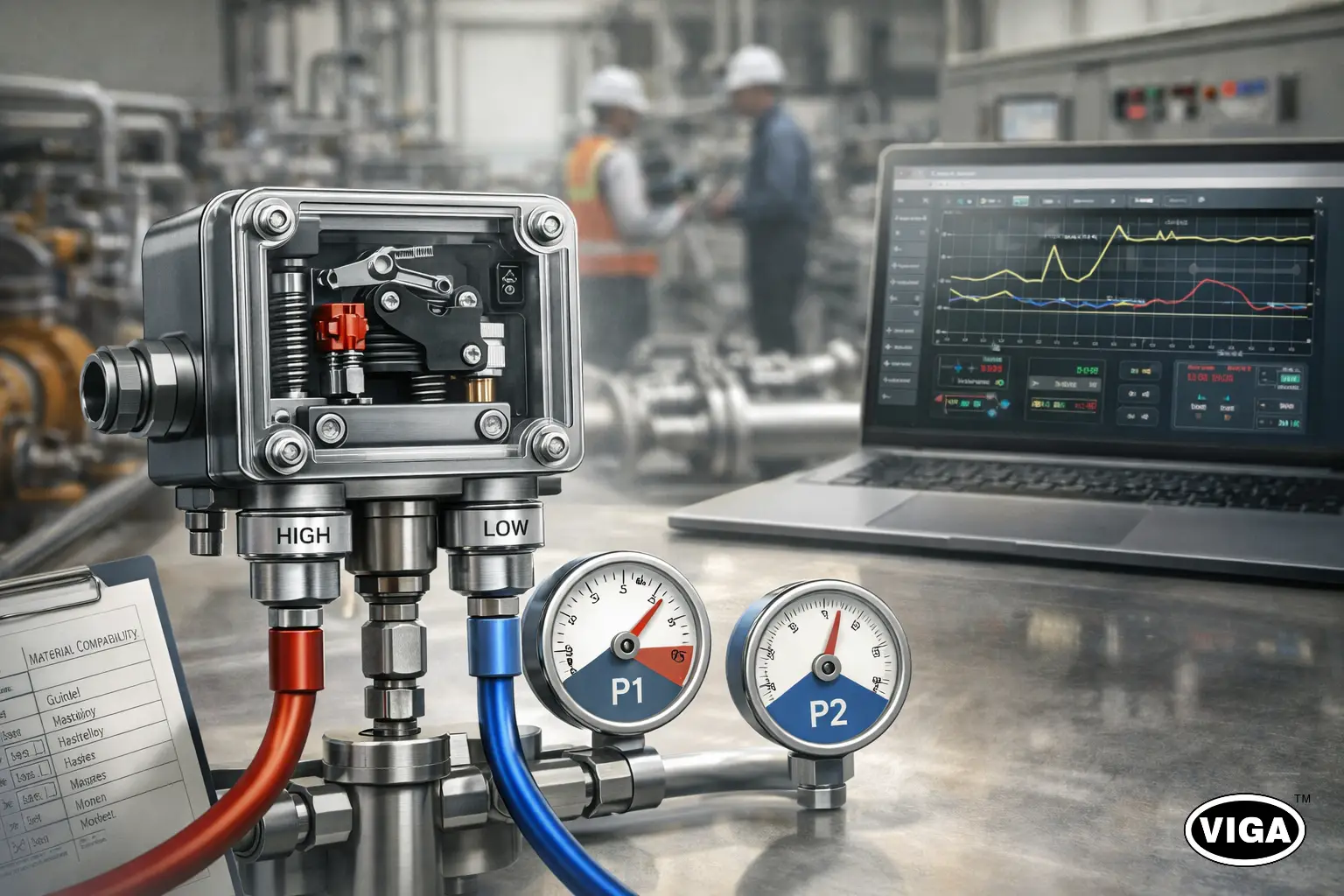
Inside the housing, the magic happens in a sealed chamber. Imagine two separate ports. Port High (P1) is your supply or inlet side. Port Low (P2) is the downstream or suction side. A flexible element sits between them. In low-pressure setups, that element is a diaphragm (think of a sturdy rubber drumhead). In high-pressure industrial lines, it’s a precision-ground piston or a metal bellows.
As pressure mounts at P1, the force pushes against the resistance of an internal spring. Once that force outweighs the spring, it trips a switch mechanism—usually a microswitch. It’s an “all or nothing” logic. The PLC sees a circuit closure, and suddenly, you have an actionable status update.
Why Logic Fails (And Why It Doesn’t)
If your industrial differential pressure switch feels “sluggish,” you are likely facing friction. This is why we insist on quality. A cheap switch will have “sticktion” (static friction) where the piston doesn’t slide perfectly. You might set it to trigger at 5 PSI, but due to grime or poor tolerances, it doesn’t fire until 7 PSI. In high-risk chemical environments, that 2 PSI difference is the gap between a process safely stopping and a pipe burst.
Key Factors for Selecting a Differential Pressure Switch
Selecting a switch isn’t a task for an intern. You need to verify four things before you open a PO.
The Media Compatibility Audit
Do you know what your “wetted parts” are made of? If you put a copper-beryllium sensing element into a system that uses aggressive, sulfur-rich process media, that metal is going to pit and fail within weeks. For aggressive fluids, stainless steel (316L) is the floor, not the ceiling. For acidic environments, look for Hastelloy or Monel housings. Never guess; check the material compatibility charts in the vendor’s PDF manual.
The Static Pressure Trap
Here is a mistake that burns million-dollar budgets: confusing the setpoint range with the proof pressure.
- Setpoint Range: The actual window (say, 0–20 PSI) where you want the switch to click.
- Static (Line) Pressure: The massive, crushing force the entire casing must handle just by existing in the pipeline (often 300 to 3000 PSI).
If you have a 10 PSI range switch, but you put it on a 1500 PSI hydraulic line, the casing won’t hold. The internal pressure differential is tiny, but the ambient line pressure is enormous. Ensure your DP pressure switch housing is rated for the system’s “Maximum Working Pressure.”
The “Deadband” Debate
Hysteresis, or the “deadband,” is the space between the on and off trigger points. If your switch has a fixed, non-adjustable deadband, and your system has pump pulsations, you are going to experience “chatter.”
Chatter is the rapid-fire opening and closing of your relay contacts. It creates heat, sparks, and electrical interference. In a high-vibration environment, you must have an adjustable deadband so you can “tune out” the minor pulses that aren’t real process anomalies.
HVAC and Filter Applications
Let’s talk about the most common field application: differential pressure switch for air filters.
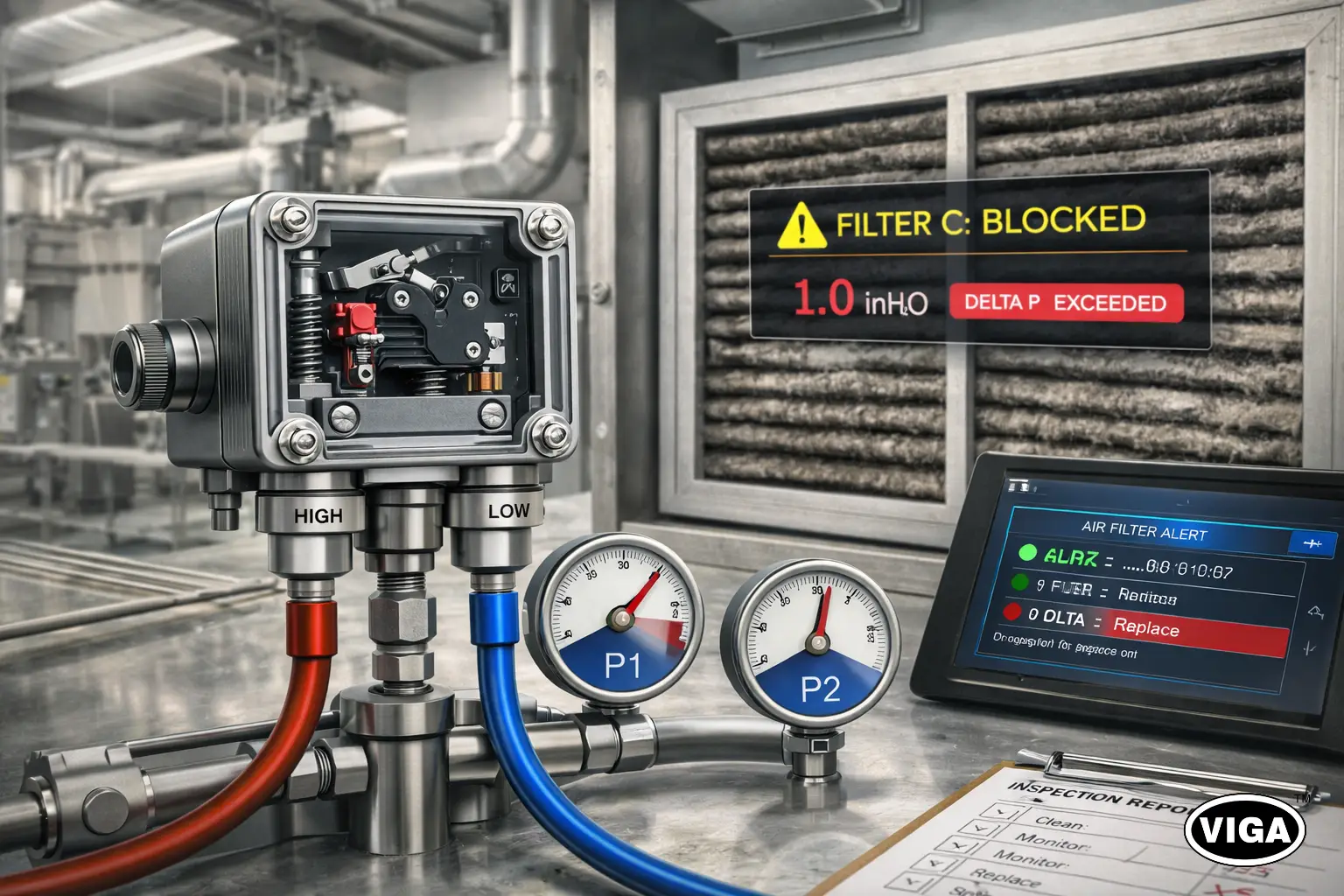
Your building management system (BMS) lives and dies by air flow. As your MERV 13 or HEPA filters catch dust, they create back-pressure. If you don’t track this, you’re essentially suffocating your air handler unit (AHU). The fan tries to push through a clogged wall of dirt, drawing more amps and potentially tripping the breaker.
A good HVAC differential pressure switch is set at a point representing the “end of life” for the filter. When the delta-p hits, say, 1.0 inch water column, the switch clicks, sends a dry contact signal to your building controller, and someone gets an email: “Filter C, Blocked.”
This is maintenance gold. It moves you from “calendar-based maintenance” (changing perfectly good filters because it’s the 1st of the month) to “condition-based maintenance.” You only pull a ladder out when you actually need to change the media.
|
Feature |
Low-Range Switch |
High-Range Switch |
|
Typical Range |
0.1 to 10″ Water Column |
10 to 500 PSI |
|
Common Use |
Airflow/Cleanroom |
Hydraulic/Lubrication |
|
Sensing Style |
Diaphragm |
Piston |
|
Sensitivity |
Extremely High |
Moderate/Rugged |
Installation Best Practices
Don’t install a switch just anywhere. The location is just as important as the component quality.
- Mounting Plane Matters: Some low differential pressure switches use gravity to help return the internal mechanism to a neutral position. If your installation guide shows “Mounting: Vertical,” and you mount it at a 45-degree angle, you are introducing artificial drift. Gravity will influence the trigger point. Stick to the vertical.
- Impulse Line Length: The pipes connecting your switch to the main flow line are the most vulnerable parts of your entire circuit. Keep them short. The longer the impulse line, the more chance you have of fluid buildup, clogging, or liquid hammering.
- Vibration Damping: If the pipe is shaking, the switch should be somewhere else. Build a simple mounting rack nearby. Connect the switch to the process line with stainless steel flexible tubing. This disconnects the sensor from the physical vibration of the pump or compressor.
Expert Pro-Tip: Use a “three-valve manifold” assembly when installing your switch on liquid lines. This allows you to vent the lines and isolate the switch for testing without shutting down the entire facility. If you aren’t using a manifold, you are creating an environment where routine maintenance will always be resisted by your production floor managers.
Calibration and Accuracy
When the annual inspection rolls around, don’t treat the switch like a thermostat. Use a standard.
- First, Zero It Out: You must reach true zero delta-p to start. If the switch still shows continuity, your baseline is flawed.
- The “As-Found” Value: Always record the trigger point before you turn any adjustment screws. If the switch triggered at 15 PSI last year and is firing at 12 PSI now, you have identified a problem (a drifting spring or internal deposit). You cannot identify this trend if you simply “fix it” without recording the status.
- Micro-Adjustment: Adjust the spring tension in tiny, almost imperceptible increments. If the dial moves in “clicks,” count them. Use a master-calibrated reference gauge that is twice as accurate as your switch to ensure you are moving the target toward the bullseye.
Switch vs Transmitter vs Gauge
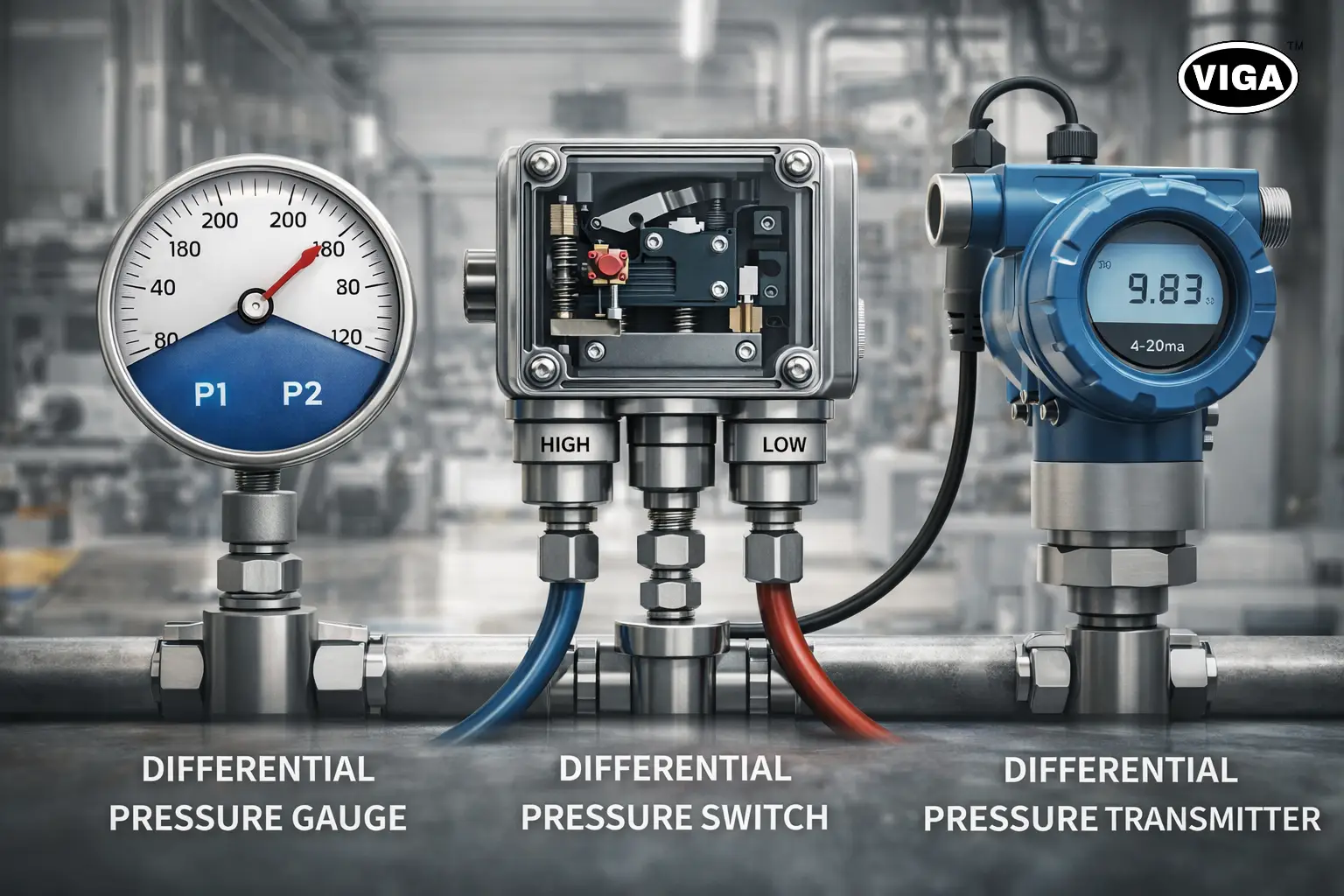
We see a lot of facilities trying to swap every DP pressure switch for a pressure transmitter (which outputs a 4-20mA loop signal). Here is the reality check: transmitters are sensitive electronics. They can be knocked out of calibration by EMI/RFI noise, power surges, or bad loop power supplies.
A switch is purely electromechanical. It works through a power failure. If you lose electricity in your building, a simple, non-powered alarm circuit can often be routed through a Differential Pressure Switch contact because it doesn’t need a CPU to “process” the input—it just closes the circuit. If your goal is safety (keeping a system from blowing up), a mechanical switch is your safest friend. Save the 4-20mA transmitters for your reporting logs, not your hard-wired safety interlocks.
To make your job easier, let’s strip away the confusion about what does what:
- Differential Pressure Gauge: Visual check only. Great for a guy walking through the plant who wants to see, at a glance, how a filter looks. It doesn’t tell anyone if the filter has burst.
- Differential Pressure Switch: Safety monitor. Only “caring” when a limit is hit. Ideal for alarms and shutdowns.
- Differential Pressure Transmitter: Analyst. Constant data flow to a PLC or Scada. Used for graphing trends, calculating flow through orifice plates, or adjusting VFDs in real-time.
Choosing the right tool is the defining mark of an engineer who has learned the hard way. Do not over-specify. Buy the tool that serves the task.
Industrial Applications and Use Cases
In industries like pharma, “washdown” is a requirement. If your unit is sitting near a cleanroom intake or an autoclave, look for an NEMA 4X or IP67 enclosure rating. Water ingress into a cheap electrical terminal box creates electrolysis, which creates a short, which shuts down your facility. Spend the extra money on high-grade sealed connectors.
When selecting an industrial differential pressure switch for high-care facilities:
- Material Traceability: Ask for MTR (Material Test Report) documentation to ensure the stainless steel is 316L and hasn’t been substituted for a lower-grade scrap.
- Set Point Security: Get a model with a lockable set-point cover. This prevents “calibration drift by accident,” where a well-meaning operator turns the screw because they don’t like the noise of the alarm, inadvertently turning your safety trigger into a paperweight.
FAQs About Differential Pressure Switch
Q1. Why is my Differential Pressure Switch triggering intermittently when the compressor starts?
A: This is a “fluid hammer” event. When the compressor motor initiates, it causes a violent spike in flow for a split second. Your switch, sensing that pulse, believes it is a blockage. To solve this, you need to add a “time delay” to your PLC software—do not let the alarm register until the pressure has stayed over the threshold for at least 3-5 seconds. This filters out start-up noise without sacrificing safety.
Q2. Can a standard air-filter switch be used for coolant filtration?
A: Usually no. Coolant is dense, often abrasive, and chemically aggressive compared to air. Using an air switch on coolant will lead to premature seal failure within the switch housing. Once the internal seals swell or crack, fluid will migrate into the microswitch contact area, causing permanent electrical failure. Use the appropriate liquid-rated hardware.
Q3. How do I clean an impulse line that has become sluggish?
A: If possible, use a blow-back system if the media allows (if it’s dry air). If it’s liquid, you need to break the line at the switch manifold. Flush with a compatible solvent—water or denatured alcohol—to clear the crystallization or particulate buildup. Never use high-pressure air to “blast” an impulse line that has liquid inside, as the trapped liquid will act like a bullet and shatter your sensitive internal sensing element.
Q4: Is it possible for a differential pressure switch to “stick” in the closed position?
A: Yes. This usually happens in older units or those with extreme internal gunking. If the sensing element has become fouled with sludge, it can get pinned to one side of its range. You will need to inspect the sensing chamber. If you find debris there, replace the unit. Do not try to clean the interior of the chamber—it is designed to hold a precise mechanical balance, and any micro-scratch caused by your cleaning rag will ruin the performance of the switch.
Q5. When should I upgrade to an “Intrinsically Safe” or Explosion-Proof switch?
A: If your plant environment is designated as Class I, Division 1 or 2 (meaning flammable gases or dust could be present), a standard NEMA housing is not sufficient. An explosion-proof switch has an extremely thick, heavy casing designed to “contain” a minor internal explosion of fumes if they get inside, preventing a major plant fire. If your facility manager tells you it’s a hazardous zone, do not cut corners.
This guide serves as a practical, technical baseline for the integration of differential pressure components into mission-critical loops. Success in instrumentation, however, always remains in the detail—keep your specs documented, your mounts rigid, and your impulse lines clear.
Related Articles
Loading articles…

