

Thermocouple vs RTD: Industrial Selection Guide
Thermocouple vs RTD: Which Temperature Sensor Is Right for Your Process?
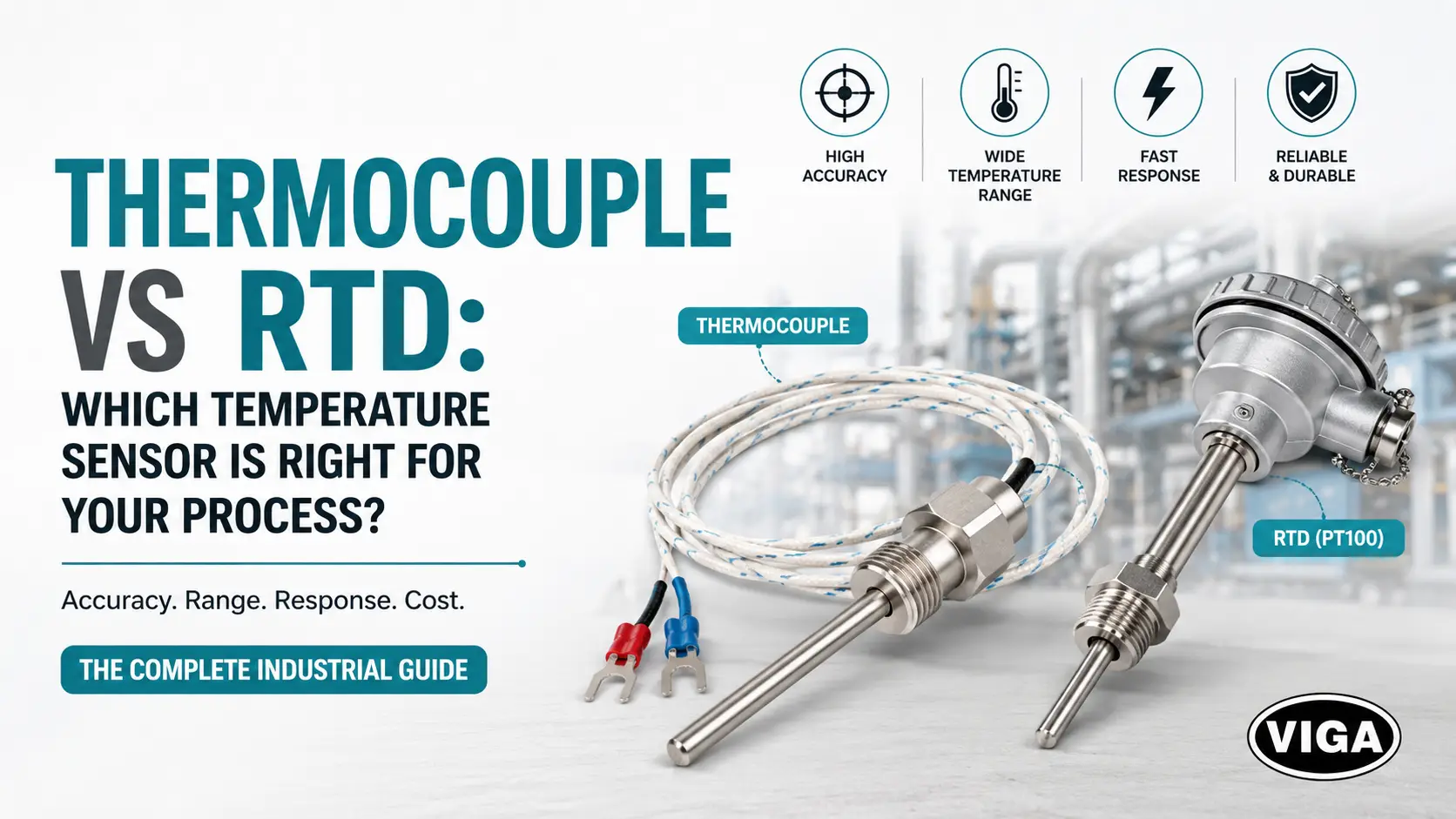
Both measure temperature. But choosing wrong costs you either accuracy or your sensor melting. Here’s the line.
A thermocouple vs RTD decision looks simple on a datasheet and turns expensive on a live process. Pick a PT100 RTD for a 1100°C furnace and the element drifts, then fails. Drop a Type K thermocouple into a pharmaceutical reactor that needs ±0.2°C and the batch record never passes audit. The RTD vs thermocouple difference is not about which sensor is “better” — it comes down to temperature, accuracy, response speed, and budget, weighted against the process itself. Engineers asking which temperature sensor to use usually already sense the trade-off; this guide draws the exact boundary so the specification is right the first time.
Choose RTD (PT100)
Best when precision matters most and operating temperatures stay below ~600°C. Delivers superior long-term stability and repeatability.
Choose Thermocouple
Ideal for high temperature environments, fast response time requirements, or cost-sensitive projects where standard tolerance is acceptable.
Core Rule: Temperature decides first; accuracy decides second.
Before the line-by-line breakdown, the single comparison most engineers want sits at the top.
Quick Comparison Table
This temperature sensor comparison captures the practical differences that drive a specification. Numbers reflect general industrial-grade sensors; exact figures vary by manufacturer, element grade, and construction.
Thermocouple vs. RTD (PT100) Specification Matrix
Comprehensive technical comparison across operational parameters
| Parameter | Thermocouple | RTD (PT100) |
|---|---|---|
| Working principle | Seebeck effect (voltage from two dissimilar metals) | Change in electrical resistance of platinum |
| Temperature range | −200°C to +1700°C (type dependent) | −200°C to +600°C (some to 850°C) |
| Accuracy | ±1°C to ±2.5°C typical | ±0.1°C to ±0.5°C typical |
| Stability / drift | Drifts faster at high temperature | Very stable, low drift |
| Response time | Faster (lower thermal mass) | Slower |
| Output signal | Millivolt (mV) | Resistance (Ω) |
| Linearity | Non-linear, needs compensation | Nearly linear |
| Cost | Lower, especially at high temperature | Higher |
| Wiring sensitivity | Needs cold junction compensation | Needs 3- or 4-wire to cancel lead resistance |
| Best suited for | Furnaces, kilns, exhaust, fast transients | Labs, pharma, food, HVAC, precise loops |
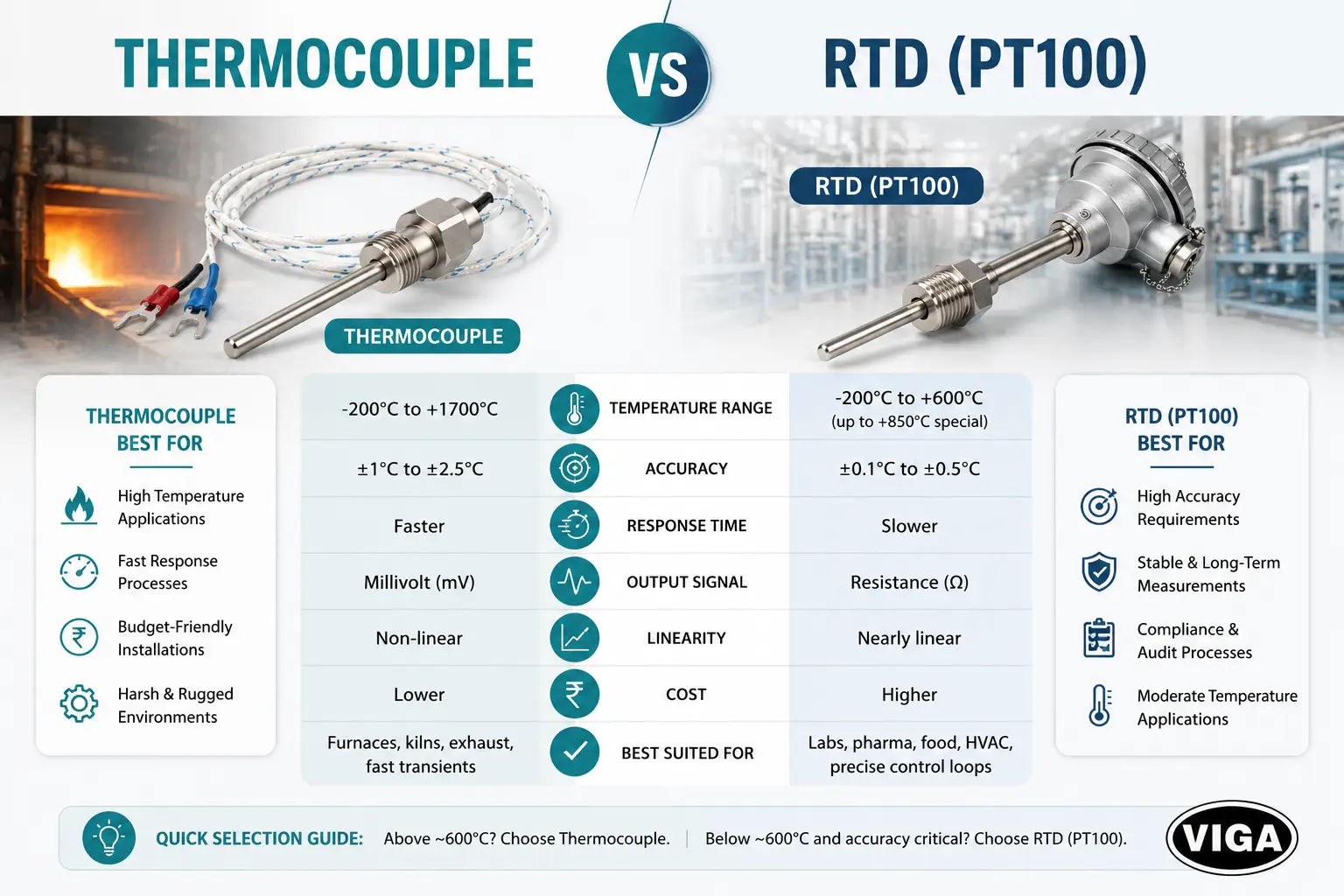
The table answers most quick queries. The sections below explain why each row reads the way it does, because a furnace engineer in Faridabad and a QA lead in an Okhla formulation plant will read the same table and reach opposite — and correct — conclusions.
How a Thermocouple Works
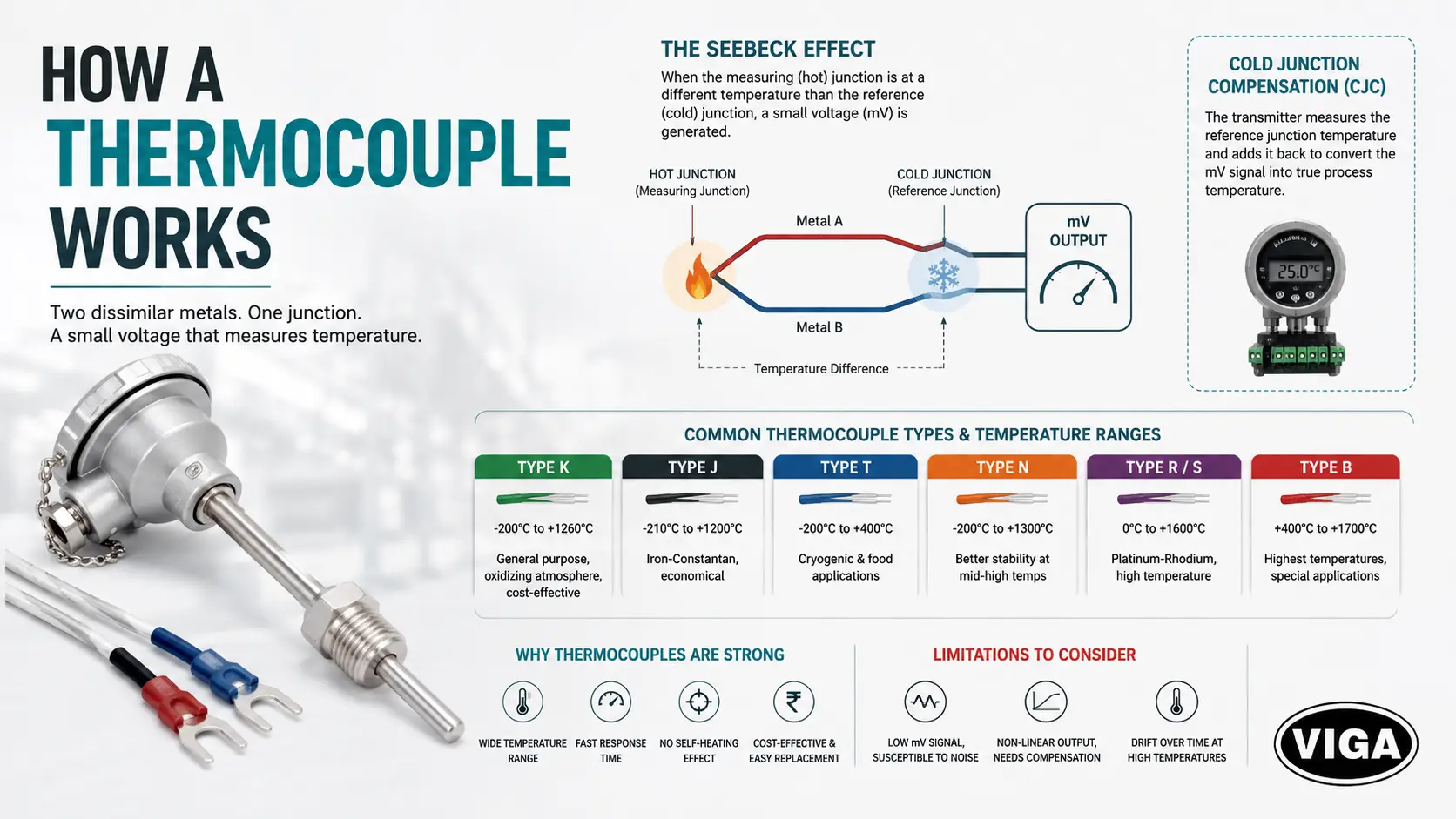
A thermocouple is built from two wires of different metals joined at one end, called the measuring or hot junction. When that junction sits at a different temperature from the other end, a small voltage appears across the wires. This is the Seebeck effect, named after the physicist who observed it in the 1820s. The voltage is tiny — usually a few millivolts — and it rises predictably as the temperature gap widens.
That voltage carries no absolute temperature on its own. It only reports the difference between the hot junction and the reference (cold) junction, which is why every thermocouple loop needs cold junction compensation. The transmitter or controller measures the reference junction temperature electronically and adds it back, converting the millivolt reading into a true process temperature.
Different metal pairs give different ranges and characteristics, which is where the Type K thermocouple earns its popularity. Type K (nickel-chromium / nickel-alumel) covers roughly −200°C to +1260°C, handles oxidising atmospheres reasonably well, and costs little. For higher duty, Type R, S, and B use platinum-rhodium alloys and push past 1600°C in kilns and glass furnaces. Type J, T, E, and N fill specific niches — Type T for cryogenic and food work, Type N for better stability in the mid-high range.
The strengths follow directly from the design. There is no element to self-heat, the junction can be made physically small, and a bare or thin-sheathed junction reacts to temperature swings almost instantly. The weaknesses follow too: the millivolt signal is small and vulnerable to electrical noise over long runs, the voltage-to-temperature curve bends rather than runs straight, and at very high temperatures the metals slowly degrade, so calibration shifts over months of service. A thermocouple measuring exhaust on a Wazirpur rolling-mill reheat furnace is doing exactly what it was designed for — wide range, brutal heat, fast response, low replacement cost when it eventually burns out.
How an RTD Works
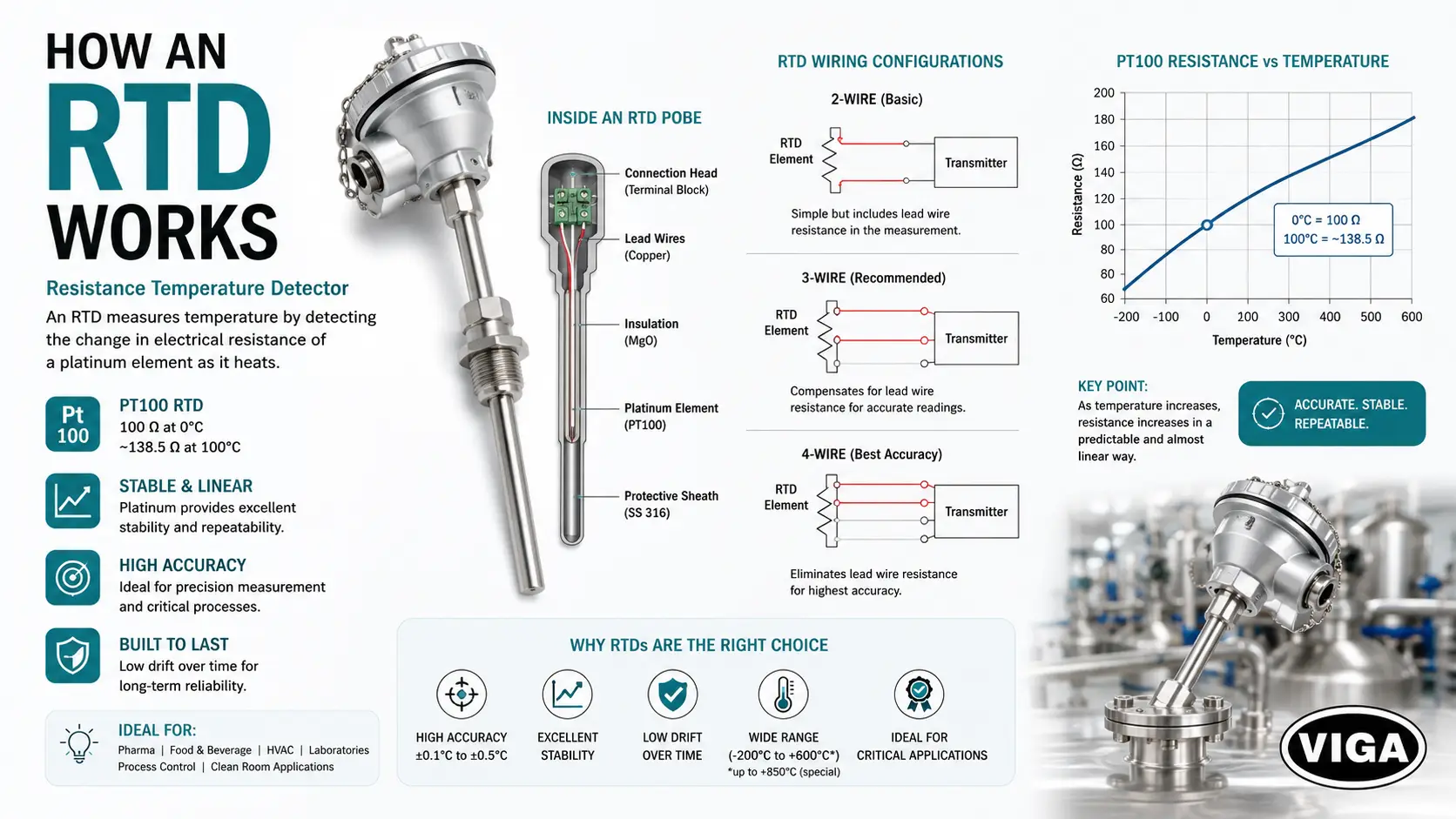
An RTD — Resistance Temperature Detector — works on a cleaner principle. The electrical resistance of a metal rises in a known, repeatable way as it heats. Pass a small, steady current through a precision metal element, read the resistance, and the temperature follows from a standard curve.
Platinum is the metal of choice because its resistance-temperature relationship is stable, well-documented, and almost linear across the industrial band. The PT100 RTD is the workhorse: “PT” for platinum, “100” because the element reads exactly 100 ohms at 0°C. As temperature climbs, resistance climbs in step — close to 138.5 ohms at 100°C for a standard element. The PT1000 variant (1000 ohms at 0°C) is increasingly common in HVAC and lower-current designs because the larger resistance is easier to read accurately over distance.
Because the RTD reports resistance rather than voltage, lead wires matter. The thin copper running from the element back to the transmitter has its own resistance, and a basic 2-wire connection adds that error straight into the reading. Serious installations use a 3-wire or 4-wire configuration so the electronics can measure and cancel the lead resistance — essential when an element sits 30 metres from the control room on a long temperature loop.
The payoff is precision and stability. A platinum element drifts very little over years of service, repeats its readings closely, and follows a near-straight curve that needs minimal correction. The trade-offs are real but narrow: platinum costs more than thermocouple alloys, the element has more thermal mass so it responds a touch slower, the upper limit sits far below what a Type S thermocouple shrugs off, and the sensing current causes slight self-heating that careful design keeps negligible. An RTD on a jacketed reactor in an Okhla pharmaceutical line — where a batch record demands tight, traceable temperature — is the textbook fit.
Accuracy Compared
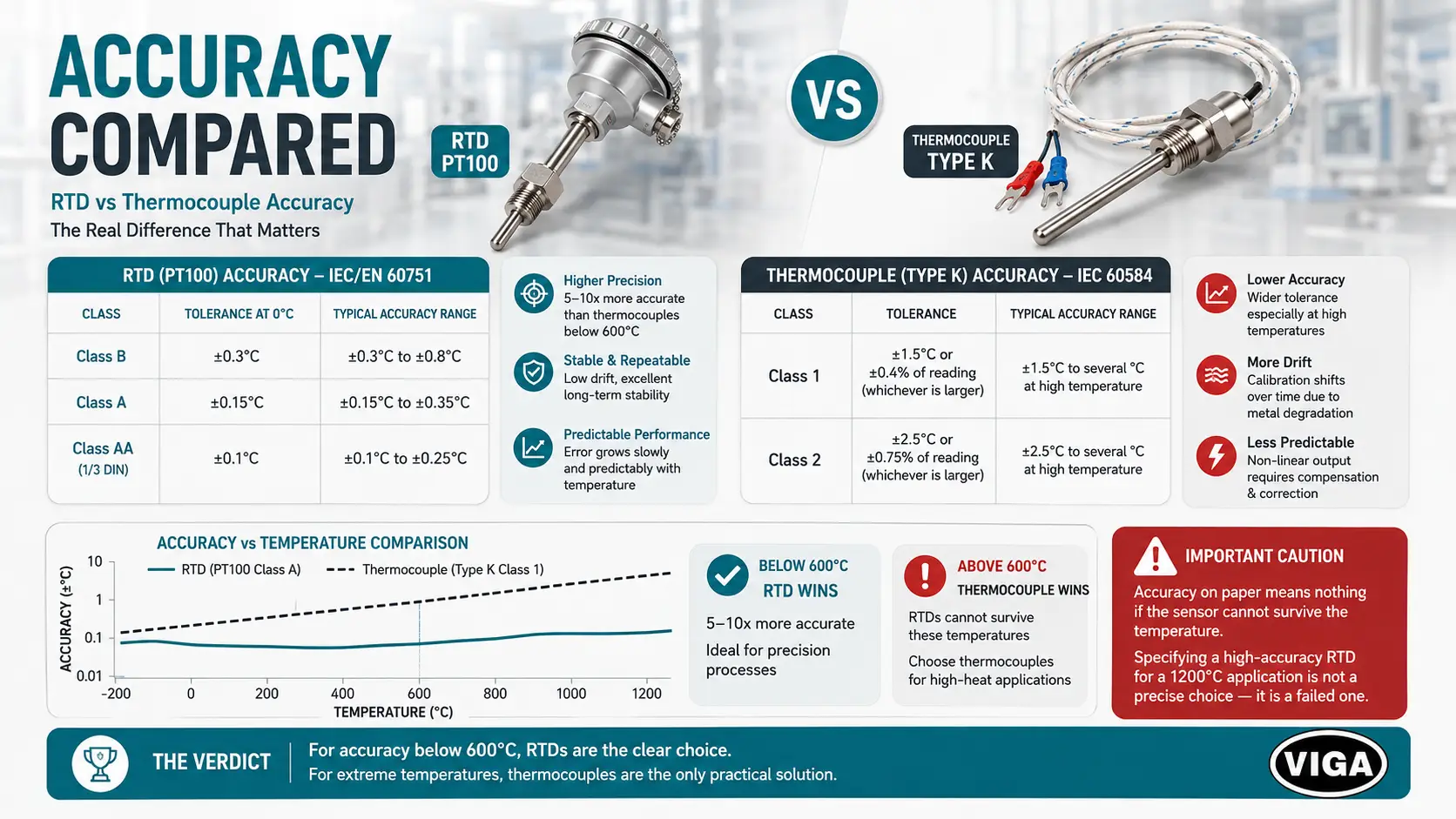
Accuracy is where the RTD accuracy vs thermocouple question gets decided, and the gap is not subtle.
A standard industrial RTD holds tolerances defined by IEC/EN 60751. A Class B PT100 sits within about ±0.3°C at 0°C; a Class A element tightens that to roughly ±0.15°C, and the premium Class AA (1/3 DIN) goes finer still. Crucially, that error grows slowly and predictably as temperature rises, and the element holds its calibration for a long time.
A thermocouple, governed by IEC 60584, runs looser. A Class 1 Type K is specified at about ±1.5°C or ±0.4% of reading, whichever is larger; Class 2 widens to ±2.5°C or ±0.75%. At 1000°C, that percentage term alone can mean several degrees of uncertainty. Add long-term drift from metal degradation and the real-world spread is wider than the datasheet line.
The verdict is clean. For accuracy below 600°C, the RTD wins, and it usually wins by a margin of five to ten times. A heat-treatment shop chasing AMS or NADCAP uniformity surveys reaches for RTDs precisely because the repeatability survives audit. A combustion process that only needs to know whether the chamber is at “about 900” versus “about 1100” gets nothing useful from RTD precision it cannot even reach.
One caution worth stating plainly: accuracy on paper means nothing if the sensor cannot survive the temperature. Specifying a high-accuracy RTD for a 1200°C application is not a precise choice — it is a failed one.
Temperature Range Compared
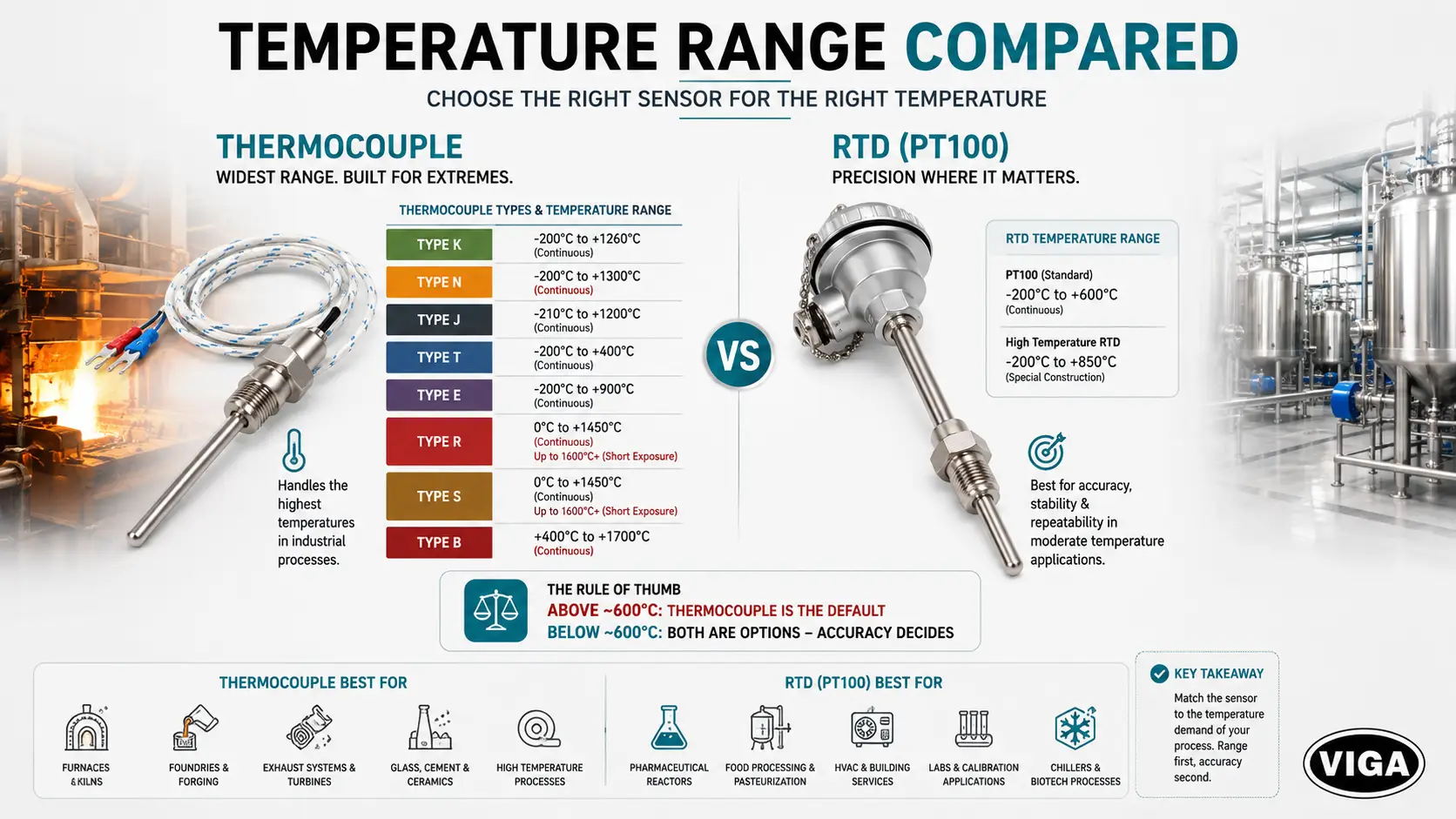
Range is the first filter, and it often ends the debate before accuracy is even discussed.
The thermocouple temperature range is the widest of any common contact sensor. Base-metal types like K and N comfortably handle 1000°C–1260°C in continuous service. Noble-metal types push the ceiling much higher — Type S and R operate to around 1450°C continuous and 1600°C+ for short exposure, while Type B reaches toward 1700°C. Nothing in the RTD world comes close at the top end.
A PT100 RTD typically covers −200°C to +600°C, with specially constructed elements reaching 850°C. Beyond that, platinum begins to suffer and the cost of ruggedising the element stops making sense against a thermocouple that handles the same heat for less money.
So the rule of thumb writes itself: above roughly 600°C, the thermocouple is the default; below it, both are candidates and accuracy breaks the tie. A glass-tank or forging furnace in a Mayapuri or Faridabad industrial cluster lives in thermocouple territory. A bioreactor, a pasteuriser, a calibration bath, or a building HVAC chiller line lives in RTD territory. The melting steel does not care about ±0.1°C, and the fermentation broth never sees 700°C.
Response Time & Cost
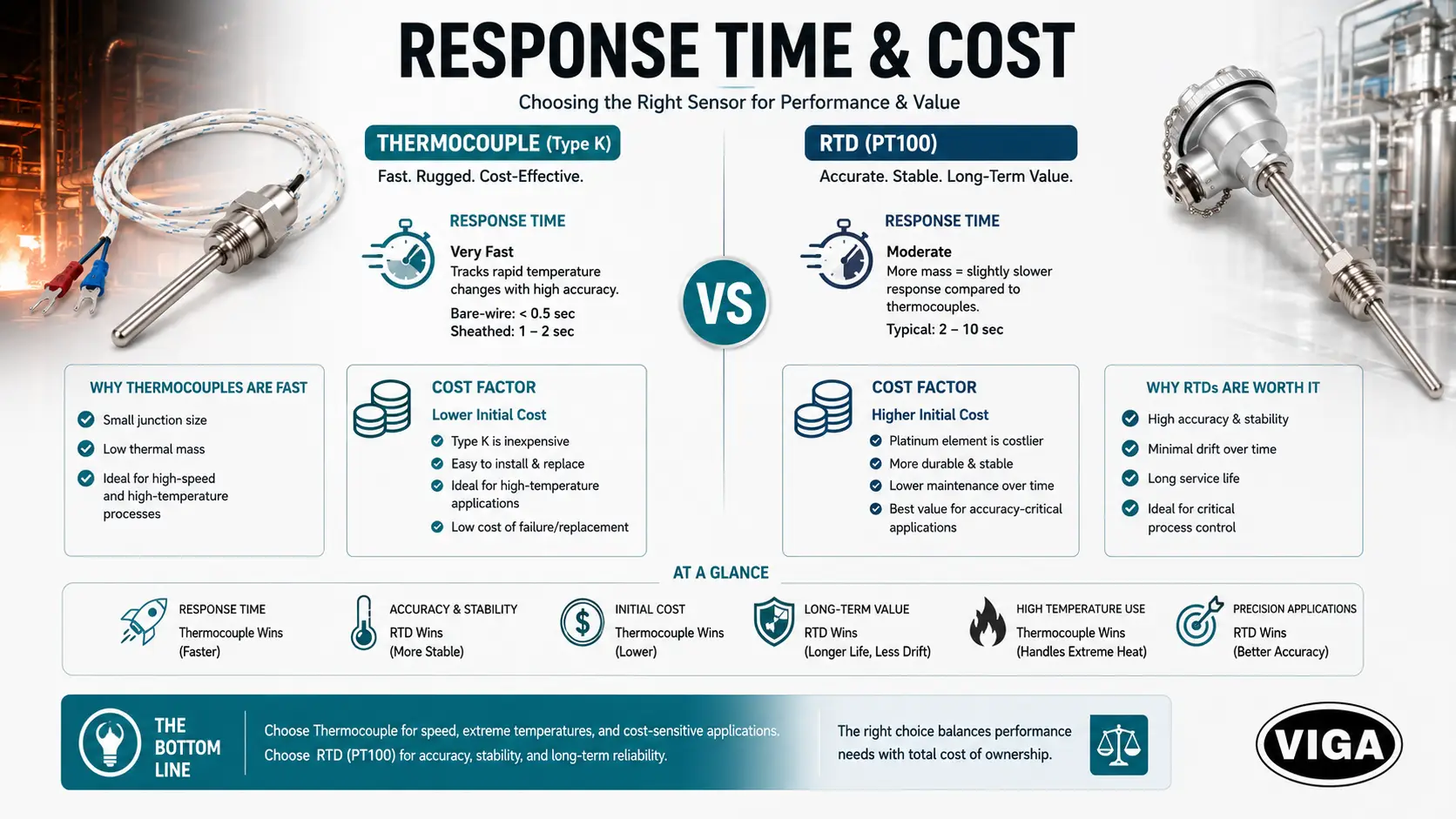
Two practical factors decide many borderline cases: how fast the sensor reacts, and what the installed loop costs.
Sensor response time favours the thermocouple. Its junction can be made physically tiny with very little metal to heat, so it tracks rapid temperature swings closely. A fine bare-wire thermocouple responds in fractions of a second; a sheathed one still beats most RTDs. The platinum element of an RTD carries more mass inside its protective sheath, so it lags slightly. For a slow, stable process — a water bath, a storage tank, a room — that lag is irrelevant. For a turbine exhaust, a flue, or any loop with fast transients, the thermocouple’s speed earns its place.
On the money side, the RTD vs thermocouple cost comparison shifts with temperature. At moderate temperatures the two sit closer than many expect, and once transmitter and wiring are added the gap narrows further. But push into the high range and economics swing hard toward the thermocouple: a base-metal Type K element is cheap, and even when it burns out, replacement is inexpensive and quick. A high-temperature RTD, where one is even feasible, costs far more and lasts no longer in the heat. Across a plant running dozens of high-temperature points, that difference compounds into a real number on the maintenance budget.
A balanced read: the RTD often costs more at the point of purchase but earns it back through accuracy and a long, drift-free service life on the loops that need precision. The thermocouple costs less and tolerates abuse, which is exactly what high-temperature, high-replacement points demand.
Application Matrix: Which Sensor Where
This matrix turns the trade-offs into a direct temperature sensor for furnace — and everything-else — selection. Find the application, read the recommended sensor, note the reason.
Industrial Application & Sensor Selection Guide
Recommended temperature sensors matched by industrial environment and operating requirements
| Application | Recommended Sensor | Why |
|---|---|---|
| Furnace, kiln, foundry (>600°C) | Thermocouple (K, N, R, S) | Survives heat the RTD cannot reach |
| Heat treatment / annealing | Thermocouple, RTD for survey points | High temp duty; RTD where uniformity audit demands it |
| Pharmaceutical reactors & autoclaves | RTD (PT100, Class A) | Precision and traceability for batch records |
| Food processing & pasteurisation | RTD (PT100) | Tight accuracy, stable, hygienic ranges |
| HVAC, chillers, building services | RTD (PT100 / PT1000) | Moderate temp, accuracy, long stable life |
| Boiler & steam lines | Thermocouple or RTD | RTD if <600°C and accuracy matters; TC for headers |
| Engine / turbine exhaust | Thermocouple (K, N) | High temp plus fast response |
| Laboratory & calibration baths | RTD (PT100, Class A/AA) | Reference-grade precision |
| Plastic extrusion & moulding | Thermocouple (J, K) | Mid-high temp, fast control, cost-effective |
| Cryogenic / cold chain | RTD or Type T thermocouple | Stable low-temperature performance |
| Cement, glass, ceramics (very high temp) | Thermocouple (R, S, B) | Only thermocouples reach these temperatures |
Read the matrix as a starting point, not a final word. Sheath material, insulation, immersion depth, vibration, corrosive media, and connection head all shape the final part number. A Type K element correct on paper still fails fast in the wrong protection tube. Matching the full assembly to the process — not just the sensing principle — is where field experience pays off, and where a knowledgeable supplier shortens the path from requirement to working installation.
FAQ: Thermocouple vs RTD
Q1. Which is more accurate?
The RTD is more accurate. A PT100 RTD holds roughly ±0.1°C to ±0.5°C depending on its class, while a typical thermocouple sits at ±1°C to ±2.5°C. Below 600°C, where both can operate, the RTD delivers tighter tolerance, better repeatability, and far less long-term drift — which is why precision processes in pharma, food, and laboratory work specify RTDs almost by default.
Q2. Which for high temperature?
The thermocouple, without question. RTDs top out near 600°C (850°C for special elements), but thermocouples run far higher — Type K to around 1260°C, and noble-metal types R, S, and B beyond 1600°C. Any furnace, kiln, foundry, or high-temperature exhaust application above the RTD ceiling needs a thermocouple, because accuracy is meaningless from a sensor that has already failed in the heat.
Q3. Which is cheaper?
The thermocouple is generally cheaper, and the gap widens at high temperatures where base-metal elements and inexpensive replacements keep costs low. The RTD usually costs more upfront, but on precision loops it returns that cost through accuracy and a long, stable, low-drift service life. The honest answer: thermocouples win on price, RTDs win on lifetime value where precision is required.
The Bottom Line
Strip away the detail and the selection comes down to two filters applied in order. First, temperature: if the process runs above roughly 600°C, the thermocouple is the answer, and the conversation ends there. Second, accuracy: if the process stays below that line and the reading must be precise, stable, and traceable, the RTD is the answer. Everything else — response time, cost, wiring, drift — refines the choice between two valid candidates rather than overturning it.
Specifying the right sensor is only half the job. Matching the element to the correct sheath, insulation, immersion length, and connection head — and pairing it with a transmitter that protects signal integrity over distance — is what turns a correct choice on paper into a reliable measurement on the floor.
Specify with confidence
For a deeper look at thermocouple types, junctions, and selection, read the companion Thermocouple Selection Guide on viga.in. To match the right sensor to a live process, explore the full Temperature Instrument Range — PT100 RTDs, Type K and noble-metal thermocouples, sheathed assemblies, and transmitters, available through VIGA as an authorized distributor of leading instrumentation brands including WIKA.
VIGA (Vinod Gautam Sales) 20 Chawri Bazar, Delhi – 110006 Phone: +91-11-43025959 / +91-11-41582888 Email: [email protected]
Serving plant engineers, purchase teams, and project consultants across Delhi NCR and industrial India.