
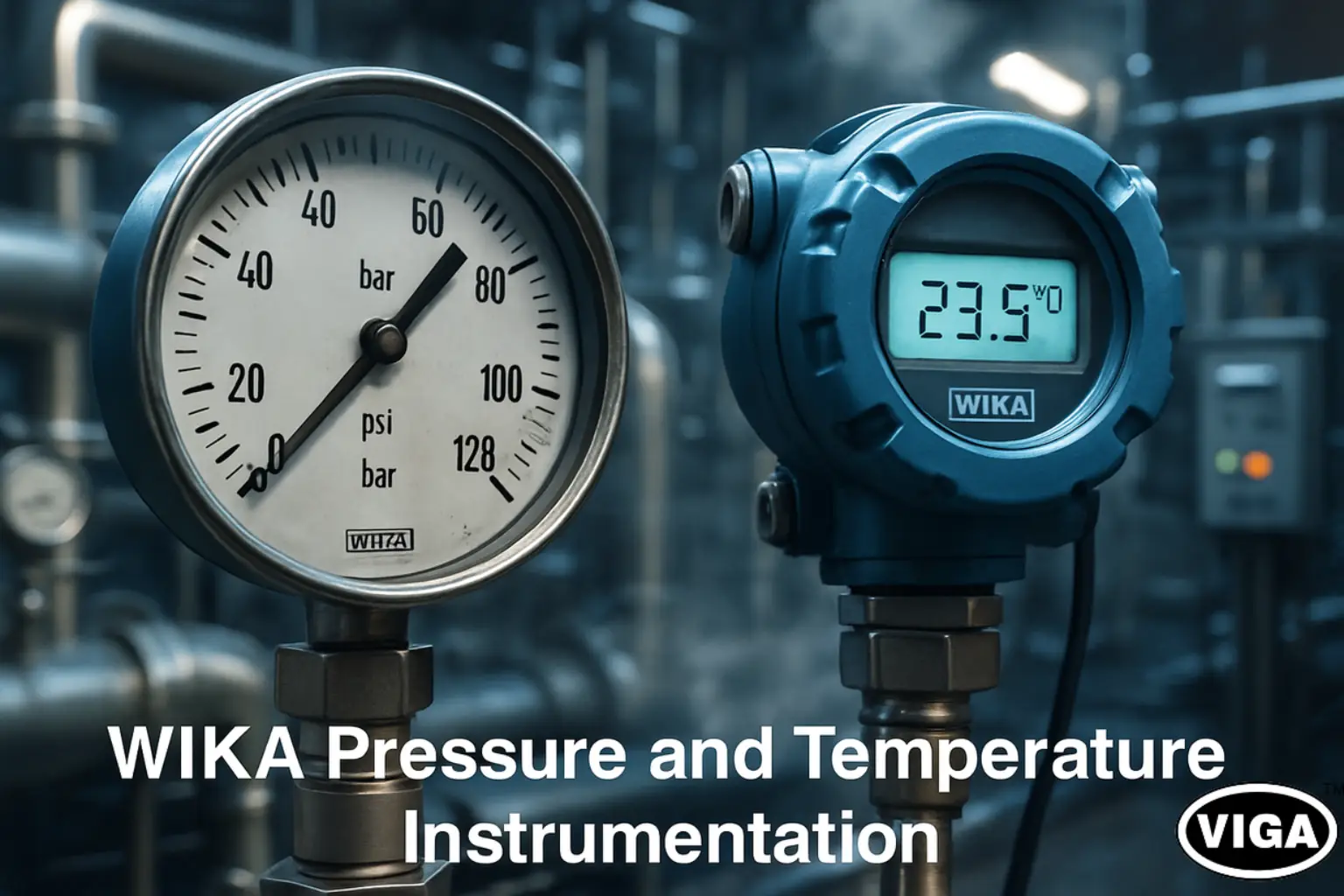
Why WIKA Dominates in Pressure & Temperature Instrumentation
Decoding Excellence: Why WIKA Leads the Global Pressure and Temperature Measurement Market
In the cutting-edge worlds of industrial processing, manufacturing, and energy, precision isn’t just an aspiration; it’s the non-negotiable bedrock of safety, efficiency, and quality. Every critical operation hinges on the rock-solid accuracy of measurement devices. In this high-stakes arena, one name continually rises as the universal standard for dependability and innovation: WIKA. So what keeps the company on top of the global Pressure and Temperature Instrumentation market year after year?
It isn’t one flashy invention or an over-the-top advertising blitz. WIKA’s leadership rests on three sturdy pillars: a proud German engineering legacy, an endlessly wide range of products, and a relentless drive to crack the toughest industrial puzzles. In the pages ahead, we’ll dive into each of these core strengths, revealing how WIKA converts deep know-how into real, measurable value for customers around the globe.
A Legacy Built on Precision: Where Trust Begins
WIKA’s journey started in 1946, when Europe was rebuilding and quality counted above all. Alexander Wiegand and Philipp Kachel set up practice in Klingenberg, Germany, and turned their hands to crafting sturdy, dependable pressure gauges. The post-war German spirit of careful, lasting workmanship still pulses at the heart of the company, shaping every product we make.
This long march through decades is more than years on a page; it is a storehouse of know-how packed into the art of measurement. Unlike younger rivals, WIKA has walked with industry as it moved from pure mechanics to the smart, connected worlds of Industry 4.0. That depth of background means we can spot problems before they arise and build answers that blend cutting-edge technology with a track record in harsh environments. That is why when an engineer chooses a WIKA gauge, it is not a simple purchase; it is a choice to trust in more than three-quarters of a century of fine-tuned engineering and on-the-ground toughness.
A Collection So Broad It Fits Almost Any Need
WIKA leads the market not just because it sells things, but because it sells the right things—lots of them. The company stocks everything you’d find in a typical measurement store, plus smart, custom-built gadgets for the oddest jobs, the strangest fluids, and the harshest places.

Deep Expertise in Pressure Measurement
If it has a signature skill, it’s pressure measurement. WIKA’s lineup is famous, and it runs the whole length from simple dial readouts to brainy digital sensors that run entire factories without a nudge.
Mechanical Pressure Gauges: The traditional WIKA gauge has held factories together for half a century. Choose from Bourdon tubes, diaphragms, or capsules, and mix-and-match cases, connections, and accuracy grades until it fits. The finished gauge slides right into hydraulic presses, pneumatic pumps, or any general machinery that needs steady, reliable pressure data.
Electronic Pressure Sensors and Transmitters: In today’s smart factories, the WIKA sensor is the unsung hero. WIKA builds a huge family of pressure sensors, transmitters, and transducers using piezoresistive, ceramic thick-film, or metal thin-film tech. Once you bolt one on, it turns changing pressure into a tidy electronic signal that PLCs and control rooms can read. You’ll find them in jet cockpits, municipal water towers, and anywhere else that needs pressure data to flow like water itself.
Diaphragm Seals: When dealing with aggressive, corrosive, or high-purity liquids and gases, protecting instrumentation becomes tough. WIKA’s large selection of diaphragm seal systems keeps the measuring device safely away from the media, so the two never meet. This know-how is vital in chemicals, pharmaceuticals, and food and beverage industries, where any direct contact could cause contamination or ruin the instrument. A report from last year said the diaphragm seal market is growing in line with the chemical processing boom, and WIKA is a major player in that market

Mastery in Temperature Instrumentation
WIKA’s Temperature Instrumentation lineup matches the pressure division in depth and know-how. Precise temperature control is key to process safety and product quality, and WIKA offers solutions that work from cryogenic chills to the hottest industrial heat.
Electrical Thermometers: This group includes Resistance Thermometers (RTDs) like the trusted Pt100 and Pt1000, plus a full range of thermocouples (Type K, J, S, and more). These sensors deliver accurate electronic temperature readings that are critical for control loops in power plants, refineries, and high-tech manufacturing.
Mechanical Thermometers: When you need to measure heat right where it’s happening but can’t plug anything in, WIKA’s bimetal and gas-actuated thermometers are the smart choice. Built to take a beating, you’ll spot them attached to industrial boilers, in HVAC rooms, and mounted on storage tanks, keeping a constant eye on temperature.
Thermowells: To keep temperature sensors safe from punishing conditions—like intense pressure, caustic fluids, and high-flow turbulence—thermowells are a must. WIKA makes a broad lineup of thermowells from a variety of tough materials, designed to guard the sensor and let you swap it out for maintenance without missing a beat in the process.

The Pillars of WIKA’s Global Dominance
Having a huge product lineup is just a start. WIKA stays at the front of the market by following smart business principles that forge a strong competitive edge and earn deep Trustworthiness from customers around the world.
Pillar 1: Unwavering Commitment to Quality and Reliability
For WIKA, quality is woven into every step, not just checked at the end. The factories are certified under global standards like ISO 9001 for quality and ISO 14001 for environmental care. On top of that, key product lines meet tight industry rules, including ATEX and IECEx for volatile zones, 3-A and EHEDG for clean lines, and NACE for sour gas.
You can see the commitment right on the factory floor. WIKA keeps a close grip on the entire supply chain, making nearly every part—right down to the tiny sensor elements—under one roof. Those sensing elements that sit at the heart of many WIKA instruments are produced on-site, which means the company can fine-tune their performance and ensure they won’t drift over time. Not many rivals can match this level of vertical control. By sticking to strict standards like the ASME B40.100 for pressure gauges, WIKA guarantees that every instrument performs reliably and safely. That kind of dependability matters most in high-risk industries like oil and gas, pharmaceuticals, and aerospace, where failure is simply not an option.
Pillar 2: Innovation at the Core
Deep roots in tradition don’t stop WIKA from pushing forward. The company pours a significant share of its budget into research and development, constantly nudging the limits of measurement technology. The results show up year after year in a steady flow of new instruments and fresh patents, all tuned to the newest industrial demands.
Recent breakthroughs include:
IIoT and Smart Sensors: WIKA is right in the thick of the Industry 4.0 movement. Their smart instruments come with IO-Link communication, making it a snap to weave them into the digital factory of the future. That connection unlocks real-time diagnostics, remote fine-tuning, and smart predictive maintenance. A basic measurement device suddenly becomes a clever node in an intricate, living network.
Hydrogen Opportunities: The world is moving towards hydrogen energy, and that comes with special material and safety challenges. WIKA has stayed ahead by creating pressure and temperature instruments that are life-tested and certified for hydrogen service, proving its readiness to lead in the newest energy technologies.
High-Purity and UHP Solutions: In semiconductor fabs, even the tiniest particle can ruin a chip. WIKA’s instruments for ultra-high-purity gas systems are built to safeguard against this risk, showing a depth of engineering that meets the tightest cleanliness and control requirements.
Pillar 3: Global Reach, Local Know-How
With 43 subsidiaries and a partner network in 75+ countries, WIKA’s worldwide presence is a powerful, strategic resource. But it’s more than geography; it’s rooted in community.
This network lets WIKA:
– Grasp Local Needs: Regulations, certifications, and standard design practices can differ from one place to another. WIKA’s nearby teams know the rules and can deliver the right, compliant solutions.
– Deliver Better Support: Customers gain from local specialists, shorter lead times from nearby factories, and calibration that meets the region’s measurement standards.
Adapt to Market Dynamics: Operating on a global scale lets the company see industrial shifts everywhere at once. This bird’s-eye view means the teams can act fast whether regulations tighten in Europe or a wave of new railways starts in Asia.
The WIKA Advantage in a Digital Age
Industry is getting tighter and smarter. WIKA sensors are no longer quiet watchers; they now pulse essential data straight into bigger business networks.
WIKA is already stepping boldly into the digital future. Fresh spending on digital tools guarantees that the classic gauges and transmitters—still marvels of metal and circuit-board craft—stay at the center of the industrial internet age. These instruments chat, warn of problems before they grow, and plug right into cloud services. That way, WIKA doesn’t just sell devices; it joins customers on the entire digital journey, earning a seat at the table as a partner that matters.
Summary and What’s Next
WIKA’s success in Pressure and Temperature Instrumentation stands as a model of smart, long-term thinking. Their leadership isn’t riding a fad, but rests on five solid pillars: a proud German engineering tradition, a wide-ranging and complete product line, a rock-solid promise of quality, a culture that never stops innovating, and a global reach that still feels local.
For engineers, plant managers, and purchasing teams, the choice of measurement instruments isn’t a small detail. It affects safety and the smooth running of the whole plant. WIKA keeps its promise of precise, dependable, and purpose-built solutions, making it the obvious choice in the field. As industries change, WIKA blends its time-tested strengths with the latest digital tech, ensuring it will stay the gold standard.
To learn how WIKA’s top-tier instruments can be customized for your unique challenges, [see the full product line] or [schedule a chat with a technical expert].
Frequently Asked Questions (FAQ)
Q 1. Which industries mainly count on WIKA instruments?
A. WIKA instruments are trusted across a wide range of industries. Customers in Oil & Gas (covering both exploration and refining), Chemical and Petrochemical production, Power Generation (including both fossil and renewable sources), Food & Beverage, Pharmaceuticals & Biotechnology, and Water/Wastewater still rely on us. We also support manufacturers of mobile equipment, like cranes and tractors. Our edge comes from developing tailored solutions, like sanitary sensors for food plants or explosion-proof gauges for refineries, letting us fit comfortably into almost every large industrial sector.
Q 2. What sets a WIKA pressure gauge apart from a basic, budget gauge?
A. The differences start with how each one is built and the materials inside. WIKA gauges are usually made from high-grade stainless steel for the case and the parts that touch the pressure, and we use advanced welding methods like laser welding. The internal components also handle pressure more consistently. Together, these features keep measurements accurate for longer, resist vibration and rust better, and meet strict safety rules like EN 837-1 or ASME B40.100, which many inexpensive gauges don’t.
Q 3. Are WIKA sensors and transmitters ready for today’s IIoT?
A. Definitely. WIKA puts a strong focus on Industry 4.0 and the Industrial Internet of Things. Many of our latest sensors and transmitters come with digital communication protocols, especially IO-Link. This tech lets the device and the system talk back and forth. Operators can set them up, check their health, and even get warnings of future problems—all from a distance. This smart talk is key for fitting our gear into tomorrow’s smart factories and advanced control systems.
Q 4. Why is regular calibration critical for pressure and temperature instruments?
A. Calibration is the backbone of accuracy, safety, and energy-efficient operations. Instruments face mechanical strain, vibrations, and changing temperatures, causing their readings to slowly drift off the true mark. By testing them against a reliable standard on a regular schedule, we can spot the drift and correct it. In fields like pharmaceuticals and aerospace, calibration is not just best practice; it is a strict rule that guarantees products meet strict safety and quality standards.

