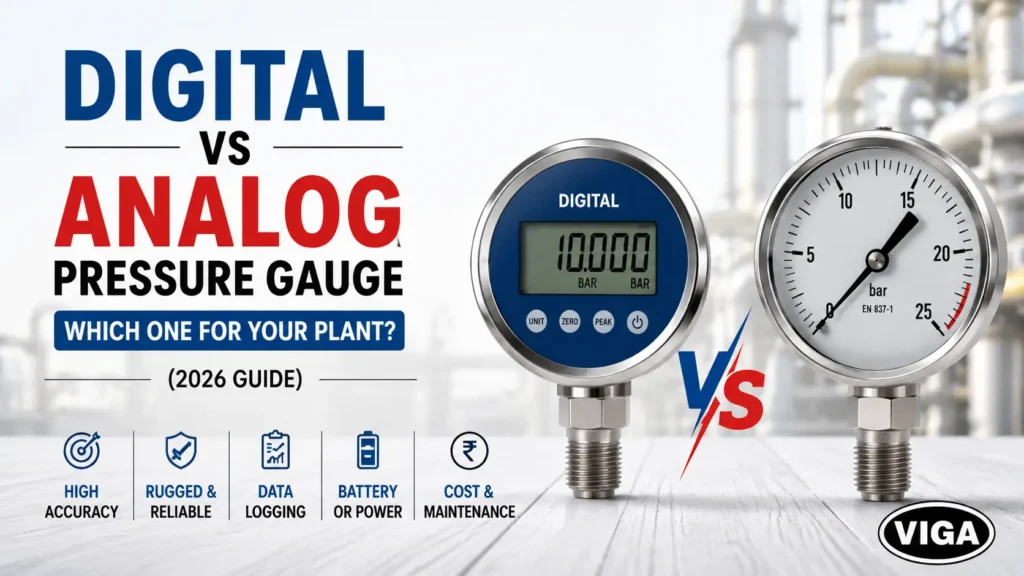
Digital vs Analog Pressure Gauge: Plant Engineers Guide
Table of Contents [-] Digital vs Analog Pressure Gauge: Which One for Your Plant? (2026 Guide) Digital isn’t automatically better. Replace a working dial with the wrong digital gauge and the plant finds out the expensive way — usually on a vibrating compressor skid, two monsoon seasons in, with a cracked display and a sensor that gave up. The digital vs analog pressure gauge decision gets sold as old-versus-new, as if every needle on a header is overdue for retirement. That story moves inventory. It does nothing for the engineer at a pump discharge trying to spec something that will still be readable a year from now. The real choice turns on four things: what the gauge has to read, where it’s mounted, who reads it, and whether the number ever has to be written down. Choose a digital pressure gauge for calibration, precise setpoints, and any point that needs logged data — top accuracy reaches ±0.05%. Choose a liquid-filled analog gauge for vibration, pulsation, high heat, or unpowered remote points, where it runs for years with no battery and no electronics to fail. That capsule covers roughly 90% of purchase decisions. The rest of this guide is the why behind it — the digital pressure gauge advantages worth paying for, the analog gauge reliability that still wins corners of every plant, and exactly when to use a digital pressure gauge instead of reaching for the cheaper dial out of habit. Factor Analog Gauge Digital Gauge Power needed None Battery or loop power Typical accuracy ±1.0% to ±2.5% of full scale (test grade: ±0.25%) ±0.5% to ±0.1% (reference grade: ±0.05%) How it reads Pointer — trend visible at a glance Numeric — precise, no parallax Vibration & pulsation High tolerance (liquid-filled) Moderate — needs a snubber or damping Data logging / peak hold No Yes — min, max, peak, recorded logs Output signal None (purely mechanical) 4–20 mA / switch contacts available Temperature range Wide Limited by display and battery Upfront cost Lower Higher Ongoing maintenance Minimal Battery changes + recalibration Lives best on Vibration, no-power, bulk monitoring Calibration, precise setpoints, records Read that table and the split is obvious: digital buys precision and memory, analog buys ruggedness and independence. Procurement teams that pick one answer for the whole plant overpay on one side and under-spec on the other. Bourdon Tube vs Pressure Sensor: What’s Actually Reading the Pressure The two gauges behave differently because different things are moving inside them. An analog pressure gauge runs on a Bourdon tube — a curved, flattened metal tube that straightens as pressure builds inside it. That movement is geared up to a pointer sweeping a printed dial. No electronics sit in the signal path. Pressure in, metal flexes, needle moves. Process dials follow EN 837-1, the standard that also fixes the accuracy classes (2.5, 1.6, 1.0, and the tighter test classes 0.25 and 0.1). Flood the case with glycerine or silicone and the same gauge laughs off vibration that would shake a dry pointer into a useless smear. A digital pressure gauge drops the dial mechanism and uses a sensing element — usually piezoresistive or strain-gauge — to turn pressure into a small electrical signal. Onboard electronics condition it, compensate for temperature, and print a number on an LCD. Because the reading is calculated rather than mechanical, the same unit can hold a peak, log a trend, or push 4–20 mA to a control system. None of that happens without power, which is the quiet line every glossy spec sheet skips past. Flexing metal versus a powered sensor — that single difference explains every win and every weakness below. Why Vibrating Pump Skids Shatter Digital Displays Mount a dry digital gauge on a reciprocating compressor or a pump discharge full of pulsation and the electronics never forgive it. The number jumps, the sensor takes fatigue it was never sized for, and the display ages in months. To prevent this equipment fatigue, understanding proper industrial gauge maintenance and calibration cycles is mandatory. Take a reciprocating air compressor in a Faridabad auto-component unit. A plant that swapped its tired liquid-filled dials for sharp new digital gauges had three displays cracked or reading garbage inside two monsoon seasons — unfilled cases couldn’t absorb the hammering, and the sensors wore out under constant pulsation. The dials that had come off, glycerine-filled and a decade old, were still dead accurate on the test bench. What finally stayed on the machine were liquid-filled analog gauges with a snubber fitted — exactly what the old maintenance hands had specified before anyone went chasing displays. This is where analog gauge reliability stops being nostalgia and becomes physics. The fill fluid damps the pointer, kills the flutter, and shields the movement from pulsation and shock. High ambient heat tells the same story — the kind of temperature that slows an LCD or drains a battery barely registers on a Bourdon tube. For vibrating, hot, wet, dusty corners of a plant, the dial isn’t the legacy option. It’s the correct one. The Failure Mode That Simply Doesn’t Exist on a Dial The most underrated line on an analog spec sheet is the one that isn’t printed: no battery, no power supply, no firmware. Nothing to discharge, freeze, or crash. Then there is the gauge nobody looks at until it matters. A fire-water header at a Wazirpur rolling mill carried a battery digital gauge that had quietly died months earlier. The day a safety check actually needed it, the display showed nothing — no reading, no warning, just a dead point on a critical line. Its replacement was a plain analog dial: no battery to outlive, no power point to wire, correct every time someone finally walks up to it. Multiply that across a plant. The dozens of “confirm it’s pressurised” points — utility headers, isolation valves, seasonal skids, remote lines — don’t need precision. They need to be right whenever someone reads them, at the lowest sensible cost. Analog owns that