The Air Regulator Difference: Achieving Rock-Solid Operational Stability
Air Pressure Regulators are the most undervalued assets in the vast majority of industrial setups, yet they prevent production disasters every single minute of every working day. You know that gnawing anxiety—that tiny, cold fear that hits when a high-speed assembly sequence on your line hesitates, stutters, or momentarily loses power. We’ve all seen the resulting disaster: a part is misaligned, a torque wrench underperforms, or a paint finish suddenly appears patchy. The cause, far too often, is traced back not to a faulty machine, but to the inherently unpredictable nature of its energy source.
Let’s be candid. You spend a fortune on a high-end air compressor, capable of delivering a beastly 175 PSI. Logically, the air should be perfect at the workhead, right? Wrong. The moment a compressor cycles, a distant machine engages, or a major line manifold is accessed, that output pressure violently shifts. Imagine running an automated screw feeder that requires precisely 75 PSI for repeatable performance. Without consistent control, an air spike might blow a seal, while a sudden pressure drop might cause an unacceptable half-turn on a crucial fastener. This true industrial scenario illustrates why we constantly fight the specter of instability, underscoring the massive importance of an air pressure regulator for continuous output quality. The truth is, reliable operation hinges entirely on controlling the very air you feed your machines.
What Causes Pressure Drops in Pneumatic Systems?
You cannot fix chaos until you know its root cause. If your machines are consistently battling chronic performance problems, a significant pressure drop in pneumatic systems is the likeliest culprit. You might be paying a premium for compressed air, but your machinery is receiving volatile fluctuations, contributing to significant Pneumatic Pressure Loss. We have to drill down into the non-negotiable answers to Causes of Pressure Drops :
- The Turbulent Compressor Source: I know you paid for a steady supply, but the fact is, the tank is always refilling, starting, and stopping. This natural fluctuation means the high-side supply line pressure constantly varies by 10 to 20 PSI—it’s never truly constant. Without an Air regulator for compressor output, that erratic feed immediately introduces chaotic pressure spikes and falls across your entire compressed air system.
- Simultaneous Demand Overload (Systemic Starvation): The common issue of multiple tools or actuators activating concurrently—an air blast here, a major clamp there. These demands instantly create a brief but substantial localized vacuum, starving the immediate local area of volume (CFM) and dramatically dropping the pressure. This peak flow deficiency is why many Why pressure drops happen in air lines incidents occur only during maximum production speed.
- Chronic and Undiscovered Line Leakage: This is the invisible money pit. You’d be surprised how much pressure—and, thus, money—is hemorrhaging through tiny, neglected seals or slightly loose hose clamps across a large facility. That persistent, collective hiss forces your compressor to run longer and harder, which directly and consistently degrades the baseline stable air pressure available to your devices.
- Air Quality and Pipeline Resistance: If you aren’t diligently maintaining your upstream dryer and filter, moisture and contaminants collect inside the piping. Over time, that buildup reduces the actual flow diameter, creating frictional resistance that mimics a chronic bottleneck. This hidden choke point translates into a measurable loss of performance right where the actuator requires its full push force.
- Design Flaws: The Curse of Undersizing: A mistake made years ago by a systems designer: installing piping that is simply too small for today’s demand load. While you can send enough pressure, the piping can’t pass the volume without creating significant friction, resulting in an inherent pressure-loss defect built into the structural DNA of your pneumatic system efficiency setup.
What Is an Air Pressure Regulator?
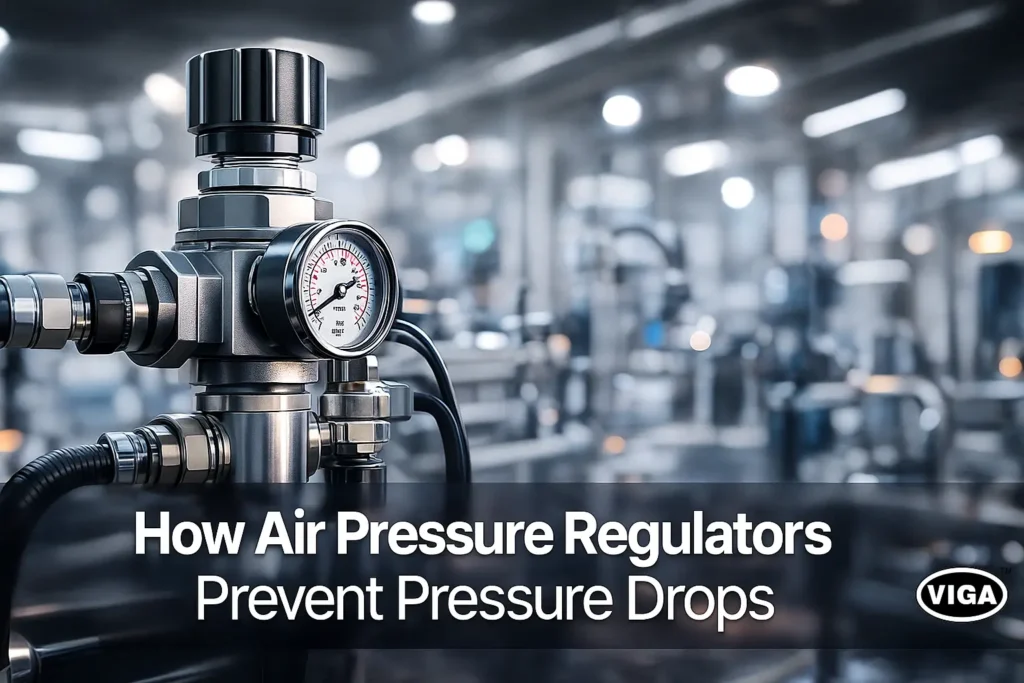
Let’s be incredibly clear about the function. The Air Pressure Regulator acts as a dedicated pressure-reducing and stabilizing mechanism. Its purpose is entirely focused: it converts the unpredictable, high input pressure from the supply source into the precise, much lower set-point of stable air pressure required by the tool. And crucially, it holds that output number static, almost without exception.
The Crucial Last Step
Positioning is key for success. The regulator isn’t installed next to the huge main tank. Instead, you’ll find it strategically located immediately before the end-use device, usually integrated with the final filtration—often less than five feet from the pneumatic cylinder it controls. This point-of-use proximity ensures highly localized downstream pressure control , meaning its mechanical action accounts for the last moments of turbulence in the line, securing pressure consistency exactly where performance is judged.
Know the Difference: Regulator vs. Relief Valve
An expert distinction must be made here, as relying on one to do the job of the other is a frequent industrial mistake that risks costly damage:
- The Air Pressure Regulator (The Governor): This device performs the active work of control and reduction. Its mandate is operational—it makes sure the output pressure never exceeds the set-point during normal use.
- The Safety Relief Valve (The Safety Fuse): This component is designed to remain completely passive until a catastrophic event occurs—it only activates to dump pressure overboard if the entire system unintentionally over-pressurizes far above the regulator’s cap. Its sole job is the final defense against extreme failure and overpressure damage from structural rupture.
The regulator is a full-time operator; the relief valve is merely the ultimate, last-second safety back-up.
How Air Regulators Keep Air Pressure Stable
How exactly does this clever arrangement of components achieve such unerring stability? The mechanical truth of how air regulators work is based entirely on the principle of mechanical counter-balance. Every reliable regulator utilizes its core components—the adjustable spring, the sensitive diaphragm (or piston), and the shut-off valve—in a perpetual negotiation.
The moment you adjust the knob, this internal process begins:
- Setting the Control Standard (Downward Force): By turning the adjustment knob, you physically load the main internal spring. The resultant tension creates a measurable, downward mechanical force on the system’s flexible diaphragm or sensing piston. This is your commanded stable air pressure target (e.g., 90 PSI).
- Measuring the Operational Reality (Upward Force): On the opposite side of the diaphragm, a separate sensing line continuously channels the regulated output air pressure (the downstream pressure). This air creates a corresponding upward pressure force against the diaphragm, directly opposing the force of the spring.
- The Sweet Spot (Perfect Equilibrium): The system’s desired “idle state” occurs when the strong downward spring tension is precisely countered and equalized by the output air’s upward pressure. In this moment of equilibrium, the regulator valve is set exactly right, only allowing minute amounts of air flow through to match any passive consumption, which is critical for continuously maintaining stable air pressure.
- Reacting to a Pressure Drop (Compensatory Opening): A major downstream tool engages. Pressure drops sharply below the target (say, from 90 to 75 PSI). The air’s upward force suddenly weakens. The superior, unmoving force of the primary spring instantly drives the diaphragm down, pushing the regulator valve further open. This deliberate and immediate mechanical action releases a sudden surge of air volume to instantly rebuild pressure to the set 90 PSI target.
- Reacting to a Pressure Spike (Throttle and Relief): Demand shuts off instantly. The pressure skyrockets above the set-point. The excessive air pressure upwardly shoves the diaphragm, overcoming the spring force. This action immediately pushes the valve seat closed against the inlet flow. The best regulators also “relieve” this excess pressure safely through the top port (a feature vital for immediate spike compensation), which prevents internal stress and ensures predictable air flow stability for connected components.

Why Every Machine Needs a Proper Air Regulator
Failing to properly regulate your compressed air system isn’t merely inefficient; it’s a guaranteed pathway to high replacement costs and process variability. It is vital to articulate the core Importance of Air Regulator functionality:
- Financial and Physical Protection: Pneumatic actuators, motors, and clamps are all rated with maximum safe working pressures. Running the components unregulated (up to the compressor max of, say, 150 PSI) creates a direct risk of catastrophic, instantaneous component failure due to metal stress. Regulation eliminates the risk of terminal overpressure damage.
- The Assurance of Quality: Quality is always defined by zero variation. Whether it’s the exact application of torque on an automotive fastener or the constant push on a printing platen, pneumatic pressure control ensures every repetition uses precisely the same force. A reliable Air regulator for compressor output translates directly into lower defect rates and repeatable operational excellence.
- Enhanced Equipment Lifespan: An investment in a robust Air Pressure Regulator is an insurance policy. When your expensive pneumatic tool can be consistently locked in at its optimal operational window (enforcing those best regulator settings for pneumatic tools), friction, heat, and internal stress are dramatically lowered. Tools simply run longer and more reliably.
- A Safety Precaution for Everyone: A poorly managed compressed air system can develop line weaknesses. If one of these gives way during a severe pressure surge (which a poor regulator allows), the hose whip becomes a potentially lethal workplace accident. Regulation is a mandatory safety function.
- Maximum Pneumatic System Efficiency (Energy Conservation): By setting the regulator to the lowest functional PSI (instead of over-specifying just in case), you reduce air consumption, minimizing unnecessary load cycles on the compressor itself. It’s an efficient use of expensive resources.
Types of Air Pressure Regulators
Real application authority comes from selecting the specialized tool for the task at hand. Just saying “regulator” is too simple; a professional must specify the correct technology from the various Types of Air Regulators based on the required durability and tolerance.
|
Regulator Type |
Primary Mechanism & Design Goal |
Application Authority/EEAT Use Cases |
|
Piston Regulators |
Highly rigid metal or hardened seal piston replaces a diaphragm. Engineered for maximum physical durability and handling high upstream pressure. |
The workhorse Industrial air regulator: Necessary for construction sites, heavy machining, high-heat locations, or areas prone to heavy particle contamination that would quickly compromise a softer diaphragm. |
|
Precision Regulators |
Complex design utilizing extremely low-friction materials and oversized diaphragms to increase sensitivity. Often features fine external threads for precise control. |
Used only where stability must be nearly absolute. Found in metrology, test rigs, laboratory equipment, or when highly specialized best regulator settings for pneumatic tools must hold true over hours (e.g., specialized coatings). |
|
High-Flow / Ported Regulators |
Internal porting is massive (often 1-inch to 2-inch piping) to maximize flow and minimize resistance. |
Used when a continuous, heavy draw of air is needed (large cylinders, central manifolds). It manages high CFM while maintaining consistent PSI, fighting upstream Causes of Pressure Drops related to volumetric flow. |
|
Back Pressure Regulators |
A different function entirely: regulates pressure on the inlet side of the valve (to prevent flow restriction elsewhere) rather than controlling the output. |
Specialized for chemical or pharmaceutical process systems that require exact, non-fluctuating upstream pressure or flow resistance for continuous fluid blending or reaction containment. |
How to Choose the Right Air Pressure Regulator
For your machinery to perform its best, the regulator selection process cannot be arbitrary. If you’re charged with maintenance or purchasing, follow these core technical specifications when Choosing the right air pressure regulator. The consequences of choosing a non-optimal model will be felt throughout the production floor.
- Validate the Volume Requirement (CFM is King): Your primary failure point in air flow stability is always flow, not just PSI. Total up the absolute maximum flow rate (in CFM or L/min) that could occur on a single line. The selected regulator must safely exceed that CFM capacity with minimal pressure “droop.” Selecting the right best air pressure regulators always starts with adequate CFM sizing.
- Define the Precision Requirement: Ask, “What is my maximum allowable PSI variation?” Simple clamping can allow 5-10 PSI swing. Sensitive operations, like chemical mixing, often require less than a 1 PSI fluctuation. Your required pressure consistency dictates whether a standard piston or an expensive precision diaphragm model is required.
- Know Your Material: Process Fluid and Environmental Attack: If the regulator is handling corrosive gases (e.g., in a brewery) or operating outdoors, standard materials are a catastrophic risk. Stainless steel or marine-grade anodized aluminum may be mandatory to avoid internal corrosion that quickly leads to a fatal sticking or unsealing regulator valve.
- Confirm the Adjustment Mechanism and Placement: Can the operator easily access and reliably change the pressure setting? If settings must be secure, use regulators with lockable adjustment knobs. For automated processes, look for electronically-controlled pneumatic pressure control options that can be adjusted via the machine’s PLC.
Signs Your Air Regulator Is Failing
Proactive intervention is the signature of a superior maintenance program. When failure is looming, the regulator will signal its distress long before it shuts down the line. Becoming expert at Pressure Regulator Troubleshooting saves enormous amounts of money. Pay attention to these unmistakable signs your regulator is failing Pressure Regulator Failure:
- Excessive and Hazardous Pressure Creep: If you check the line when idle, and the pressure has gradually risen far above the set-point, it’s a terminal sign. It means the internal valve seat can no longer fully close off the flow, which puts all downstream components directly at risk of terminal overpressure damage during standby. Immediate attention is mandatory.
- The Unmistakable Hiss (Air Leakage): That high-pitched, persistent air leakage sounds originating from the regulator bonnet itself signals an acute tear in the diaphragm. When this happens, the vital pressure-sensing element loses integrity and actively bleeds regulated air. It loses all ability to provide pressure consistency and often exhibits violent, erratic fluctuating pressure.
- Gauge Needle Vibration (Erratic Behavior): Minor vibrations are acceptable, but if the needle is violently cycling, the unit is hunting—the internal mechanical parts (springs, seats, spool) are severely degraded, gummed up, or scored. It can’t stabilize because friction is too high, leading to chronic slow tool response.
- Lack of Quick Recovery on Tool Activation: A tool runs slow immediately after activation. When an actuator suddenly demands air, a healthy regulator immediately snaps open to compensate. If the pressure recovery is noticeably sluggish, the internal control mechanism is likely sticking due to poor lubrication or contaminant buildup.

Maintenance Checklist for Regulators
Effective Air Regulator Maintenance is based on routine checks that go beyond a quick glance. A professional Pneumatic System Care checklist should enforce disciplined validation of the set pressure, not just visual inspection.
|
Maintenance Task |
Timing / Required Frequency |
Detail: Focus for Control |
|
Verify Calibration Against Standard |
Annually or Bi-annually |
Most Critical Step. The best air pressure regulators require physical validation. Use an independently certified gauge to check the regulator’s face reading against reality under flow. Any variance necessitates precise adjustment using the Air regulator adjustment guide. |
|
Monitor for Contamination and Sticking |
Monthly (Or After Filter Alarm) |
Physically inspect transparent filter bowls near the regulator for water and oil. Internal cleanliness is the only way to avoid valve seating problems (the main cause of pressure creep and valve failure). |
|
Listen for Leaks and Check Flow Rate |
Daily / During Peak Operations |
Actively survey all bonnet vents, connections, and output ports for any abnormal, constant air leakage sounds. Loss of flow volume due to regulator malfunction can severely hamper overall system pneumatic system efficiency. |
|
Internal Seat/Diaphragm Inspection (If Repairable) |
Annually / Upon Noted Failure |
For critical components, follow documented lockout procedures and open the regulator. Check the diaphragm for hardening, tearing, or permanent compression, which often reveals early signs of terminal Air Regulator Problems and Solutions issues. |
|
Document Set Pressure Consistency |
Daily (Operator Check) |
Log the regulator’s output PSI at critical junctions during operational windows. A consistently stable air pressure reading by the end user helps quickly isolate pressure drop complaints. |
With Regulator vs Without Regulator
If there is any doubt about the investment, this clear summary should provide total clarity. When you ignore pneumatic pressure control, the ensuing instability is not worth the slight savings on upfront hardware costs.
|
Parameter |
System With a Proper Air Pressure Regulator |
System Without Any Air Pressure Regulator |
|
Performance Quality |
High and Guaranteed: Unchanging pressure delivery, enabling optimal process performance and high pressure consistency. |
Wildly Variable: Performance is dependent entirely on uncontrollable, volatile compressor output cycles and pressure drop events. |
|
Safety and Damage Risk |
Low Risk: Total asset protection assured via strict downstream pressure control and capping the system’s exposure limit. |
Extremely High Risk: Constant exposure to high-pressure spikes, leading to early failure, metal fatigue, and physical risk of severe overpressure damage. |
|
Component Longevity |
Max Life Expectancy: Tools operate within safe factory specifications; component wear and seal degradation are significantly minimized. |
Drastically Reduced Life: Continuous overstressing of materials accelerates seal wear, leading to much earlier asset breakdown. |
|
System Reliability |
Predictable and Trustworthy: Automatic compensation prevents disruption from sudden load changes. |
Chaotic: Tools frequently become sluggish and inefficient due to unexpected flow starvation (slow tool response) when the line load fluctuates. |
Real Industry Use Cases
Real-world success comes down to using the right tools in the right way. This selection of high environments illustrates why top Industrial air regulator installations are not optional:
- Custom Coatings (Spray and Atomization): Precision application requires the highest level of Air flow stability imaginable. The atomizing pressure (which separates the paint particles) must be flawless. A standard diaphragm regulator valve must maintain precise control, or the output quality collapses—leading to high material waste and the production of defective parts (patchy texture).
- Semi-Conductor and Microchip Assembly: The tiny mechanisms and cleanroom demands here are hyper-sensitive. The actuators used must move delicate items with extremely light, highly-controlled pneumatic force to avoid damage. A standard regulator that has just a 2 PSI creep or drop can instantly damage a high-value circuit board. Only high-end, certified Precision Regulators are used here for guaranteed stability.
- High-Force Robotic Assembly Clamping: Massive assembly robots clamp heavy engine blocks or steel pieces. If a pressure-hungry blast cycle downstream causes a momentary pressure drop in the clamping supply line, the block could slip during welding or machining. This immediate component misalignment, all because of an uncontrolled air dip, destroys the tool head and scraps the multi-ton material piece, requiring an uncompromising, high-CFM piston Air Pressure Regulator setup.
- Remote Field Servicing and Tool Boxes: Here, ruggedness is key. Since Piston Regulators are highly resistant to heat and abuse, they are preferred in mobile repair units and heavy equipment service trailers. Their tolerance for dirty air and temperature swings ensures the portable air regulator for compressor unit performs reliably outside the clean shop environment.

Conclusion — Stability Depends on the Regulator
Let’s summarize: volatility kills both machine performance and component life. Every unmanaged pressure spike is destructive, and every pressure drop is inefficient. Trying to optimize a process that begins with unpredictable power is an exercise in pure frustration—it wastes energy, reduces component lifespans, and, crucially, jeopardizes quality output.
Your investment in the precise Air Pressure Regulator acts as the absolute guarantee against this chronic instability. By focusing intensely on maintenance—and validating your settings against the Air regulator adjustment guide and external standards—you move beyond guesswork. Your consistent quality, reduced tool downtime, improved energy consumption, and heightened safety all directly flow from the rigorous application of controlled pneumatic pressure control. Don’t let a small technical oversight dictate the pace and performance of your most valuable automated assets. Embrace stable air pressure and control your certainty.
FAQs
Q1: I’m noticing a gradual slow tool response in my pneumatic drill. What’s wrong?
When tools become sluggish, especially under load, it’s often a sign of insufficient flow (CFM) due to either an undersized regulator for the tool’s volume demand or an internal restriction. It is also a classic Signs your regulator is failing clue, meaning its flow mechanism is sticking, hindering immediate compensation during demand surges.
Q2: What’s the main function that gives the best air pressure regulators a superior edge?
The biggest edge for the best air pressure regulators is minimal droop. Droop is the tendency for pressure to slightly drop when high air volume is being pulled through. Superior design ensures maximum Air flow stability during continuous flow, which is achieved via extremely high sensitivity (usually a thin diaphragm) and large, unrestricted internal flow passages.
Q3: How do Air Regulators combat issues raised under Causes of Pressure Drops related to system leaks?
A quality regulator is not a magic solution for line leaks. However, because it continuously strives to maintain a constant downstream pressure control, it prevents the effect of that system leak from passing on to the machine itself. The regulator’s stability acts as a buffer against any transient system issues upstream, including mild leakage-induced pressure falls.
Q4: I hear a rapid, high-frequency ticking noise near my regulator—is that bad?
Yes, a rapid tick or light hammering noise strongly suggests that your main valve regulator valve is continuously flapping (a failure mode) or trying to reseat because of dirt on the valve stem or the seat. This high-frequency actuation signals fluctuating pressure and likely requires opening the unit (refer to the Air Regulator Problems and Solutions guide) to clean or replace the seal components before a catastrophic Pressure Regulator Failure.
Q5: What level of commitment is required for Air Regulator Maintenance?
True, reliable Air Regulator Maintenance requires commitment to annual external gauge validation and adjustment (to ensure accurate settings) and diligent cleaning of any sticky materials (oils, gunk) that impede the movement of the delicate internal components. Failure to keep components moving freely severely increases the chance of pressure creep and catastrophic internal overpressure damage failures.