August 2025

Top 7 Industries That Rely on WIKA Instruments Daily
Blog

Top 7 Industries That Rely on WIKA Instruments Daily

Top 7 Industries That Count on WIKA Instruments Every Day   In industrial operations, being precise isn’t just nice to have; it’s a must for keeping people safe, machines running, and products up to standard. Every second, systems need to know the exact numbers for pressure, temperature, level, and flow. That’s where WIKA comes in. As a leading maker of measurement tools worldwide, their devices are the gold standard for dependability and performance. Although they work in almost every field, some industries depend on the solid engineering of WIKA products more than the rest.   These fields run in extreme heat, cold, and pressure, are kept in line by tough rules, and can’t risk a measurement failure. Whether they’re hundreds of meters underwater or in a spotless lab, the demand for instruments that never lie is the same. In the following sections, we’ll look at seven key industries that trust WIKA devices every day, showing how that trust keeps their operations safe and successful. Why WIKA Instruments Are the First Choice for Critical Industries   Before we look at how WIKA meets the needs of different sectors, it’s important to see what makes their instruments so trusted. Engineers, plant managers, and procurement teams around the world point to a few solid reasons.   First, WIKA is all about quality and durability. Their instruments are designed to handle tough industrial conditions, whether that means strong vibration, extreme temperatures, or harsh, corrosive fluids. The wide product selection means you can often find everything you need from a single vendor, which simplifies even the most complicated projects.   Second, WIKA backs its durability with a deep knowledge of global standards. Instruments carry approvals for hazardous areas like ATEX and IECEx, for food and pharmaceutical plants you see 3-A and EHEDG, and the ISO 9001 stamp for quality management. These certifications are proof that the instruments can perform under the strictest conditions, supporting the four pillars of Experience, Expertise, Authoritativeness, and Trustworthiness. In industries where compliance isn’t optional, that proof is non-negotiable.  The 7 Industries Where WIKA Instruments Are Essential   The following sectors are a snapshot of today’s economy. Here, accurate and dependable measurement isn’t a luxury—it’s a must.  Oil & Gas: From the Ground to the Gas Station   The oil and gas sector is tough on equipment. Starting in the field and continuing on pipelines and in refineries, workers face high pressure, raging heat, and stuff that eats metal. If a sensor or valve lets go, the bills, the spills, and the injuries skyrocket.   What We Do:   Upstream: In the field, WIKA products watch the wellhead pressure, control the separators, and manage the injection pumps. Our high-pressure gauges and transmitters keep working under wild vibration and in the risk of hydrogen sulfide (H2S). Many of them pass the harsh NACE MR0175 and ISO 15156 tests for sour gas.   Midstream: Pipelines and tankers need eyes on the oil and gas the whole trip. Our flow meters, pressure transmitters, and temperature sensors keep the product safe and on the clock. Level gauges on the storage tanks guard against overfills and keep the inventory counts straight.  Downstream: Refineries turn crude oil into products that drive our economy, but doing it safely and reliably is anything but simple. In this challenging setting, WIKA diaphragm seals stand guard over delicate pressure gauges, keeping harmful, sticky fluids at bay. Accurate temperature readings in distillation towers, furnaces, and reactors are equally crucial; they help maintain stable operations and ensure that products meet strict quality specs. According to Kimberlite International Oil & Gas Research, a single day of unplanned shutdown on an offshore platform can burn a $7-8 million hole in the budget, making dependable gear an absolute must. Chemical & Petrochemical: Keeping Safety and Purity First   The chemical sector operates in a world where the smallest tweak can swing a product from gold to waste, or worse, spark an explosion. Reactions need to stay within razor-thin limits; if they stray, quality drops and the risks rise. The fluids involved are often aggressive, poisonous, or inherently unstable, so every instrument has to be built for pinpoint accuracy and rugged safety.   Key Applications:   Reactor Monitoring: Pressure and temperature are the twin pulse beats of any chemical reactor. WIKA’s transmitters and thermometers serve up the live readings that let operators fine-tune conditions, push yields up, and keep the whole system stable and secure.  Material Compatibility: Standard stainless steel sometimes isn’t enough when faced with the toughest chemicals. WIKA steps up with gauges and diaphragm seals made from specialty metals like Hastelloy®, Monel®, and Tantalum, which laugh in the face of chlorine, sulfuric acid, and hydrofluoric acid. These exotic materials keep your readings steady and your process safe.  Hazardous Area Safety: Chemical plants often rank as hazardous zones because of flammable gases or dust clouds. WIKA has you covered with a wide choice of instruments that carry ATEX, IECEx, and other important safety stamps. Whether you need intrinsically safe (Ex i) designs or robust explosion-proof (Ex d) cases, our gear shrugs off danger. Keeping these instruments running smoothly helps you meet process safety management (PSM) rules that protect people and the planet from chemical leaks. Power Generation: Keeping Efficiency and Uptime High  Power plants, whether traditional or green, count on measurement tools to keep the lights on and the impact low. WIKA gear helps squeeze every last bit of performance from every cycle. Just a small uptick in efficiency can shave big bucks off your bill and trim the planet’s carbon coat. With our gauges, every megawatt you generate is cleaner and cheaper.  Key Applications:  Conventional Power: Whether it’s burning fossil fuels or working with nuclear energy, turbines run safest and most efficiently when pressure and temperature are measured right. WIKA gives you solutions for checking boiler drum levels, keeping condenser vacuums on track, and watching turbine bearing temperatures. For nuclear plants, our instruments are specially made and rigorously tested to meet the toughest safety and documentation rules the industry has to offer.  Renewable Energy: Moving to
What Is a Diaphragm Pressure Gauge and Where Is It Used
Blog

What Is a Diaphragm Pressure Gauge and Where Is It Used?

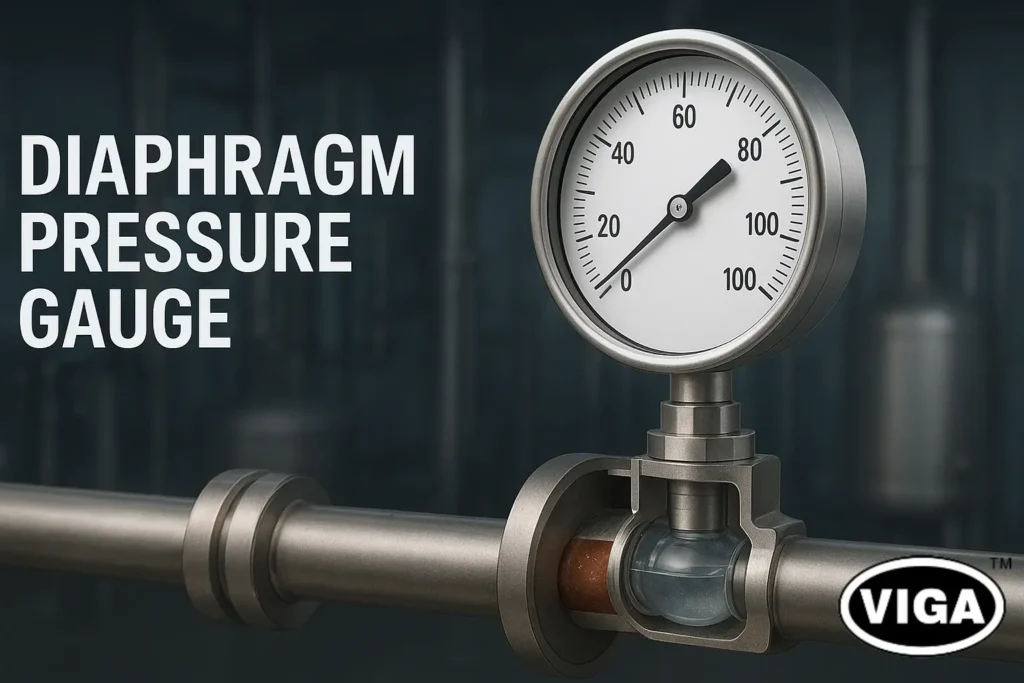
What Is a Diaphragm Pressure Gauge and Where Is It Used? Understanding the Diaphragm Pressure Gauge: A Complete Industrial Guide  In industrial processing, precise pressure readings do more than keep production running smoothly—they protect people, ensure the right product quality, and extend the life of machinery. Regular Bourdon tube gauges handle many jobs, but they can struggle with tough liquids, hot gases, and corrosive chemistries. That’s when the diaphragm pressure gauge becomes a necessary tool.  This guide presents a clear overview of the diaphragm pressure gauge, sometimes called a diaphragm seal pressure gauge. We’ll break down how it works, why it outperforms standard gauges, where it’s used in every major industry, and what to look for when choosing one for your unique application.   What Is a Diaphragm Pressure Gauge?  A diaphragm pressure gauge measures pressure by using a flexible diaphragm to keep the sensitive parts of the device safe from the process fluid. In a standard gauge, the process fluid enters the instrument directly, putting it in contact with the sensing mechanism. In contrast, a diaphragm gauge positions the diaphragm as a protective wall, allowing the pressure to be felt without the fluid getting inside. When the process fluid, gas, or slurry presses against the outer surface of the diaphragm, that little flexible membrane bends inward. This bend slides weightlessly through a sealed, incompressible fill fluid to the Bourdon tube gauge sitting a few inches away. The gauge senses the motion and the needle swings to show how hard the fluid is pushing.  That little barrier of fill fluid is the magic. It keeps acids, gunky slurries, and even sterile biological fluids safely on the diaphragm’s skin, so the delicate gauge mechanics can keep ticking without rust, blockage, or contamination.  Core Principle: How It Works The diaphragm gauge works on the straightforward, clever rule discovered by Pascal: when you push on a fluid inside a sealed container, the same push travels through and touches every tiny corner without fading.  Here’s a step-by-step breakdown: Pressure Application: The fluid, whether it’s biting-acid or sticky-gravel slurry, nudges the outer face of the diaphragm seal.  Diaphragm Deflection: Sorry membrane! The fluid’s push slams the diaphragm inward and the bending keeps on going a little more or a little less, depending on how much push the fluid is training on the diaphragm. Hydraulic Pressure Transfer: A carefully chosen fill fluid completely occupies the space behind the diaphragm and the connector to the pressure transmitter. When the diaphragm bends under pressure, it drives the fill fluid forward and sends pressure signals along the hydraulic line.  Instrument Activation: That hydraulic pressure reaches the pressure measurement device—often a Bourdon tube type—and behaves as if the tubing had been pushed directly by the process itself.  Pressure Indication: A trace pointer sweeps the scale face, clearly showing the process pressure in the readable units of the calibration.  The whole design—diaphragm, fill fluid, and pressure-sensing relay—is completely sealed against atmosphere, producing a fortified and leak-tight system.   Key Components Explained Recognizing the individual components of a diaphragm pressure gauge system reveals why it performs reliably and why it is critical.  The Diaphragm: Acting as the mechanism’s core, this flexible, disk-like, wavy barrier is made of durable metals or synthetic materials. The chosen composition is both supple enough to bend and strong enough to resist the process fluid. For aggressive corrosives, the diaphragm may be formed from 316L stainless steel, Hastelloy C276, Monel, or tantalum, providing the safety and long life demanded by the service. The Housing: Picture a sturdy outer shell that guards the fragile measuring element inside. This shell, usually called the seal body, holds the flexible membrane steady while forming a tight link to the piping carrying the process fluid. The part that truly interacts with the fluid is the bottom half of the seal, dubbed the wetted section, which must be crafted from a metal, plastic, or ceramic that remains strong against whatever it faces.  System Fill Fluid: Imagine a thick, clear liquid that conducts pressure the way a metal rod conducts sound. This liquid fills the space inside the housing, pushing the diaphragm outward to match the pressure of the process. Picking the right liquid is a delicate task. Options include the sweet, sticky consistency of glycerin, a slippery silicone oil, or a specialty Halocarbon safe for food. Each one performs well within a particular range of temperatures and cleanliness rules.  The Pressure Instrument: This is the front face everyone sees—a round dial, a glowing digital readout, or sometimes a sharp little switch. The heart of the operation is usually a Bourdon tube that bends with the pressure, though more modern versions might send electronic signals back to a control room.  The Clear Benefits of Diaphragm Seal Systems Choosing a diaphragm seal is not a matter of preference; it is a choice to defeat the weaknesses of metal-only gauges. The pressure sensor industry is now a multi-billion-dollar sector, growing fast because every factory, refinery, and food plant needs measurements that stay accurate in extremes. The diaphragm seal, with its simple design and robust isolation, is the method that the market trusts again and again. Here’s what these tools can do for you:  Protection from Corrosive and Aggressive Media: They resist harmful chemicals. Ordinary brass or stainless Bourdon tubes quickly corrode in acids or caustic liquids. A diaphragm made from high-grade alloys like Hastelloy or Tantalum stays intact where standard materials would fail.  Prevention of Clogging and Blockages: They stop clogs before they start. Thick liquids, slurries, or sludged solids that would block a tiny gauge orifice slide freely over the broad, unobstructed surface of the diaphragm. That’s why they’re vital in waste treatment, pulp mills, and other places where slurries are normal.  Maintaining Purity and Sanitation: They keep everything hygienic. In pharma, biotech, and food and beverage production, keeping the process pure is a rule you can’t bend. A diaphragm seal gauge fitted with sanitary clamps—often a smooth Tri-Clamp—eliminates corners and gaps where bacteria can hide and

How to Calibrate a Pressure Gauge
Blog

What Is a Diaphragm Pressure Gauge and Where Is It Used?

What Is a Diaphragm Pressure Gauge and Where Is It Used? In any industrial setting that matters—from sprawling manufacturing plants to tightly regulated oil refineries—precision isn’t just a nice-to-have. It’s a core requirement for keeping operations safe, efficient, and compliant. A simple pressure gauge is one of the most common instruments on the front line, providing the critical data that fuels key decisions. But what happens when that data is wrong? An uncalibrated gauge isn’t just slightly off; it’s a potential catalyst for equipment failure, poor product quality, and serious safety hazards. Knowing how to properly calibrate a pressure gauge is, therefore, a fundamental skill for any technician, engineer, or quality professional worth their salt. This guide cuts through the noise to give you a detailed, professional walkthrough of the entire process. We’ll get into why it’s so important, how to know when it’s time to calibrate, and the exact steps to ensure your measurements are rock-solid. Why Accurate Pressure Gauge Calibration Is So Critical Before jumping into the “how,” it’s crucial to firmly grasp the “why.” Calibrating a pressure gauge is much more than a routine check-up. It’s a foundational process that verifies the instrument’s accuracy, directly supporting an organization’s operational integrity. The process is simple in concept: compare the readings from your gauge (the Device Under Test, or DUT) against a measurement standard that has a known, superior accuracy. Keeping People and Equipment Safe Let’s be clear: inaccurate pressure readings are a major safety liability. Picture a pressurized vessel in a chemical plant. If its gauge wrongly indicates a safe pressure level while it’s actually creeping into the danger zone, the result could be a catastrophic rupture. Official reports often point to equipment malfunction—including instrumentation failure—as a key cause of workplace incidents. Diligent calibration is one of the most effective lines of defense against these preventable events. Driving Efficiency and Product Quality So many industrial processes hinge on exact pressure levels to work correctly. Pharmaceuticals: In sterile manufacturing, maintaining specific positive or negative pressures in cleanrooms and bioreactors is non-negotiable. It’s what ensures product purity. Food and Beverage: Think about carbonation, pasteurization, or homogenization. Each relies on precise pressures to deliver a consistent, high-quality product every single time. Manufacturing: Hydraulic presses and pneumatic automation need accurate pressure to stamp, form, and assemble parts with tight, repeatable tolerances. A single out-of-spec gauge can cause subtle process deviations that lead to entire batches being scrapped, reducing yield and burning through money and materials. Meeting Tough Regulatory and Quality Standards Most serious industries are governed by strict regulations and quality management systems like ISO 9001. These frameworks require that key measuring tools get calibrated at defined intervals. Crucially, that calibration must be done against standards that are traceable to national or international benchmarks (like those from NIST in the United States). Ignoring your calibration schedule isn’t an option. It can lead to failed audits, costly non-compliance penalties, and even the loss of certifications that are essential to stay in business. How Often Do Gauges Need Calibration? Nailing Down the Frequency There’s no single, universal answer to how often a pressure gauge needs calibrating. The best approach is a risk-based one, weighing several key factors. Start with the Manufacturer: The manufacturer’s recommendation is your baseline. They know their instrument’s design and will suggest a starting interval. Look at the Application: The stakes of the application matter. A gauge on an aerospace life-support system will have a much more aggressive calibration cycle than one monitoring a general-purpose air compressor in a workshop. Consider the Environment: This is a big one. A gauge exposed to heavy vibration, temperature swings, corrosive chemicals, or sharp pressure spikes will drift out of tolerance far quicker than one sitting in a stable, clean control room. Harsher conditions demand more frequent calibration. Calibrate After Any “Event”: It’s mandatory to recalibrate if the gauge gets dropped, slammed with pressure beyond its maximum rating (over-pressured), or has undergone any repairs. Think of it this way: if a gauge consistently passes its annual check-up with flying colors, you might extend its next appointment to 18 months. But if it’s always on the edge or failing, you need to shorten that interval, fast. Analyzing the calibration history (“As Found” data) is the only way to truly optimize your schedule. The Right Tools for the Job: Your Pressure Calibration Checklist Performing a proper calibration means having the right equipment. Skimping on your tools simply invalidates the whole process. It’s that simple. Here’s what you need to have on your bench. Device Under Test (DUT): This is simply the pressure gauge you’re about to test. Reference Standard (Master Gauge): This is your source of truth and the most important tool in the setup. It absolutely must be more accurate than the DUT. The widely accepted guideline is a Test Accuracy Ratio (TAR) of at least 4:1. This means if you’re calibrating a gauge with a ±1% accuracy, your reference standard needs an accuracy of ±0.25% or better. Critically, this standard must have its own valid, current calibration certificate traceable to a body like NIST. Pressure Source: You need a clean, stable way to generate and fine-tune pressure. Pneumatic Hand Pump: Great for lower pressures, typically up to 600 PSI, using air. Hydraulic Hand Pump/Comparator: The go-to for high-pressure work, using water or calibration oil. Deadweight Tester (DWT): The gold standard. A DWT is a primary standard that creates incredibly precise pressure using finely machined piston-cylinder assemblies and calibrated masses. These are often used to calibrate the master gauges themselves. Fittings and Tubing: A good set of leak-proof fittings (e.g., NPT, BSP) and high-pressure tubing. Leaks are the enemy of stable pressure. Environmental Tools: A basic calibrated thermometer and hygrometer. You need to know the ambient temperature and humidity, as they can affect instrument performance, and you must record them on the certificate. How to Calibrate a Pressure Gauge: The Step-by-Step Method With the groundwork laid, we can get into the practical, hands-on process. Follow

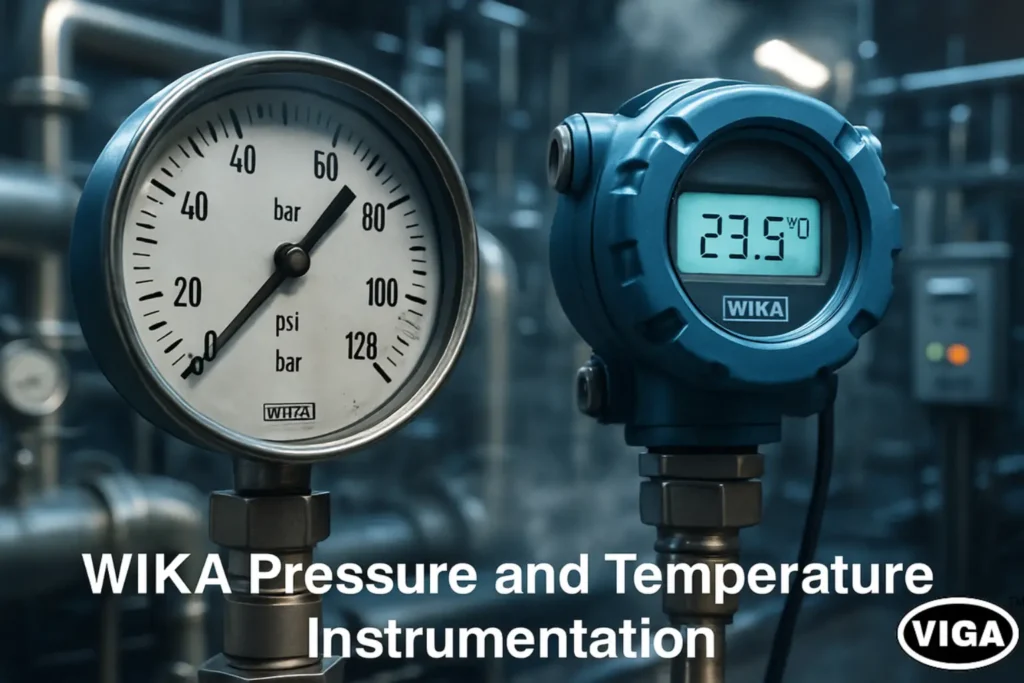
WIKA pressure and temperature instrumentation
Blog

Why WIKA Dominates in Pressure & Temperature Instrumentation

Why WIKA Dominates in Pressure & Temperature Instrumentation Decoding Excellence: Why WIKA Leads the Global Pressure and Temperature Measurement Market In the cutting-edge worlds of industrial processing, manufacturing, and energy, precision isn’t just an aspiration; it’s the non-negotiable bedrock of safety, efficiency, and quality. Every critical operation hinges on the rock-solid accuracy of measurement devices. In this high-stakes arena, one name continually rises as the universal standard for dependability and innovation: WIKA. So what keeps the company on top of the global Pressure and Temperature Instrumentation market year after year?   It isn’t one flashy invention or an over-the-top advertising blitz. WIKA’s leadership rests on three sturdy pillars: a proud German engineering legacy, an endlessly wide range of products, and a relentless drive to crack the toughest industrial puzzles. In the pages ahead, we’ll dive into each of these core strengths, revealing how WIKA converts deep know-how into real, measurable value for customers around the globe.  A Legacy Built on Precision: Where Trust Begins  WIKA’s journey started in 1946, when Europe was rebuilding and quality counted above all. Alexander Wiegand and Philipp Kachel set up practice in Klingenberg, Germany, and turned their hands to crafting sturdy, dependable pressure gauges. The post-war German spirit of careful, lasting workmanship still pulses at the heart of the company, shaping every product we make.   This long march through decades is more than years on a page; it is a storehouse of know-how packed into the art of measurement. Unlike younger rivals, WIKA has walked with industry as it moved from pure mechanics to the smart, connected worlds of Industry 4.0. That depth of background means we can spot problems before they arise and build answers that blend cutting-edge technology with a track record in harsh environments. That is why when an engineer chooses a WIKA gauge, it is not a simple purchase; it is a choice to trust in more than three-quarters of a century of fine-tuned engineering and on-the-ground toughness.  A Collection So Broad It Fits Almost Any Need   WIKA leads the market not just because it sells things, but because it sells the right things—lots of them. The company stocks everything you’d find in a typical measurement store, plus smart, custom-built gadgets for the oddest jobs, the strangest fluids, and the harshest places. Deep Expertise in Pressure Measurement   If it has a signature skill, it’s pressure measurement. WIKA’s lineup is famous, and it runs the whole length from simple dial readouts to brainy digital sensors that run entire factories without a nudge.   Mechanical Pressure Gauges: The traditional WIKA gauge has held factories together for half a century. Choose from Bourdon tubes, diaphragms, or capsules, and mix-and-match cases, connections, and accuracy grades until it fits. The finished gauge slides right into hydraulic presses, pneumatic pumps, or any general machinery that needs steady, reliable pressure data.   Electronic Pressure Sensors and Transmitters: In today’s smart factories, the WIKA sensor is the unsung hero. WIKA builds a huge family of pressure sensors, transmitters, and transducers using piezoresistive, ceramic thick-film, or metal thin-film tech. Once you bolt one on, it turns changing pressure into a tidy electronic signal that PLCs and control rooms can read. You’ll find them in jet cockpits, municipal water towers, and anywhere else that needs pressure data to flow like water itself.  Diaphragm Seals: When dealing with aggressive, corrosive, or high-purity liquids and gases, protecting instrumentation becomes tough. WIKA’s large selection of diaphragm seal systems keeps the measuring device safely away from the media, so the two never meet. This know-how is vital in chemicals, pharmaceuticals, and food and beverage industries, where any direct contact could cause contamination or ruin the instrument. A report from last year said the diaphragm seal market is growing in line with the chemical processing boom, and WIKA is a major player in that market Mastery in Temperature Instrumentation   WIKA’s Temperature Instrumentation lineup matches the pressure division in depth and know-how. Precise temperature control is key to process safety and product quality, and WIKA offers solutions that work from cryogenic chills to the hottest industrial heat.   Electrical Thermometers: This group includes Resistance Thermometers (RTDs) like the trusted Pt100 and Pt1000, plus a full range of thermocouples (Type K, J, S, and more). These sensors deliver accurate electronic temperature readings that are critical for control loops in power plants, refineries, and high-tech manufacturing.  Mechanical Thermometers: When you need to measure heat right where it’s happening but can’t plug anything in, WIKA’s bimetal and gas-actuated thermometers are the smart choice. Built to take a beating, you’ll spot them attached to industrial boilers, in HVAC rooms, and mounted on storage tanks, keeping a constant eye on temperature.  Thermowells: To keep temperature sensors safe from punishing conditions—like intense pressure, caustic fluids, and high-flow turbulence—thermowells are a must. WIKA makes a broad lineup of thermowells from a variety of tough materials, designed to guard the sensor and let you swap it out for maintenance without missing a beat in the process. The Pillars of WIKA’s Global Dominance  Having a huge product lineup is just a start. WIKA stays at the front of the market by following smart business principles that forge a strong competitive edge and earn deep Trustworthiness from customers around the world.  Pillar 1: Unwavering Commitment to Quality and Reliability  For WIKA, quality is woven into every step, not just checked at the end. The factories are certified under global standards like ISO 9001 for quality and ISO 14001 for environmental care. On top of that, key product lines meet tight industry rules, including ATEX and IECEx for volatile zones, 3-A and EHEDG for clean lines, and NACE for sour gas.  You can see the commitment right on the factory floor. WIKA keeps a close grip on the entire supply chain, making nearly every part—right down to the tiny sensor elements—under one roof. Those sensing elements that sit at the heart of many WIKA instruments are produced on-site, which means the company can fine-tune their performance and ensure they won’t drift

Scroll to Top