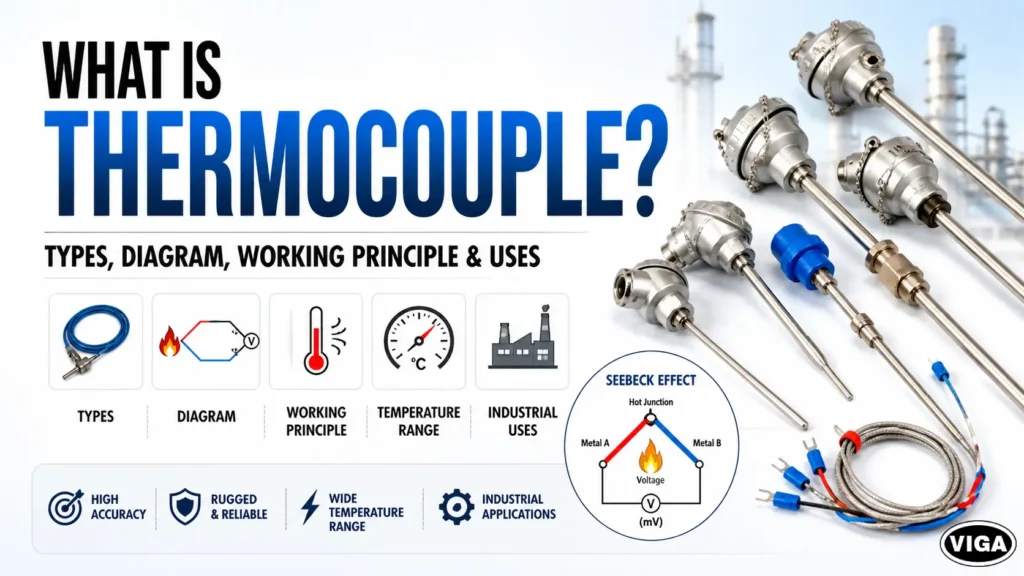
What is Thermocouple? Types, Diagram, Working Principle & Uses
Table of Contents [-] Forget fragile glass thermometers. A thermocouple is an industrial temperature measurement sensor built to survive. It uses two different metal wires welded at a single tip. Heat that junction. It instantly spits out a tiny voltage signal—the Seebeck effect in action. Pure physics powering heavy industry. Understanding the Industrial Thermocouple Sensor Heat runs the show in heavy manufacturing. If your reactor runs too cold, the chemical batch dies. If a blast furnace gets too hot? Liquid steel eats right through the floor. You need hardware that refuses to fail under extreme pressure. Too hot, and steel melts through the furnace floor. You need a sensor that survives hellish conditions, costs pennies on the dollar, and delivers fast, reliable data to your control systems. This is not a delicate laboratory instrument. It is a workhorse. It sits inside roaring incinerators, pressurized chemical vats, and freezing cryogenic chambers. Unlike standard thermometers that use expanding liquids, a thermocouple relies entirely on solid-state physics. Two different metals. One connection point. Heat it up, and it spits out a millivolt (mV) signal. The design is straightforward yet highly resilient, relying purely on solid-state physics to generate a millivolt (mV) signal when heated. Plant managers and instrumentation engineers rely on the thermocouple temperature sensor because it works when everything else fails. It has no moving parts. It requires no external power source to generate its primary signal. It is completely self-powered by the thermal energy it measures. If you are running a manufacturing plant, an oil refinery, or a commercial bakery, you are using these devices right now. But simply buying a sensor off the shelf is a recipe for disaster. You need to understand the physics, the metal combinations, and the exact failure modes. The Physics Under the Hood: Thermocouple Working Principle How does heating two pieces of metal create electricity? While it might seem counterintuitive, this process is governed by fundamental thermodynamics. To understand the thermocouple working principle, we have to look at electrons. When you heat a metal, the electrons at the hot end gain kinetic energy. They start bouncing around rapidly. Because they are highly energized, they naturally diffuse toward the cooler, less energetic end of the wire. This creates a tiny electrical imbalance. The Seebeck Effect: The Engine of Temperature Measurement In 1821, a physicist named Thomas Johann Seebeck discovered something fascinating. If you take two different conductive metals (let’s say iron and copper), join them at one end, and apply heat to that junction, a continuous electrical current flows through the circuit. Why two different metals? This material difference is the core of the measurement. Different metals have different atomic structures. Their electrons react differently to heat. If you used two wires made of the exact same copper alloy, the electron flow in both wires would cancel each other out. Net voltage: zero. But by using dissimilar metals—like Nickel-Chromium paired with Nickel-Alumel—the electrons in one wire move at a different rate than the other. This creates a measurable voltage potential at the open end of the circuit. We measure this output in millivolts (mV). As the temperature rises, the millivolt signal increases. A PID controller or PLC reads this tiny voltage, runs it through a specific algorithm based on the metal types, and converts it into a readable temperature on your screen. Cold Junction Compensation (CJC): The Hidden Hero A thermocouple does not actually measure absolute temperature. It measures a temperature differential. It measures the difference between the hot end (the measurement junction inside your furnace) and the cold end (the reference junction where the wires connect to your reading instrument). If the ambient temperature around your reading instrument changes, your entire temperature reading will be completely wrong. How do we fix this? Cold Junction Compensation (CJC). Modern thermocouple readers contain a secondary, highly sensitive internal thermometer (usually a thermistor or RTD) right at the connection terminals. This internal sensor measures the exact ambient temperature at the connection block. The microprocessor then mathematically adds this ambient temperature back into the equation. Expert Pro-Tip: “Never ignore your cold junction. I’ve seen process engineers tear apart a massive boiler system because they thought the internal temperature was dropping. The boiler was fine. The air conditioning in the control room had failed, heating up the cold junction and throwing off the entire differential reading. Always verify your CJC.” The Big League: Thermocouple Types Chart and Temperature Ranges Not all metals survive extreme heat. If you drop a copper wire into a glass-melting furnace, it vaporizes. This is why we have distinct thermocouple junction types categorized by letter designations. The letter dictates the exact metal alloys used. Choosing the right type is the difference between an accurate reading and a catastrophic system failure. Thermocouple Types Comparison Table Sensor Type Positive Wire (+) Negative Wire (-) Typical Temperature Range Best Industrial Application Type K Chromel (Ni-Cr) Alumel (Ni-Al) -200°C to +1260°C General purpose, Refineries, High heat Type J Iron (Fe) Constantan (Cu-Ni) 0°C to +760°C Plastics industry, Vacuum applications Type T Copper (Cu) Constantan (Cu-Ni) -200°C to +350°C Food processing, Cryogenics, HVAC Type E Chromel (Ni-Cr) Constantan (Cu-Ni) -50°C to +900°C Power plants, High-accuracy needs Type N Nicrosil (Ni-Cr-Si) Nisil (Ni-Si-Mg) -270°C to +1300°C High-temp nuclear, Furnace profiling Type S Platinum-10% Rhodium Platinum 0°C to +1480°C Biotech, Glass industry, Calibration labs Type R Platinum-13% Rhodium Platinum 0°C to +1480°C High-temp recovery, Ceramics Type B Platinum-30% Rhodium Platinum-6% Rhodium +870°C to +1700°C Steel production, Extreme heat Deep Dive: Base Metal Thermocouples Base metal thermocouples are the most widely deployed sensors in standard manufacturing, handling the vast majority of routine industrial tasks cost-effectively. 1. K Type Thermocouple: The Industry Standard If you blindly pull a sensor out of a factory toolkit, it is probably a Type K. Made from Chromel and Alumel, it offers an incredible temperature range (-200°C to +1260°C). It resists oxidation at high temperatures beautifully. Watch out for “Green Rot.” If you expose a Type K to a marginal