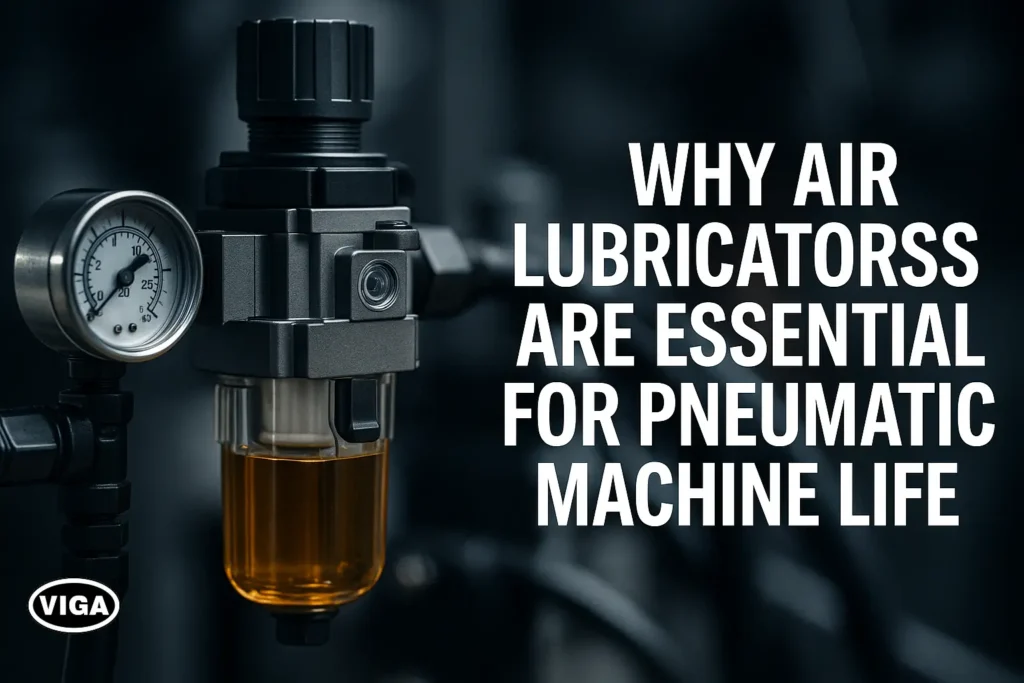
Why Air Lubricators Are Essential for Pneumatic Machine Life
The Secret to Longer Pneumatic Life — Why Air Lubricators Matter More Than You Think! Dry Air is a Destroyer When you are deeply involved in manufacturing or industrial maintenance, your most overlooked source of catastrophic failure is the very thing you use for power: dry compressed air. I can tell you from decades of experience, your Air Lubricator is the single best, simplest piece of defensive engineering you can install. It’s what protects your large investments from an incredibly simple flaw. Let’s face an unavoidable truth: dry air destroys pneumatics faster than anything else. You might have budgeted tens of thousands for high-end compressors and meticulously regulated valves, but once you start running air—filtered, moisture-stripped air—through any rapidly moving pneumatic part, you’ve created an environment of severe, accelerated self-destruction. The reason is a total absence of a separating layer. Think about a critical process stopping—it’s usually not a monumental failure; it’s a minor thing: A High value precision valve that, after three months, just can’t snap its internal spool to the correct position. That phenomenon, the dreaded sticking valve, is a textbook example of component destruction through zero pneumatic tool lubrication. What you are hearing and seeing is uncontrolled metal or plastic rubbing against metal under extreme, repetitive stress. Your focus should be on the small investment that delivers huge operational freedom. The lubricator isn’t an option; it’s an absolute necessity. It is the crucial guardian that ensures genuine tool life enhancement, converting an abrasive medium into a seamless vehicle for internal protection. Ignoring this basic truth leads directly to unpredictable and often catastrophic failure cycles. What Is an Air Lubricator? Before you can appreciate the complex mechanical protection it provides, we must simplify its purpose. So, for someone completely new to this: A Pneumatic Air Lubricator is basically an on-demand, precise dispensing machine for lubricant that gets carried along inside your existing pipe network. It automatically transforms a specialized, low-viscosity oil into a cloud and injects it into the compressed air flow before it hits the point of work. The system function, or the core Air Lubricator Function, is this: ensuring that critical, dynamic parts that are otherwise impossible to manually grease receive an uninterrupted film of protection. That layer is the barrier that prevents the surfaces of your valves, spools, and cylinder rods from ever making contact with each other. You usually see it in the field as the final component in what’s called the FRL Lubricator Unit (Filter, Regulator, Lubricator). If the filter cleans the air and the regulator stabilizes the pressure, the lubricator handles the final and perhaps most important piece of conditioning: adding a controlled dose of mist lubrication. It has to be the last component because putting oil upstream would destroy filters and cause control problems in the regulator’s pressure mechanism. Its careful placement guarantees that every cubic foot of air leaves ready to work and ready to protect its equipment. Why Pneumatic Components Need Lubrication Any experienced maintenance technician knows the real enemy is friction, not just dust. To be a true expert in pneumatics is to grasp the engineering logic of why friction is a system killer and why lubrication is an immediate necessity. This goes to the heart of the Importance of air lubricators. Real-World Mechanics and the Path to Wear We rely on incredibly fast-moving components that depend entirely on close tolerances and intact seals. Without a proper lubricating film, these dynamics work to tear themselves apart. Friction-Induced Heat is a Seal Killer: Actuators run at high cycles per minute. In dry conditions, friction rapidly generates substantial heat right where the piston seals meet the cylinder wall. What happens next is irreversible: That heat hardens the polymer or rubber seals, turning them brittle and compromising their flexibility. Once the seal loses its supple nature, it starts cracking. Pneumatic Wear: Once a seal is brittle or compromised by high heat, its integrity is lost. This results in leakage and the abrasive scouring of the cylinder’s internal surface. The Pneumatic Wear then accelerates—microscopic scores and imperfections develop, allowing more friction, more heat, and more wear. The Stiction Nightmare: This is the most visible operational fail. When a valve’s internal spool requires more pressure (more energy) to begin sliding than to continue sliding, it “sticks.” This is usually due to microscopic dry air damage and an utterly depleted seal layer. This translates directly to an instant hit on production efficiency and system reliability. Essentially, when a lubricator is skipped, you trade preventative wear prevention for an immediate and guaranteed acceleration of your components’ age, resulting in an unjustifiable reduced lifespan across your system. How Air Lubricators Work How does a single drop of oil, released under control, manage to travel 50 feet and perfectly coat an O-ring inside a manifold? It’s not magic; it’s an elegant use of air dynamics. The technology’s effectiveness lies in its core component, the sophisticated oil mist generator. The oil must be broken down to the sub-micron level so that it remains suspended in the high-speed air. The Sight-Feed Control: Oil is stored in the reservoir, but it’s released with meticulous precision. A needle valve or metering screw controls the lubricator oil flow, creating the slow, steady drip rate you observe in the sight-feed glass. This flow is constrained, ensuring you are not flooding the system but rationing the dose perfectly. The Venturi Principle (Generating Vacuum): The incoming compressed air passes through an internal restriction—the Venturi throat. By decreasing the volume for the air flow, you drastically increase the air velocity, which—due to basic physics—causes a rapid drop in local static pressure. That drop creates a crucial, local vacuum. Oil Uptake and Atomization: This generated vacuum then acts like a miniature, precise pump, drawing the precisely metered drop of oil up from the reservoir. When the single oil droplet meets the extremely high-velocity air in the restriction, it’s shattered into a fine aerosolized suspension—the perfect lubricating mist lubrication. Distribution: Air as the Carrier: Now, this is key. The minute size of the oil particles ensures they do not fall out of the airstream immediately (like rain). Instead, the high-pressure air acts as a perfect delivery vehicle, ensuring every complex, tiny channel, O-ring groove, and valve seat