Blog

Your blog category

Air Lubricators
Blog

Why Air Lubricators Are Essential for Pneumatic Machine Life

The Secret to Longer Pneumatic Life — Why Air Lubricators Matter More Than You Think! Dry Air is a Destroyer When you are deeply involved in manufacturing or industrial maintenance, your most overlooked source of catastrophic failure is the very thing you use for power: dry compressed air. I can tell you from decades of experience, your Air Lubricator is the single best, simplest piece of defensive engineering you can install. It’s what protects your large investments from an incredibly simple flaw. Let’s face an unavoidable truth: dry air destroys pneumatics faster than anything else. You might have budgeted tens of thousands for high-end compressors and meticulously regulated valves, but once you start running air—filtered, moisture-stripped air—through any rapidly moving pneumatic part, you’ve created an environment of severe, accelerated self-destruction. The reason is a total absence of a separating layer. Think about a critical process stopping—it’s usually not a monumental failure; it’s a minor thing: A High value precision valve that, after three months, just can’t snap its internal spool to the correct position. That phenomenon, the dreaded sticking valve, is a textbook example of component destruction through zero pneumatic tool lubrication. What you are hearing and seeing is uncontrolled metal or plastic rubbing against metal under extreme, repetitive stress. Your focus should be on the small investment that delivers huge operational freedom. The lubricator isn’t an option; it’s an absolute necessity. It is the crucial guardian that ensures genuine tool life enhancement, converting an abrasive medium into a seamless vehicle for internal protection. Ignoring this basic truth leads directly to unpredictable and often catastrophic failure cycles.  What Is an Air Lubricator? Before you can appreciate the complex mechanical protection it provides, we must simplify its purpose. So, for someone completely new to this: A Pneumatic Air Lubricator is basically an on-demand, precise dispensing machine for lubricant that gets carried along inside your existing pipe network. It automatically transforms a specialized, low-viscosity oil into a cloud and injects it into the compressed air flow before it hits the point of work. The system function, or the core Air Lubricator Function, is this: ensuring that critical, dynamic parts that are otherwise impossible to manually grease receive an uninterrupted film of protection. That layer is the barrier that prevents the surfaces of your valves, spools, and cylinder rods from ever making contact with each other. You usually see it in the field as the final component in what’s called the FRL Lubricator Unit (Filter, Regulator, Lubricator). If the filter cleans the air and the regulator stabilizes the pressure, the lubricator handles the final and perhaps most important piece of conditioning: adding a controlled dose of mist lubrication. It has to be the last component because putting oil upstream would destroy filters and cause control problems in the regulator’s pressure mechanism. Its careful placement guarantees that every cubic foot of air leaves ready to work and ready to protect its equipment. Why Pneumatic Components Need Lubrication Any experienced maintenance technician knows the real enemy is friction, not just dust. To be a true expert in pneumatics is to grasp the engineering logic of why friction is a system killer and why lubrication is an immediate necessity. This goes to the heart of the Importance of air lubricators. Real-World Mechanics and the Path to Wear We rely on incredibly fast-moving components that depend entirely on close tolerances and intact seals. Without a proper lubricating film, these dynamics work to tear themselves apart. Friction-Induced Heat is a Seal Killer: Actuators run at high cycles per minute. In dry conditions, friction rapidly generates substantial heat right where the piston seals meet the cylinder wall. What happens next is irreversible: That heat hardens the polymer or rubber seals, turning them brittle and compromising their flexibility. Once the seal loses its supple nature, it starts cracking. Pneumatic Wear: Once a seal is brittle or compromised by high heat, its integrity is lost. This results in leakage and the abrasive scouring of the cylinder’s internal surface. The Pneumatic Wear then accelerates—microscopic scores and imperfections develop, allowing more friction, more heat, and more wear. The Stiction Nightmare: This is the most visible operational fail. When a valve’s internal spool requires more pressure (more energy) to begin sliding than to continue sliding, it “sticks.” This is usually due to microscopic dry air damage and an utterly depleted seal layer. This translates directly to an instant hit on production efficiency and system reliability. Essentially, when a lubricator is skipped, you trade preventative wear prevention for an immediate and guaranteed acceleration of your components’ age, resulting in an unjustifiable reduced lifespan across your system.  How Air Lubricators Work How does a single drop of oil, released under control, manage to travel 50 feet and perfectly coat an O-ring inside a manifold? It’s not magic; it’s an elegant use of air dynamics. The technology’s effectiveness lies in its core component, the sophisticated oil mist generator. The oil must be broken down to the sub-micron level so that it remains suspended in the high-speed air. The Sight-Feed Control: Oil is stored in the reservoir, but it’s released with meticulous precision. A needle valve or metering screw controls the lubricator oil flow, creating the slow, steady drip rate you observe in the sight-feed glass. This flow is constrained, ensuring you are not flooding the system but rationing the dose perfectly. The Venturi Principle (Generating Vacuum): The incoming compressed air passes through an internal restriction—the Venturi throat. By decreasing the volume for the air flow, you drastically increase the air velocity, which—due to basic physics—causes a rapid drop in local static pressure. That drop creates a crucial, local vacuum. Oil Uptake and Atomization: This generated vacuum then acts like a miniature, precise pump, drawing the precisely metered drop of oil up from the reservoir. When the single oil droplet meets the extremely high-velocity air in the restriction, it’s shattered into a fine aerosolized suspension—the perfect lubricating mist lubrication. Distribution: Air as the Carrier: Now, this is key. The minute size of the oil particles ensures they do not fall out of the airstream immediately (like rain). Instead, the high-pressure air acts as a perfect delivery vehicle, ensuring every complex, tiny channel, O-ring groove, and valve seat

Air Pressure Regulators
Blog

How Air Pressure Regulators Prevent Pressure Drops

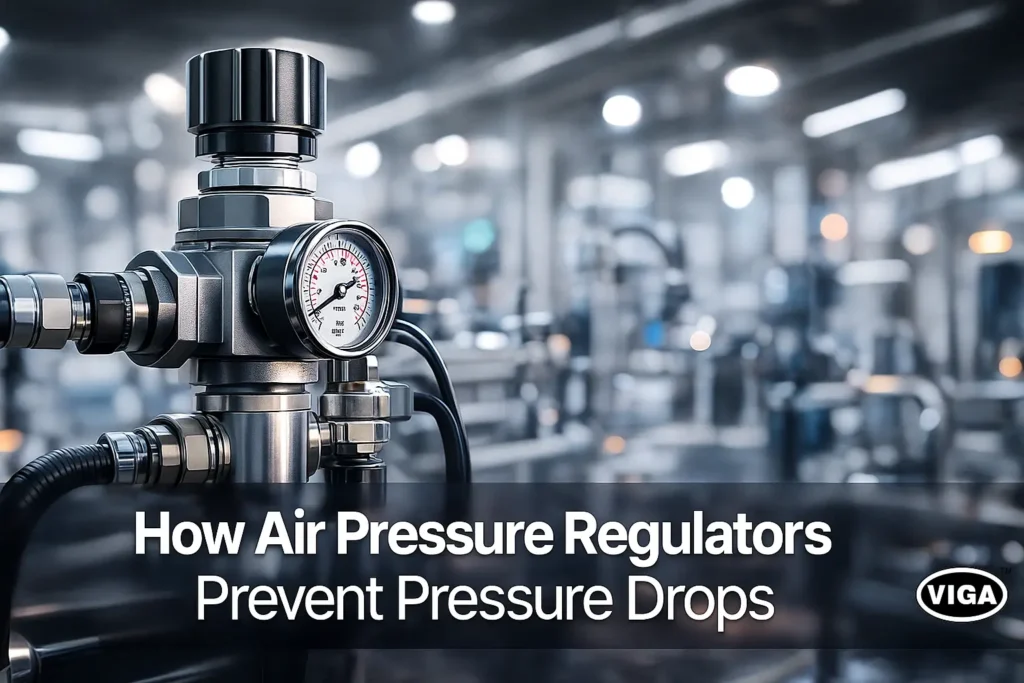
The Air Regulator Difference: Achieving Rock-Solid Operational Stability Air Pressure Regulators are the most undervalued assets in the vast majority of industrial setups, yet they prevent production disasters every single minute of every working day. You know that gnawing anxiety—that tiny, cold fear that hits when a high-speed assembly sequence on your line hesitates, stutters, or momentarily loses power. We’ve all seen the resulting disaster: a part is misaligned, a torque wrench underperforms, or a paint finish suddenly appears patchy. The cause, far too often, is traced back not to a faulty machine, but to the inherently unpredictable nature of its energy source. Let’s be candid. You spend a fortune on a high-end air compressor, capable of delivering a beastly 175 PSI. Logically, the air should be perfect at the workhead, right? Wrong. The moment a compressor cycles, a distant machine engages, or a major line manifold is accessed, that output pressure violently shifts. Imagine running an automated screw feeder that requires precisely 75 PSI for repeatable performance. Without consistent control, an air spike might blow a seal, while a sudden pressure drop might cause an unacceptable half-turn on a crucial fastener. This true industrial scenario illustrates why we constantly fight the specter of instability, underscoring the massive importance of an air pressure regulator for continuous output quality. The truth is, reliable operation hinges entirely on controlling the very air you feed your machines. What Causes Pressure Drops in Pneumatic Systems? You cannot fix chaos until you know its root cause. If your machines are consistently battling chronic performance problems, a significant pressure drop in pneumatic systems is the likeliest culprit. You might be paying a premium for compressed air, but your machinery is receiving volatile fluctuations, contributing to significant Pneumatic Pressure Loss. We have to drill down into the non-negotiable answers to Causes of Pressure Drops : The Turbulent Compressor Source: I know you paid for a steady supply, but the fact is, the tank is always refilling, starting, and stopping. This natural fluctuation means the high-side supply line pressure constantly varies by 10 to 20 PSI—it’s never truly constant. Without an Air regulator for compressor output, that erratic feed immediately introduces chaotic pressure spikes and falls across your entire compressed air system. Simultaneous Demand Overload (Systemic Starvation): The common issue of multiple tools or actuators activating concurrently—an air blast here, a major clamp there. These demands instantly create a brief but substantial localized vacuum, starving the immediate local area of volume (CFM) and dramatically dropping the pressure. This peak flow deficiency is why many Why pressure drops happen in air lines incidents occur only during maximum production speed. Chronic and Undiscovered Line Leakage: This is the invisible money pit. You’d be surprised how much pressure—and, thus, money—is hemorrhaging through tiny, neglected seals or slightly loose hose clamps across a large facility. That persistent, collective hiss forces your compressor to run longer and harder, which directly and consistently degrades the baseline stable air pressure available to your devices. Air Quality and Pipeline Resistance: If you aren’t diligently maintaining your upstream dryer and filter, moisture and contaminants collect inside the piping. Over time, that buildup reduces the actual flow diameter, creating frictional resistance that mimics a chronic bottleneck. This hidden choke point translates into a measurable loss of performance right where the actuator requires its full push force. Design Flaws: The Curse of Undersizing: A mistake made years ago by a systems designer: installing piping that is simply too small for today’s demand load. While you can send enough pressure, the piping can’t pass the volume without creating significant friction, resulting in an inherent pressure-loss defect built into the structural DNA of your pneumatic system efficiency setup. What Is an Air Pressure Regulator? Let’s be incredibly clear about the function. The Air Pressure Regulator acts as a dedicated pressure-reducing and stabilizing mechanism. Its purpose is entirely focused: it converts the unpredictable, high input pressure from the supply source into the precise, much lower set-point of stable air pressure required by the tool. And crucially, it holds that output number static, almost without exception. The Crucial Last Step Positioning is key for success. The regulator isn’t installed next to the huge main tank. Instead, you’ll find it strategically located immediately before the end-use device, usually integrated with the final filtration—often less than five feet from the pneumatic cylinder it controls. This point-of-use proximity ensures highly localized downstream pressure control , meaning its mechanical action accounts for the last moments of turbulence in the line, securing pressure consistency exactly where performance is judged. Know the Difference: Regulator vs. Relief Valve An expert distinction must be made here, as relying on one to do the job of the other is a frequent industrial mistake that risks costly damage: The Air Pressure Regulator (The Governor): This device performs the active work of control and reduction. Its mandate is operational—it makes sure the output pressure never exceeds the set-point during normal use. The Safety Relief Valve (The Safety Fuse): This component is designed to remain completely passive until a catastrophic event occurs—it only activates to dump pressure overboard if the entire system unintentionally over-pressurizes far above the regulator’s cap. Its sole job is the final defense against extreme failure and overpressure damage from structural rupture. The regulator is a full-time operator; the relief valve is merely the ultimate, last-second safety back-up. How Air Regulators Keep Air Pressure Stable How exactly does this clever arrangement of components achieve such unerring stability? The mechanical truth of how air regulators work is based entirely on the principle of mechanical counter-balance. Every reliable regulator utilizes its core components—the adjustable spring, the sensitive diaphragm (or piston), and the shut-off valve—in a perpetual negotiation. The moment you adjust the knob, this internal process begins: Setting the Control Standard (Downward Force): By turning the adjustment knob, you physically load the main internal spring. The resultant tension creates a measurable, downward mechanical force on the system’s flexible diaphragm or sensing piston. This is your commanded stable air pressure target (e.g., 90 PSI). Measuring the Operational Reality (Upward Force): On the opposite side of the diaphragm, a separate sensing line continuously channels the regulated output air pressure (the downstream pressure). This air creates a corresponding upward pressure force against the diaphragm, directly opposing the force of the spring. The Sweet Spot

Top 5 Factors Pressure Gauge Selection Guide for Industry Needs
Blog

Top 5 Factors: Pressure Gauge Selection Guide for Industry Needs

Top 5 Factors to Consider Before Selecting a Pressure Gauge for Your Industry Accurate pressure measurement is more than just a metric; it is the cornerstone of safety, quality control, and operational efficiency across every major industry. In critical environments, from refining crude oil to manufacturing pharmaceuticals, a malfunctioning or improperly chosen pressure gauge can lead to disastrous equipment failure, significant downtime, or even hazardous safety incidents. When selecting instrumentation for industrial process monitoring, choosing a pressure gauge often seems straightforward—but it shouldn’t be a hurried, box-ticking exercise. The nuances of your specific application demand a careful, methodical approach. This detailed Industrial Pressure Gauge Selection Guide outlines the top five factors that must influence your decision, ensuring you choose an instrument that provides reliability and precision for years to come. What Is Pressure Gauge Selection & Why It Matters Pressure gauge selection is the strategic process of evaluating a system’s requirements (media type, pressure range, environment) against a gauge’s specifications (accuracy, material, type) to achieve optimal performance, safety, and longevity. We commonly encounter pressure gauges in various sectors: regulating gas lines in chemical manufacturing, monitoring sterilization chambers in pharma, measuring wellhead pressure in oil & gas, or maintaining quality control in the food and beverage industry. A wrong selection can have severe consequences. For example, selecting a gauge with poor pressure gauge material compatibility for an abrasive chemical could lead to rapid internal corrosion, causing media leaks, costly equipment downtime, and, potentially, equipment rupture. Learning how to choose a pressure gauge correctly, therefore, is essential to protect assets and personnel. The Top 5 Critical Factors Factor 1: Pressure Range & Measurement Accuracy This is perhaps the most fundamental factor in pressure gauge selection criteria. Misjudging the operational pressure range can destroy the gauge rapidly or render its readings meaningless. The Golden Rule for Range Selection: The normal working pressure of your system should fall between 40% and 75% of the full-scale range (FSR) of the selected gauge. Example: If your typical operating pressure is 400 psi, your chosen gauge should have an FSR of approximately 600 psi to 1000 psi. Why 75% is the recommended limit: Constantly operating a gauge above 75% FSR significantly reduces the lifespan and negatively impacts its calibration due to over-stressing internal components. Measurement Accuracy: The accuracy class determines how closely the reading represents the true pressure. For standard industrial use, an accuracy class of ±1%±1%  is typical. However, for critical monitoring and calibration standards, ±0.5%±0.5%  or even ±0.25%±0.25%  accuracy is crucial. Higher accuracy translates to better control and safety, justifying a higher investment.  Factor 2: Process Media & Material Compatibility The medium the gauge is monitoring (the process fluid or gas) is a major determinant of material choice. This step is about preventing premature gauge failure and protecting against contamination. Process Medium Common Compatibility Issues Recommended Materials Water, Air, Oil Standard conditions Brass or Bronze Mild Corrosives Chemical corrosion Stainless Steel 304 (SS 304) Highly Corrosives (Acids, Ammonia) Pitting, rapid deterioration Stainless Steel 316L (SS 316L) or Monel/Hastelloy Slurries, Viscous Media Clogging, buildup Diaphragm Seals with non-metallic filling Failure to ensure gauge material compatibility, especially in chemical and high-purity environments, can be dangerous and extremely costly. Selecting the best pressure gauge for industrial use means first checking the fluid characteristics. Factor 3: Operating Environment & Application Type The external conditions surrounding the gauge have a profound impact on its reliability. Neglecting environmental stressors often leads to premature failure, regardless of how accurate the gauge itself is.  Vibration and Pulsation: Machinery vibration (e.g., near compressors or pumps) can damage the gauge movement (gear train and pointer). For such environments, selecting a liquid-filled pressure gauge (often filled with glycerine or silicone) is essential. The damping fluid stabilizes the pointer, reduces wear on internal gears, and extends the gauge’s lifespan. Temperature: Both high ambient temperatures and high process media temperatures must be addressed. High process temperatures require the use of accessories like cooling siphons (for steam) or chemical seals to isolate the gauge from the heat, ensuring the internal components remain within their operational temperature limit. Factor 4: Gauge Type & Mounting Configuration Industrial pressure monitoring applications require a variety of gauge types, each suited for a different measurement principle and fluid characteristic. Bourdon Tube: Most common, reliable for general process applications. Diaphragm/Capsule: Best for low pressures (Draft pressure) and protecting the sensor from clogging fluids (slurries). Digital Gauges: Offer high accuracy, readability, and integrated features like data logging and analog output, making them invaluable for precise monitoring and compliance in advanced facilities. Beyond the type, correctly choosing the pressure gauge size, range, and connection type (e.g., NPT, BSP) and ensuring a correct mounting configuration (panel, surface, or direct line) is key to proper installation and viewing accessibility. Factor 5: Calibration, Maintenance & Reliability A gauge is only reliable if its readings can be trusted. Pressure gauge calibration is not just an expense; it’s an insurance policy. Calibration confirms the accuracy of the device against known standards (like ISO/ASME) and is crucial for maintaining compliance and product quality. [Keywords: Pressure Gauge Calibration, Pressure Gauge Reliability] Industry best practice recommends establishing a recommended calibration interval based on the gauge’s environment, accuracy class, and criticality to the process, usually every 6 to 12 months. Routine checks and preventive maintenance, such as checking for external leaks and ensuring the pointer moves freely, will prevent catastrophic system failures and uphold long-term reliability. Bonus Tip: Safety Standards & Certifications When it comes to industrial pressure gauge safety, verify that your gauge complies with established national and international standards such as ASME B40.100 (U.S.) or EN 837 (European). These certifications ensure the instrument meets rigorous safety design requirements, including burst pressure and housing integrity. Always request supplier documentation to confirm traceability and manufacturing quality. [Keywords: Pressure Gauge Standards, Industrial Pressure Gauge Safety] Common Mistakes to Avoid While Selecting a Pressure Gauge A clear path to effective pressure measurement often begins with identifying potential pitfalls. The following common mistakes while choosing a pressure gauge should be actively avoided: Selecting

Industrial Pressure Gauges Comparing Triclover, Capsule, Homogeniser & Test Gauges
Blog

Industrial Pressure Gauges: Triclover, Capsule, Homogeniser Comparison

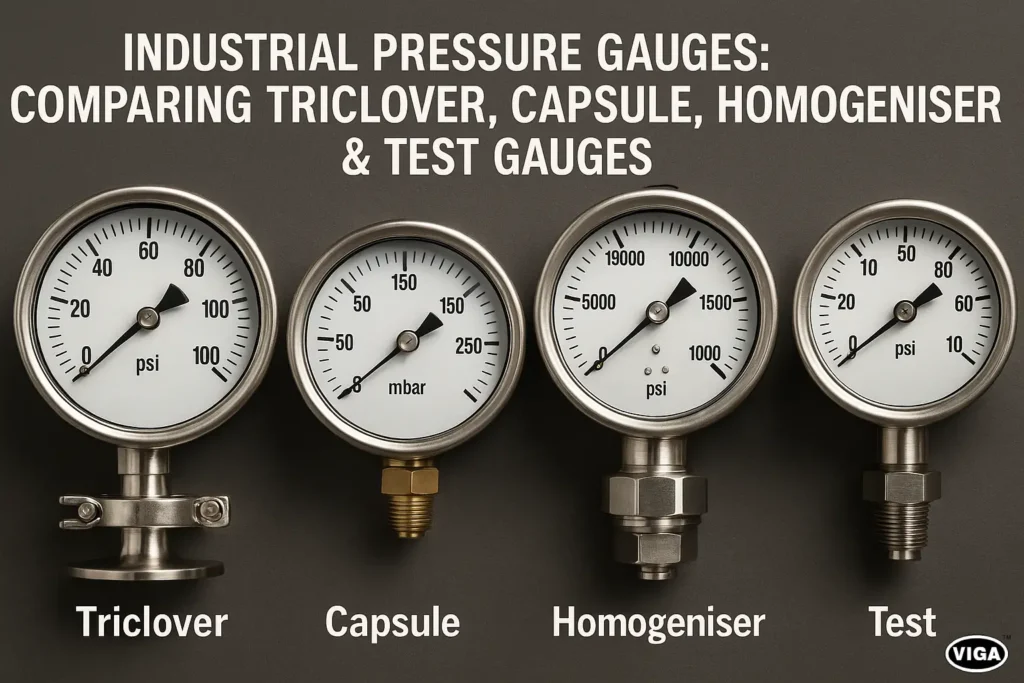
Industrial Pressure Gauges: Comparing Triclover, Capsule, Homogeniser & Test Gauges Within the complex operational landscapes of manufacturing, processing, and industrial facilities, the capacity to precisely monitor and control system dynamics represents the core of operational excellence. Process stability and safety are inherently dependent on the instrumentation chosen, particularly the measurement of pressure. As such, the selection of the correct measuring device demands careful consideration of not only range and media but also the device’s design intended purpose. Industrial Pressure Gauges serve as primary safety indicators and critical control loop elements. The fidelity of these instruments dictates product quality, adherence to strict processing recipes, and ultimately, personnel safety. Failure to select the proper gauge can lead to measurement drift, premature component fatigue, and devastating failures in high-risk environments. This necessity explains Why accuracy and calibration matter in industrial applications. Ensuring the gauge’s reading aligns precisely with actual process conditions provides the foundation for safe, compliant, and cost-effective operations. Understanding the specific mechanics and advantages of highly specialized instruments allows industry professionals to make informed procurement and maintenance decisions. This analysis offers a detailed comparative review of the hygienic Triclover Pressure Gauge, the sensitive Capsule Pressure Gauge, the high-endurance Homogeniser Pressure Gauge, and the critical Test Gauge for Calibration. An exploration of these distinct devices illuminates the sheer variety of Types of Industrial Pressure Gauges available to meet any industrial requirement. What Are Industrial Pressure Gauges? Industrial Pressure Gauges are indispensable devices designed to convert fluid force exerted on a sensing element into a readable value, typically displayed on a dial scale or digitally. The classical working principle—the mechanical gauge—revolves primarily around the utilization of the Bourdon tube. This C-shaped, helical, or spiral tube, typically forged from bronze or stainless steel, is flattened into an elliptical cross-section and closed at the tip. When process pressure is applied, the tube attempts to return to a circular cross-section, causing the free end to straighten. This minute displacement is magnified by a gear and pinion mechanism, ultimately driving the pointer around a calibrated dial. The application of these instruments transcends simple observation. Their continuous readings are vital for the efficient and safe execution of various industrial activities across the spectrum, from fine chemical handling and precision food manufacturing to controlling the energy flow in large-scale chemical plants. A well-maintained and calibrated gauge serves as the physical link to established safety limits and Pressure measurement standards. Furthermore, in industries facing high vibration or pressure pulsation, appropriate modifications, such as liquid-filled casings, are utilized to protect the sensitive internal mechanisms and enhance pointer stability, thereby guaranteeing reliable readings even under dynamic operational duress. Proper knowledge of Industrial Pressure Gauge Calibration ensures regulatory compliance and optimal process control integrity. Triclover Pressure Gauge The Triclover Pressure Gauge distinguishes itself not primarily by its internal sensing mechanism, but by its distinct connection design. Also referred to by its common industry name, the Triclamp, this sterile coupling facilitates a smooth, crevice-free junction with the process line. This feature is the hallmark of its widespread utility in sectors requiring exceptional levels of sanitary design. Its function is inherently linked to hygienic applications. When a standard threaded gauge or an exposed diaphragm assembly is utilized, media, contaminants, or microscopic biological materials can become lodged in the tiny thread gaps or sharp corners, making cleaning-in-place (CIP) or sterilization-in-place (SIP) ineffective. The use of a smooth, gasketed seal, clamped by the easy-release Triclover ferrule system, solves this crucial industry challenge. The construction materials invariably consist of high-grade, often electro-polished, Stainless Steel Pressure Gauges (typically 316L). This resistance to aggressive media and rigorous cleaning chemicals is not merely an advantage; it is a fundamental requirement in regulated environments like dairy, pharma, and food/beverage processing. Advantages central to this design include superior process integration due to easy to clean capabilities, guaranteed reliable sealing through the robust gasket compression, and its inherent corrosion-resistant nature, which prolongs the instrument’s operational life dramatically while maintaining strict sanitary validation. For applications where process cleanliness directly affects consumer safety, the Triclover design offers unparalleled assurance. Capsule Pressure Gauge When applications involve the measurement of exceptionally low pressure—differential pressure, draft pressure, or flow in specialized air or gas lines—the traditional Bourdon tube lacks the requisite sensitivity. For such scenarios, the highly sensitive Capsule Pressure Gauge offers the precise solution. The operational principle of this device centers on an enclosed element known as the capsule, which gives the instrument its name. The capsule is created by welding or soldering together two thin, deeply corrugated diaphragms along their perimeter. This assembly creates an enclosed chamber where pressure from the process media is introduced. As pressure is exerted internally, the sensitive corrugated shape allows for a greater displacement and mechanical stroke even at pressures below 1 psi (or 27 inches of water column). This large, yet sensitive, displacement is then transmitted through a movement mechanism, effectively converting a negligible pressure change into a measurable dial movement. The Capsule gauges are particularly ideal for gas measurement and filter monitoring applications where extremely minute pressure variations must be registered reliably. They are frequently deployed in laboratories, pharmaceutical isolators, ventilation and air handling units (HVAC), and cleanroom environments where measuring slight low-pressure measurement variations between different controlled zones is necessary for environmental integrity. The primary benefits include their highly accurate reading across a compressed, low-end scale and their simple construction that minimizes fluid contamination in clean environments. Understanding this instrument’s low-pressure capabilities clarifies the notable difference when making a Pressure Gauge Comparison. Homogeniser Pressure Gauge The Homogeniser Pressure Gauge is purpose-built to survive and perform under the most brutal conditions found in specialized fluid processing—specifically the homogenization process employed in the dairy and beverage industries. Homogenization involves mechanically breaking down particles (like fat globules in milk) into uniformly small sizes by forcing the liquid at high velocity through a very small, restricted opening at immense pressures, often in excess of 5,000 to 10,000 psi. This extreme pressure application introduces several engineering challenges. Not only must the instrument withstand

Test Gauges
Blog

Test Gauges: Precision Tools for Calibration and Accuracy

Test Gauges: Precision Instruments for Calibration & Accuracy Checks In engineering and industrial operations, there’s a saying: “If you can’t measure it correctly, you can’t control it correctly.” No matter how advanced a process is, its success ultimately depends on the accuracy of its measurements. For industries such as pharmaceuticals, oil and gas, chemicals, automotive, and utilities, reliable readings of pressure, temperature, and flow mean the difference between consistent quality and serious system failure. When accuracy is critical, industries turn to one tool above all others: test gauges. These instruments are not everyday operational gauges, but specialized precision devices that act as benchmarks for calibration and verification. They confirm whether working instruments are trustworthy, identify inaccuracies that could lead to costly errors, and establish measurement traceability according to recognized standards. This article examines test gauges in detail. We’ll cover their purpose, different types, applications across industries, technical benefits, compliance with global standards, trends in Indian manufacturing, and practical tips for choosing the right gauge. What Exactly Are Test Gauges? Test gauges are precision measuring instruments designed for one main purpose—calibration and validation. Where standard pressure gauges might give readings with a ±1% or ±2% accuracy, test gauges improve that figure dramatically, often down to ±0.25%, ±0.1%, or even tighter tolerances. A useful way to describe test gauges is to call them “referees”. Just as referees ensure a fair game, test gauges ensure that every working instrument—whether it’s installed on a reactor, a pipeline, or a testing bench—is reading accurately. Whenever discrepancies arise, it’s the test gauge that reveals them. Typical characteristics include: High-resolution scales, often with mirrored surfaces to eliminate parallax errors. Precision pointers for finer readability. Robust designs to minimize long-term drift in measurements. Traceable calibration certificates confirming compliance with ISO/IEC or ASME standards. Categories of Test Gauges Precision Test Gauges These are the finest category of gauges, often used where measurement cannot tolerate the slightest deviation. Typical environments include aerospace engineering, defense equipment testing, high-tech laboratories, and nuclear facilities. For example, in an R&D lab testing rocket engine components, even a tiny pressure mismatch may skew results. Precision test gauges ensure readings remain unquestionably reliable. Calibration Test Gauges As the name suggests, calibration test gauges serve as references in calibration processes. Their role is to recalibrate or verify working gauges used in production and field work. Calibration facilities often link a calibration gauge with pumps, pressure controllers, or deadweight testers to compare readings across a defined range. Accuracy Test Gauges Accuracy test gauges represent a middle ground—they are not laboratory-grade, but they are portable, rugged, and suitable for field applications. Maintenance teams, for example, use them during scheduled shutdowns to spot-check operating gauges across plants. Pressure Test Gauges These are the most widely used. Pressure test gauges validate pressure in mechanical, chemical, and hydraulic systems under real operational conditions. Available in sealed stainless steel, liquid-filled for vibration resistance, or diaphragm-protected configurations, they are indispensable across refineries, chemical plants, water treatment units, automotive hydraulics, and HVAC installations. Applications of Test Gauges Test gauges are universal in scope, spanning across industries and purposes. Industrial Calibration In large-scale industries such as steel manufacturing or petroleum processing, equipment often works under high pressures and extreme temperatures. Instruments installed in these systems gradually drift away from their calibration reference. Test gauges for industrial calibration ensure these deviations are detected and corrected before they compromise production safety or quality. Laboratories Laboratories, particularly in pharmaceuticals, biotechnology, and electronics, depend heavily on measurement accuracy. Test gauges in laboratories verify pressure in sterilizers, containment chambers, and controlled experimental setups. If a lab is conducting a test requiring pressure stability within ±0.2 bar, only a test gauge offers confidence that the values being recorded are accurate. Manufacturing and Quality Assurance Factories rely on test gauges to preserve quality assurance. In automotive plants, brake systems, fuel injectors, and hydraulic testing setups all undergo scrutiny with calibrated test gauges. The outcome ensures vehicles leave assembly lines compliant with safety regulations. Utilities and Energy Power generation is another sector that cannot risk inaccuracies. Whether in a thermal power plant measuring turbine steam pressure or a hydroelectric unit monitoring flow control mechanisms, test gauges maintain the delicate balance between efficiency, performance, and safety. Aerospace and Defense For aircraft manufacturers or defense organizations, measurement tolerances are extremely strict. Precision gauges are used in flight simulators, cabin pressurization tests, missile launch system verifications, and more. A misreading here could have consequences measured not in profits, but in lives. Benefits of Test Gauges A common question from plant managers is: “Why invest in test gauges when we already have operational gauges installed?” The answer becomes clear when considering the benefits. Unmatched Accuracy – With tolerance levels as low as ±0.1%, test gauges are several times more precise than regular gauges. Reliability in Calibration Chains – They form the backbone of calibration by providing a reference traceable to national or international standards. Enhanced Safety – Prevents critical equipment failures by verifying that operational gauges reflect true system conditions. Cost Savings Over Time – Downtime, rejected batches, or safety breaches cost much more than investing in proper test equipment. Compliance Assurance – ISO-certified processes and industries under FDA or BIS regulations all require calibration using traceable reference devices. Adaptability – Suitable for use in cleanrooms, industrial plants, R&D labs, and even outdoor maintenance conditions. Standards Governing Test Gauges The credibility of a test gauge lies not just in its construction but in its compliance with recognized standards: ASME B40.100 (United States): Specifies pressure gauge design and accuracy standards. EN 837 (Europe): Governs bourdon-type gauge design accuracy and safety. ISO/IEC 17025: Defines the requirements labs must meet to use test gauges within a traceable calibration chain. BIS Standards (India): Ensure locally manufactured gauges meet national benchmarks. For global operations, using gauges aligned with these standards ensures universal recognition of calibration results. Test Gauge Manufacturing in India Over the past decade, India has built a strong reputation as a provider of calibration instruments, including test gauges. The growing

Homogeniser Gauges
Blog

Homogeniser Gauges for Dairy & Pharma | High-Pressure Accuracy

Homogeniser Gauges in Dairy & Pharma: Ensuring Accuracy Under High Pressure The delicate homogenization of milk and cream in dairy processing plants and the preparation of pharmaceuticals and other critical liquid medicaments in sterile pharmaceutical laboratories rely on and are a product of homogenization pressure processing. In turn, homogenization pressure processing is a sophisticated, intensive high-pressure transformation. Thus, the milk in our cereal and the life-saving medication on a critical day comes down to the operational performance of the homogeniser gauge. It is the silent sentinel of the gauge, enforcing the pressure vigilant to the demanding metrics of high power, the transcendental quality of every product. To achieve homogenization, it is necessary to force liquid through a very narrow gap, where it is subject to tremendous pressure and partitioning that, in turn, creates a stable emulsion. The pressure applied is enormous and can run up to thousands of pounds per square inch (PSI). In the proportional absence of a monitoring and controlling method that is both accurate and reliable, the homogenization process would face the possibility of product failure, equipment compromise, and safety concerns. In these circumstances, homogeniser pressure gauges (HPGs) serve functions that add value to the situation, and the feedback obtained is instrumental to control and consistency of homogenization in systems where precision is paramount. Homogeniser Gauges: The Unsung Saviors On a more fundamental note, a homogeniser gauge is a type of homogeniser instrument that is different from the rest in that it is designed to withstand the very unique and extreme conditions posed by a homogeniser. Most homogenise gauges are made to withstand extreme pressures, but these are different in that they are made to survive extreme vibration and high levels of pulsating pressure that is accompanied by high levels of hygiene usually needed in the pharmaceutical and dairy industries. What is the purpose of a Homogeniser Pressure Gauge? A Homogeniser Pressure Gauge is designed to indicate and measure the amount of pressure used on a fluid while homogenization is in progress. In order to accomplish this in a clean manner, these gauges are almost always in association with a diaphragm seal. A diaphragm seal is used to protect and separate the internal workings of a gauge from the process media, such as milk, liquid drugs, and other formulations. The pressure goes through the diaphragm into a fillable gauge, then to a filling fluid, which then moves the gauge’s pressure sensing mechanism, which is usually a Bourdon tube, The diaphragm and gauge design is crucial as it prevents the process fluid from getting into the gauge and eliminates the contamination. In addition, these gauges are designed and build to endure the constant and severe pulsations of the homogenizer’s pump, a distinctive mechanism that averts the premature failure of these type gauges. The importance of the Gauge of the High-Pressure Homogenizer. The method of homogenization is critically dependent on the pressure used. The pressure applied is critical when breaking down the fat globules in milk or grinding active pharmaceutical ingredients (APIs) into micro sized particles required for stable product formulation. High pressure in these cases is a necessity. The High Pressure Homogeniser Gauges are constructed for these specific workloads. They can gauge pressures exceeding 1,600 bar (or 15,000 psi) in a number of demanding operating conditions, and in some cases, even higher with phenomenal accuracy. These instruments are constructed with extraordinary engineering durability. These factors include the robust parts of the equipment, for instance the diaphragm and process connection parts requiring minimal maintenance and engineered corrosion resistant. These parts are constructed for extreme pressure and extremely small gaps are used in the designs for maximizing accurate pressure readings. The outer casing is engineered with stainless steel 304 for durability and corrosion resistant for the elements. The importance of Purity and Safety: Benefits of Gauge Sanitary Homogeniser. Hygiene is a critical aspect of food and pharmaceutical manufacturing activities. It is for this reason that Sanitary Homogeniser Gauges have been developed. “Sanitary” or “Hygienic” means design of the instrument does not have features like: joins, threads, and spaces which products can hide, and bacteria can multiply. The mirror polished product contact surfaces can be cleaned easily, either manually or through CIP (clean-in-place) systems, because of the absence of ports and dead ends in the system. The apex of the sanitary design is the diaphragm seal which guarantees the safety of the delicate mechanics of the gauge while also avoiding any contamination. The whole assembly is compliant with the stringent of industry regulations like the 3-A Sanitary Standards in the U.S which certify that the equipment is designed and fabricated for easy cleaning and effective inspection. The positive consequences of investing in a high quality and durable gauge homogeniser is felt in various aspects ranging from the product, and operational safety. Enhanced Product Quality and Consistency  In most cases, the more delicate the process, the more difficult and complicated it becomes, and in the case of dairy, the delicate process which border directly with the complicated, and with the most effort and care, maintain the size of each and every fat globule in homogenous milk to the size of a small pinhead. This practice, of course, enables the eater the most efficient and stable experience. quivalently, in the case of pharma products, each granule of the tablet, relative to the correct bioavailability and dosage needed, must also be homogeneous for effectiveness insufficiency. Operational Productivity and Improvement  In the scenario of apparatus, equipment, and other valuable partially finished and finished products, the equipment of, with, and undergoing over pressurization is regulated and controlled with much more certainty, which ultimately helps the people working with it. Rather, it helps them avoid and escape dangerous situations which could put them in a perilous position. Besides, the people working the equipment in the situation of the pour for Liquid with other homogeneous liquid, the people working the equipment which the pour for Liquid happens, it is pourerably much more efficient and effective with an

Capsule Gauges
Blog

Capsule Gauges: Professional Low-Pressure Measurement Solutions

When precise low-pressure measurements are required, capsule gauges are the most reliable option. Standard gauge technology often fails below 1 bar (roughly 15 PSIG) because most common designs are optimized for higher pressures. Bourdon tubes, for example, suffer diminishing accuracy at the low end of their range. Their ability to track rapid changes declines, hysteresis errors increase, and parallax errors exacerbate the disparity between the pointer and actual pressure. When the low side of their characteristic curve coincides with the pressure application of interest, the measurement becomes irrelevant and engineers are effectively measuring noise instead of the signal.  This accuracy shortfall is not an abstract nuisance; it translates to significant risks and inefficiencies in critical applications. Low-pressure monitoring is the unsung backbone of performance assurance in complex HVAC system controls, leak testing of gas distribution lines, and the maintenance of cleanrooms in pharmaceutical manufacturing, among many other processes. Compliance with regulatory and internal audits, safety of personnel, and the integrity of manufactured products all rely on reliable low-pressure data. When the instrument fails to provide that data, the alternative is often unsafe guessing, which in turn leads to costly and potentially damaging corrective actions.  This is where capsule pressure gauges assert their distinct value. They are not simply alternative pressure-measuring devices; rather, their conception is rooted in the need for reliable performance within the low-pressure regime. Capitalising on engineered high sensitivity, capsule gauges detect and display pressure variations on the order of a few pascals, variations that Bourdon or diaphragm gauges of the high-pressure class routinely overlook. The ensuing discussion illustrates the operating principle of the capsule, articulates its comparative advantages, and rationalises its preferred use in low-pressure applications.   The Operative Principle: The Capsule Diaphragm in Motion   At its most fundamental, the architecture of a capsule gauge is straightforward: a sealed metallic capsule deforms in a discretely elastic manner. The analogy to the Bourdon’s rigid C-section is misleading. Envision instead a pair of thin, corrugated, circular metal diaphragms, each resembling a refined and miniaturised cymbal. Following precise fusion or brazing the circumferences of the disks form a sealed, elastic chamber, the capsule that acts as the responsive “lung” of the instrument.   The process of pressure measurement within the capsule gauge unfolds as follows: first, the instrument admits low-pressure gas or air to the interior of the sealed chamber.  The capsule enlarges: When external pressure increases, the sealed capsule distends, a phenomenon akin to the inflation of the thoracic tissue. While the absolute increment in diameter seldom exceeds a few tenths of a millimeter, the displacement is remarkably consistent over the entire working range.   The motion is magnified: This minuscule excursion is mechanically leveraged by a nested train of rigid steel levers, micron-toleranced gears, and ultra-low-friction bearings. Each link multiplies the displacement by a factor of 15 to 25, translating the capsule’s microscopic deformation into a macroscopic sweep in the indicator.   The reading is definite: The scaled motion transmits a uniform angular displacement to the index needle, which traverses the scored dial with uninterrupted rhythm. Therefore, subtle changes in pressure are rendered as discrete and reproducible graduations, eliminating human interpretation error and ensuring traceability in calibrated units.  The wavy patterns, or micro-corrugations, embossed on the diaphragm of the pressure capsule serve a critical engineering function. They are not ornamental; by providing a tuned elasticity, they permit the capsule to alternate between its maximum and minimum volume indefinitely without permanent deformation, all while resisting accidental bulging in the otherwise symmetric shape. Equally critical is the selection of the diaphragm material. For the great majority of laboratory and field applications, 316L stainless steel is the preferred option; its relatively low reactivity, excellent tensile strength, and immune behaviour to ordinary corrosives ensure long service. In applications featuring chemical aggressiveness, elevated temperature, or both, high-performance alloys—specifically Hastelloy and Inconel—are warranted even though their lower elongation can impose tighter diameter tolerances. Domains of Application: Capsule Gauges in Context  Capsule gauges are preeminent in the measurement of low differential pressures in sectors where minute filament pressures are a performance driver. The contemporary HVAC system is, in effect, a self-regulating biome that depends upon a finely judged differential to synchronize fluid horsepower with thermal demand.  Duct static pressure is the most frequently monitored variable: the capsule gauge thereby verifies that the fan motor is running at its design duty while nuclearizing the risk of energy gradient, or entropy, losses attributable to excessive acceleration against internal fouling. The separation of the gauge in the airstream allows for an unprecedented real-time cross-tab of fan behaviour against projected air path resistance.  Monitoring Differential Pressure Across Filters: By quantifying the change in pressure measured immediately upstream and downstream of a filter, facility engineers obtain an unambiguous indicator of filter condition, eliminating inefficient replacements dictated solely by predetermined intervals. Maintenance cycles may therefore be extended or accelerated without the waste and expense of a blanket schedule.  Room Pressurization for Containment Environments: Maintaining a precise pressure differential is a critical barrier for facilities that process or analyze potentially hazardous agents. For clinical, pharmaceutical, and research environments, even a differential of a few Pascals—typically between one-tenth and one-twentieth of an inch water column—constitutes a vital control. Portable capsule gauges, whose resolution is the same order of magnitude as the differential, provide the only rapid, in-situ verification of the minute pressure boundaries that safeguard sterile zones from contamination.  For laboratory instrumentation, exact control of low pressure and vacuum is equally vital. Many analytical and process instruments require steady low pressure to obtain valid analytical responses or to ensure that process variables track designed parameters.  Manufacturing and containment of therapeutics rely on capsule gauges to verify the enclosure of biological containment chambers and the integrity of biocontainment suites. By maintaining a negative differential pressure, both personnel and product are protected from the ingress of biological agents, while regulatory bodies, such as the FDA and EMA, demand validated, datalogged evidence that these pressure levels are sustained. Capsule gauges deliver that assurance by supplying time-stamped, quantifiable pressure

Complete Guide to Triclover Gauges Applications & Benefits
Blog

Complete Guide to Triclover Gauges: Applications & Benefits

A Complete Guide to Triclover Gauges: Applications, Benefits & Industry Standards So you’re dealing with pressure gauges in your plant and someone mentioned Triclover gauges. Maybe you got written up by an inspector, or maybe you’re just tired of replacing gauges every few months because they keep getting gunked up during cleaning. Either way, you’re here because regular gauges aren’t cutting it anymore. Been there. Spent way too many years fighting with threaded gauges that looked like science experiments after a few cleaning cycles. The worst part? You never know if they’re reading correctly until something goes wrong. Real wrong. Here’s the thing about Triclover gauges – they’re not magic, but they solve problems that regular gauges can’t. If you work anywhere that has to stay clean (food, pharma, dairy, whatever), these might save your sanity. And probably some money too. What Are Triclover Gauges Anyway? Regular pressure gauges screw into your piping with threads. Works fine until you need to clean everything with hot chemicals. Those threads trap gunk, the internals get contaminated, and pretty soon you’re looking at a gauge that might be lying to you. Triclover gauges work different. Instead of threads, they use this clamp-on system. Three pieces – two pipe ends, a rubber gasket, and a metal clamp that squeezes everything together. No threads anywhere. The gauge sits flush against your pipe with smooth surfaces all around. The name comes from the three-part clamp system. Used to be a trademark thing, but now everyone calls them Triclover gauges even when they’re made by other companies. Like how people say “Kleenex” for tissues. Main thing is the design. Everything that touches your product is smooth stainless steel, polished up nice. Bacteria hate that. They need rough spots to grab onto, and these gauges don’t give them any. Why does this matter? Because contaminated gauges have shut down entire plants. Seen it happen. One bad gauge reading leads to bad product, which leads to recalls, which leads to very unhappy customers and regulators. Where You Actually Need These Things Pharmaceutical Plants Pharma is where this stuff gets really serious. One contaminated batch can literally kill people. No exaggeration. I know a guy who works at a facility that makes cancer drugs. They had a contamination event traced back to a pressure gauge that wasn’t getting clean during their wash cycles. Cost them three batches worth about $2 million, plus they had to shut down for a week while they figured out what happened. Their bioreactors need precise pressure control. Too much pressure kills the cells, too little stops the process. But they also have to sterilize everything with superheated steam between batches. Regular gauges either fail from the heat shock or create dead spaces where bugs can hide. After switching to Triclover gauges, their contamination rate dropped way down. Turns out those smooth surfaces really do make a difference when you’re trying to keep things sterile. Food and Beverage Operations Food processing has gotten pretty serious about contamination. Used to be “if it doesn’t smell bad, it’s probably fine.” Not anymore. Dairy plants are probably where these gauges make the most sense. Milk is basically bacteria food. Everything has to be spotless or you get nasty stuff growing everywhere. Their pasteurization lines need exact pressure and temperature control – too low and you don’t kill the bad stuff, too high and you ruin the taste. Worked with a dairy plant that was replacing regular gauges every six months because the cleaning chemicals were eating them up. Switched to Triclover gauges four years ago and they’re still using the same ones. Plant manager says it’s the best equipment decision they ever made. Breweries are getting into this too. Craft beer guys are obsessive about cleanliness because wild bacteria can ruin entire batches. One brewery owner told me he switched after losing three batches in a row to contamination. Said the Triclover gauges paid for themselves in the first month just from not losing product. Other Places Where Clean Matters Water treatment plants use these on their membrane filtration systems. Makes sense – you don’t want your monitoring equipment contaminating the water you’re trying to clean. Cosmetics companies too. Sounds less critical than pharma, but think about it – people put this stuff on their faces every day. Contaminated moisturizer can cause skin reactions in thousands of people. The lawsuits alone will kill you. Why These Gauges Actually Work Cleaning That Works Regular gauges are impossible to clean properly. All those internal threads and cavities never get completely clean no matter what you do. Even if you take them apart (which screws up the calibration), you still can’t get to everything. Triclover gauges solve this by eliminating the problem. The sensing part stays sealed while everything else can be cleaned in place. When you run cleaning chemicals through your lines, you’re cleaning the gauge connection at the same time. Had a facility do contamination testing after cleaning – swabbed both types of gauges after identical cleaning procedures. Traditional gauges still showed bacteria colonies. Triclover gauges came up clean every time. Maintenance That Doesn’t Suck Here’s what nobody tells you about gauge maintenance – it’s expensive. Not just parts, but labor time, production downtime, recalibration after every cleaning. Adds up fast. Triclover gauges disconnect in about 30 seconds. Pop the clamp, pull out the gauge, clean it, put it back. No tools needed except the clamp itself. No recalibration because you didn’t mess with the sensing mechanism. One pharmaceutical plant I know has been running the same Triclover gauges for eight years. Same accuracy, still look new. Try that with regular gauges in that environment. Staying Legal FDA inspectors know what they’re looking at. When they see Triclover gauges, they know you understand contamination control. When they see old-style threaded gauges, they start asking uncomfortable questions. The 3-A standards spell out exactly what sanitary equipment should look like. Smooth surfaces, no dead spaces, materials that can handle cleaning chemicals.

Top 7 Industries That Rely on WIKA Instruments Daily
Blog

Top 7 Industries That Rely on WIKA Instruments Daily

Top 7 Industries That Count on WIKA Instruments Every Day   In industrial operations, being precise isn’t just nice to have; it’s a must for keeping people safe, machines running, and products up to standard. Every second, systems need to know the exact numbers for pressure, temperature, level, and flow. That’s where WIKA comes in. As a leading maker of measurement tools worldwide, their devices are the gold standard for dependability and performance. Although they work in almost every field, some industries depend on the solid engineering of WIKA products more than the rest.   These fields run in extreme heat, cold, and pressure, are kept in line by tough rules, and can’t risk a measurement failure. Whether they’re hundreds of meters underwater or in a spotless lab, the demand for instruments that never lie is the same. In the following sections, we’ll look at seven key industries that trust WIKA devices every day, showing how that trust keeps their operations safe and successful. Why WIKA Instruments Are the First Choice for Critical Industries   Before we look at how WIKA meets the needs of different sectors, it’s important to see what makes their instruments so trusted. Engineers, plant managers, and procurement teams around the world point to a few solid reasons.   First, WIKA is all about quality and durability. Their instruments are designed to handle tough industrial conditions, whether that means strong vibration, extreme temperatures, or harsh, corrosive fluids. The wide product selection means you can often find everything you need from a single vendor, which simplifies even the most complicated projects.   Second, WIKA backs its durability with a deep knowledge of global standards. Instruments carry approvals for hazardous areas like ATEX and IECEx, for food and pharmaceutical plants you see 3-A and EHEDG, and the ISO 9001 stamp for quality management. These certifications are proof that the instruments can perform under the strictest conditions, supporting the four pillars of Experience, Expertise, Authoritativeness, and Trustworthiness. In industries where compliance isn’t optional, that proof is non-negotiable.  The 7 Industries Where WIKA Instruments Are Essential   The following sectors are a snapshot of today’s economy. Here, accurate and dependable measurement isn’t a luxury—it’s a must.  Oil & Gas: From the Ground to the Gas Station   The oil and gas sector is tough on equipment. Starting in the field and continuing on pipelines and in refineries, workers face high pressure, raging heat, and stuff that eats metal. If a sensor or valve lets go, the bills, the spills, and the injuries skyrocket.   What We Do:   Upstream: In the field, WIKA products watch the wellhead pressure, control the separators, and manage the injection pumps. Our high-pressure gauges and transmitters keep working under wild vibration and in the risk of hydrogen sulfide (H2S). Many of them pass the harsh NACE MR0175 and ISO 15156 tests for sour gas.   Midstream: Pipelines and tankers need eyes on the oil and gas the whole trip. Our flow meters, pressure transmitters, and temperature sensors keep the product safe and on the clock. Level gauges on the storage tanks guard against overfills and keep the inventory counts straight.  Downstream: Refineries turn crude oil into products that drive our economy, but doing it safely and reliably is anything but simple. In this challenging setting, WIKA diaphragm seals stand guard over delicate pressure gauges, keeping harmful, sticky fluids at bay. Accurate temperature readings in distillation towers, furnaces, and reactors are equally crucial; they help maintain stable operations and ensure that products meet strict quality specs. According to Kimberlite International Oil & Gas Research, a single day of unplanned shutdown on an offshore platform can burn a $7-8 million hole in the budget, making dependable gear an absolute must. Chemical & Petrochemical: Keeping Safety and Purity First   The chemical sector operates in a world where the smallest tweak can swing a product from gold to waste, or worse, spark an explosion. Reactions need to stay within razor-thin limits; if they stray, quality drops and the risks rise. The fluids involved are often aggressive, poisonous, or inherently unstable, so every instrument has to be built for pinpoint accuracy and rugged safety.   Key Applications:   Reactor Monitoring: Pressure and temperature are the twin pulse beats of any chemical reactor. WIKA’s transmitters and thermometers serve up the live readings that let operators fine-tune conditions, push yields up, and keep the whole system stable and secure.  Material Compatibility: Standard stainless steel sometimes isn’t enough when faced with the toughest chemicals. WIKA steps up with gauges and diaphragm seals made from specialty metals like Hastelloy®, Monel®, and Tantalum, which laugh in the face of chlorine, sulfuric acid, and hydrofluoric acid. These exotic materials keep your readings steady and your process safe.  Hazardous Area Safety: Chemical plants often rank as hazardous zones because of flammable gases or dust clouds. WIKA has you covered with a wide choice of instruments that carry ATEX, IECEx, and other important safety stamps. Whether you need intrinsically safe (Ex i) designs or robust explosion-proof (Ex d) cases, our gear shrugs off danger. Keeping these instruments running smoothly helps you meet process safety management (PSM) rules that protect people and the planet from chemical leaks. Power Generation: Keeping Efficiency and Uptime High  Power plants, whether traditional or green, count on measurement tools to keep the lights on and the impact low. WIKA gear helps squeeze every last bit of performance from every cycle. Just a small uptick in efficiency can shave big bucks off your bill and trim the planet’s carbon coat. With our gauges, every megawatt you generate is cleaner and cheaper.  Key Applications:  Conventional Power: Whether it’s burning fossil fuels or working with nuclear energy, turbines run safest and most efficiently when pressure and temperature are measured right. WIKA gives you solutions for checking boiler drum levels, keeping condenser vacuums on track, and watching turbine bearing temperatures. For nuclear plants, our instruments are specially made and rigorously tested to meet the toughest safety and documentation rules the industry has to offer.  Renewable Energy: Moving to

What Is a Diaphragm Pressure Gauge and Where Is It Used
Blog

What Is a Diaphragm Pressure Gauge and Where Is It Used?

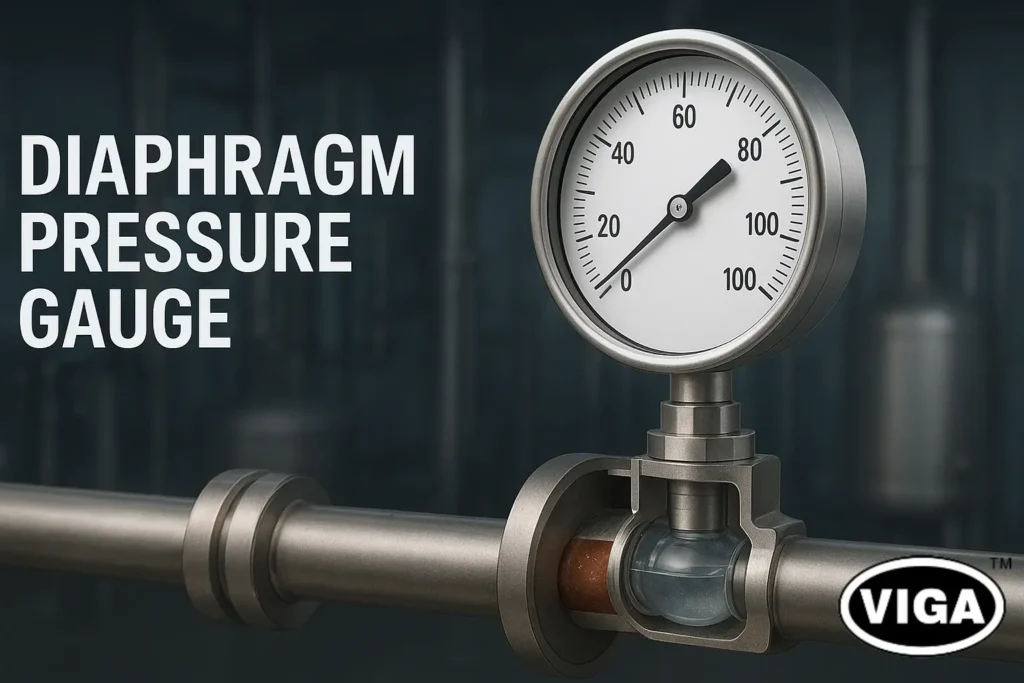
What Is a Diaphragm Pressure Gauge and Where Is It Used? Understanding the Diaphragm Pressure Gauge: A Complete Industrial Guide  In industrial processing, precise pressure readings do more than keep production running smoothly—they protect people, ensure the right product quality, and extend the life of machinery. Regular Bourdon tube gauges handle many jobs, but they can struggle with tough liquids, hot gases, and corrosive chemistries. That’s when the diaphragm pressure gauge becomes a necessary tool.  This guide presents a clear overview of the diaphragm pressure gauge, sometimes called a diaphragm seal pressure gauge. We’ll break down how it works, why it outperforms standard gauges, where it’s used in every major industry, and what to look for when choosing one for your unique application.   What Is a Diaphragm Pressure Gauge?  A diaphragm pressure gauge measures pressure by using a flexible diaphragm to keep the sensitive parts of the device safe from the process fluid. In a standard gauge, the process fluid enters the instrument directly, putting it in contact with the sensing mechanism. In contrast, a diaphragm gauge positions the diaphragm as a protective wall, allowing the pressure to be felt without the fluid getting inside. When the process fluid, gas, or slurry presses against the outer surface of the diaphragm, that little flexible membrane bends inward. This bend slides weightlessly through a sealed, incompressible fill fluid to the Bourdon tube gauge sitting a few inches away. The gauge senses the motion and the needle swings to show how hard the fluid is pushing.  That little barrier of fill fluid is the magic. It keeps acids, gunky slurries, and even sterile biological fluids safely on the diaphragm’s skin, so the delicate gauge mechanics can keep ticking without rust, blockage, or contamination.  Core Principle: How It Works The diaphragm gauge works on the straightforward, clever rule discovered by Pascal: when you push on a fluid inside a sealed container, the same push travels through and touches every tiny corner without fading.  Here’s a step-by-step breakdown: Pressure Application: The fluid, whether it’s biting-acid or sticky-gravel slurry, nudges the outer face of the diaphragm seal.  Diaphragm Deflection: Sorry membrane! The fluid’s push slams the diaphragm inward and the bending keeps on going a little more or a little less, depending on how much push the fluid is training on the diaphragm. Hydraulic Pressure Transfer: A carefully chosen fill fluid completely occupies the space behind the diaphragm and the connector to the pressure transmitter. When the diaphragm bends under pressure, it drives the fill fluid forward and sends pressure signals along the hydraulic line.  Instrument Activation: That hydraulic pressure reaches the pressure measurement device—often a Bourdon tube type—and behaves as if the tubing had been pushed directly by the process itself.  Pressure Indication: A trace pointer sweeps the scale face, clearly showing the process pressure in the readable units of the calibration.  The whole design—diaphragm, fill fluid, and pressure-sensing relay—is completely sealed against atmosphere, producing a fortified and leak-tight system.   Key Components Explained Recognizing the individual components of a diaphragm pressure gauge system reveals why it performs reliably and why it is critical.  The Diaphragm: Acting as the mechanism’s core, this flexible, disk-like, wavy barrier is made of durable metals or synthetic materials. The chosen composition is both supple enough to bend and strong enough to resist the process fluid. For aggressive corrosives, the diaphragm may be formed from 316L stainless steel, Hastelloy C276, Monel, or tantalum, providing the safety and long life demanded by the service. The Housing: Picture a sturdy outer shell that guards the fragile measuring element inside. This shell, usually called the seal body, holds the flexible membrane steady while forming a tight link to the piping carrying the process fluid. The part that truly interacts with the fluid is the bottom half of the seal, dubbed the wetted section, which must be crafted from a metal, plastic, or ceramic that remains strong against whatever it faces.  System Fill Fluid: Imagine a thick, clear liquid that conducts pressure the way a metal rod conducts sound. This liquid fills the space inside the housing, pushing the diaphragm outward to match the pressure of the process. Picking the right liquid is a delicate task. Options include the sweet, sticky consistency of glycerin, a slippery silicone oil, or a specialty Halocarbon safe for food. Each one performs well within a particular range of temperatures and cleanliness rules.  The Pressure Instrument: This is the front face everyone sees—a round dial, a glowing digital readout, or sometimes a sharp little switch. The heart of the operation is usually a Bourdon tube that bends with the pressure, though more modern versions might send electronic signals back to a control room.  The Clear Benefits of Diaphragm Seal Systems Choosing a diaphragm seal is not a matter of preference; it is a choice to defeat the weaknesses of metal-only gauges. The pressure sensor industry is now a multi-billion-dollar sector, growing fast because every factory, refinery, and food plant needs measurements that stay accurate in extremes. The diaphragm seal, with its simple design and robust isolation, is the method that the market trusts again and again. Here’s what these tools can do for you:  Protection from Corrosive and Aggressive Media: They resist harmful chemicals. Ordinary brass or stainless Bourdon tubes quickly corrode in acids or caustic liquids. A diaphragm made from high-grade alloys like Hastelloy or Tantalum stays intact where standard materials would fail.  Prevention of Clogging and Blockages: They stop clogs before they start. Thick liquids, slurries, or sludged solids that would block a tiny gauge orifice slide freely over the broad, unobstructed surface of the diaphragm. That’s why they’re vital in waste treatment, pulp mills, and other places where slurries are normal.  Maintaining Purity and Sanitation: They keep everything hygienic. In pharma, biotech, and food and beverage production, keeping the process pure is a rule you can’t bend. A diaphragm seal gauge fitted with sanitary clamps—often a smooth Tri-Clamp—eliminates corners and gaps where bacteria can hide and

Scroll to Top